
As the FIFA World Cup returns to North America in 2026, fans are preparing for a familiar ritual: not just cheering from the stands, but paying increasingly eye-watering prices for the privilege of doing so. A cold beer has long been part of football’s matchday culture, yet over the past two decades the cost of that simple pleasure has risen far faster than many supporters’ wages. For travelling fans already facing expensive flights, hotel bills, and some of the highest World Cup ticket prices ever recorded, stadium concessions have become another reminder that the biggest tournament in football (or soccer as they call it over the Pond) is designed around commercial opportunity as much as around the celebration of the sport and its supporters.
This year’s tournament arrives at a moment when fan spending is under greater scrutiny than ever. With the competition expanded to 48 teams and spread across the United States, Canada, and Mexico, supporters are already facing soaring travel, accommodation, and ticket costs. Even the price of a beer and a bottle of water has become part of a wider conversation about affordability and the modern fan experience. As debates are only intensifying ahead of kick-off, the team at PlayersTime looked into the price of a pint fans are expected to pay at the stadiums over the next month and how it has changed over the past 20 years. Just for reference, we added the average prices of local draft beers at restaurants in the host cities – and around the world.
Key Takeaways:
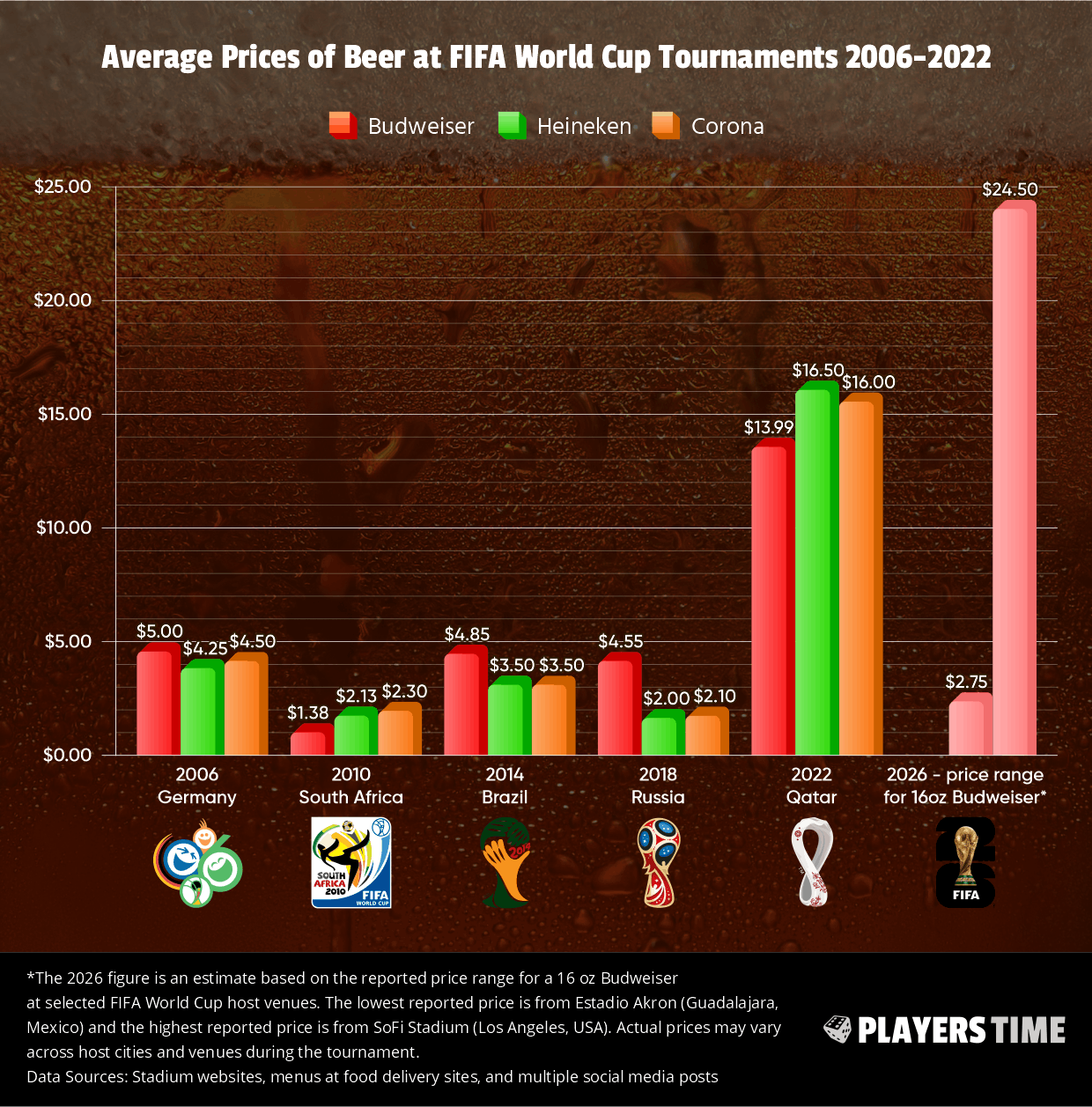
- Beer prices at FIFA World Cups have increased significantly over the past 5 tournaments – from roughly $1-$5 between 2006 and 2018, they skyrocketed to record highs at the 2022 World Cup in Qatar when fans paid between $14 and $16.50 for a single pint.
- The 2026 tournament in North America is set to break pricing records, with a standard Budweiser can at certain venues expected to cost as much as it did in Qatar or even more.
- Levi’s Stadium in Santa Clara, California, now renamed simply as San Francisco Bay Area Stadium, emerges as the most expensive FIFA World Cup 2026 stadium, with the price for a single 20oz beer (equivalent to around 600 ml in Europe) exceeding $24.
- Across most 2026 host cities, stadium beer prices sit at a clear premium over local restaurant prices – often around 100% to over 500%. The biggest discrepancies are in Mexico City and at the Monterrey Stadium, where beer inside stadiums is now 5-6 times what it typically costs locally and reaches the standard daily wage in the country.
FIFA World Cup 2026 Expected to Break Past Cost Records
Beer has quietly become one of the World Cup’s most revealing stories; it is not just a drink, but a pulse check on how each host city handles the sudden arrival of millions of fans looking to celebrate together.
Russia 2018 showed what happens when that wave hits at full force. In Moscow, bars and venues around the city centre were overwhelmed as international supporters poured in, with some reportedly running out of beer entirely during peak match days. As fans enjoyed cheap pints, as cheap as $2 for imported brands, the image that stuck from that tournament wasn’t just crowded fan zones. The whole world remembers the pubs and restaurants struggling to keep up with a level of demand they simply hadn’t experienced before; cities briefly “drunk dry” by their own success as hosts.
Earlier tournaments told a softer version of the same story. Brazil 2014 and South Africa 2010 leaned into affordability (a pint could be bought for as little as $1-$2), keeping beer cheap enough to encourage long, social nights that split from stadiums into streets without too much friction. The atmosphere was loose, continuous, almost self-sustaining.
Then came Qatar 2022, where the script flipped. High prices and tight controls didn’t just reduce consumption; they reshaped behaviour entirely, turning beer from a mass-participation ritual into something more limited, more regulated, and far more expensive. Just two days before kick-off, authorities banned beer at the tournament; it became available only at specially dedicated fan zones at record-high prices. While a standard imported brand at the fan zones was sold for up to $14 per can, several bars and restaurants around Doha took advantage of the limited availability and sold pints for up to $16-$17.
These figures raise an interesting question – how much pricier will the FIFA World Cup 2026 be? It is expected that beer prices, along with water, snacks and full meals, will get the premium once the tournament officially starts on Friday, with standard pints available from $2.75 to over $20, depending on the host city. Comparing prices from now and 4 years ago may not make sense due to the inflation that hit most of the world in 2022 and 2023. Inflation is one thing, but at many venues, food and beverages are currently much more expensive than they are in other parts of the city.
Beer Prices at the Stadium Up to 500% Higher Than Elsewhere in the City
Beer has become one of the unofficial currencies of the FIFA World Cup, as important to the fan experience as flags, jerseys, or late-night street celebrations. Across tournaments, it sits at the centre of the social ritual: something that turns stadiums, fan zones, and city centres into temporary, global neighbourhoods where strangers celebrate (or drown disappointment) together.
Hovering over it all is Budweiser, which marks four decades as FIFA’s official beer partner in 2026. Since first appearing on World Cup touchlines in 1986, the brand has become almost inseparable from the tournament itself, surviving changing host nations, shifting drinking cultures, and even the alcohol controversies that defined Qatar 2022. But for many fans heading to North America this summer, the real question is no longer who sponsors the beer, but how much that next round will cost. It turns out the price does not always depend on the host city alone – while pints at some venues certainly cheaper than others, there is also a huge discrepancy when we look at the average price of beer at bars and restaurants all over the host city.
at the 2026 World Cup
| Host City | Stadium | Average price at stadium | Draft beer at restaurants in the host city | Difference |
|---|---|---|---|---|
| Monterrey | Estadio BBVA | $17.69 | $2.86 | +518.6% |
| Mexico City | Estadio Azteca | $17.43 | $3.38 | +415.7% |
| San Francisco | Levi’s Stadium | $24.50 | $8.00 | +206.3% |
| Kansas City | Arrowhead Stadium | $18.50 | $7.00 | +164.3% |
| Houston | NRG Stadium | $15.23 | $6.00 | +153.8% |
| Seattle | Lumen Field | $18.49 | $8.00 | +131.1% |
| Dallas | AT&T Stadium | $16.45 | $7.25 | +126.9% |
| Boston | Gillette Stadium | $18.00 | $8.00 | +125.0% |
| Los Angeles | SoFi Stadium | $17.50 | $8.00 | +118.8% |
| New York /New Jersey | MetLife Stadium | $17.00 | $8.00 | +112.5% |
| Toronto | BMO Field | $12.59 | $6.45 | +95.2% |
| Philadelphia | Lincoln Financial Field | $11.50 | $6.00 | +91.7% |
| Miami | Hard Rock Stadium | $12.00 | $8.00 | +50.0% |
| Atlanta | Mercedes-Benz Stadium | $10.00 | $7.00 | +42.9% |
| Vancouver | BC Place | $7.72 | $6.50 | +18.8% |
| Guadalajara | Estadio Akron | $2.75 | $2.86 | -3.8% |
Mexico surprisingly contains both extremes of World Cup beer pricing. Guadalajara remains the tournament’s only venue where fans can still buy a beer slightly cheaper inside the stadium than at nearby bars (-3.8%), at least according to the latest reports we could find. Following the official launch of the tournament, multiple social media posts revealed a striking increase in the prices of both meals and drinks at the World Cup venues.
While no posts mention the Guadalajara stadium, Mexico’s other two host cities tell a completely different story. In Monterrey, a beer at Estadio BBVA costs an eye-watering 518.6% more than the average pint in local restaurants, while at Mexico City’s Estadio Azteca the markup reaches 415.7%, making the two Mexican venues by far the biggest outliers of the tournament. At $17.69 in Monterrey and $17.43 in Mexico City on average (around 300 pesos), a single stadium beer would also cost roughly the equivalent of Mexico’s daily minimum wage, underlining just how disconnected World Cup concession prices can become from local purchasing power.
Beyond Mexico, several U.S. stadiums also impose steep premiums on supporters. The San Francisco Bay Area (+206.3%) leads the American venues, followed by Kansas City (+164.3%), Houston (+153.8%), Seattle (+131.1%), Dallas (+126.9%), Boston (+125.0%), Los Angeles (+118.8%), and New York/New Jersey (+112.5%), highlighting how World Cup stadiums frequently charge more than double local market prices for a pint. Toronto (+95.2%) and Philadelphia (+91.7%) charge just below double the typical cost of a beer in restaurants, while Vancouver (+18.8%) and Atlanta (+42.9%) offer comparatively modest markups, showing just how uneven World Cup ‘beer inflation’ can be from one host city to another.
Fans in Los Angeles Set to Pay A Premium for A Pint
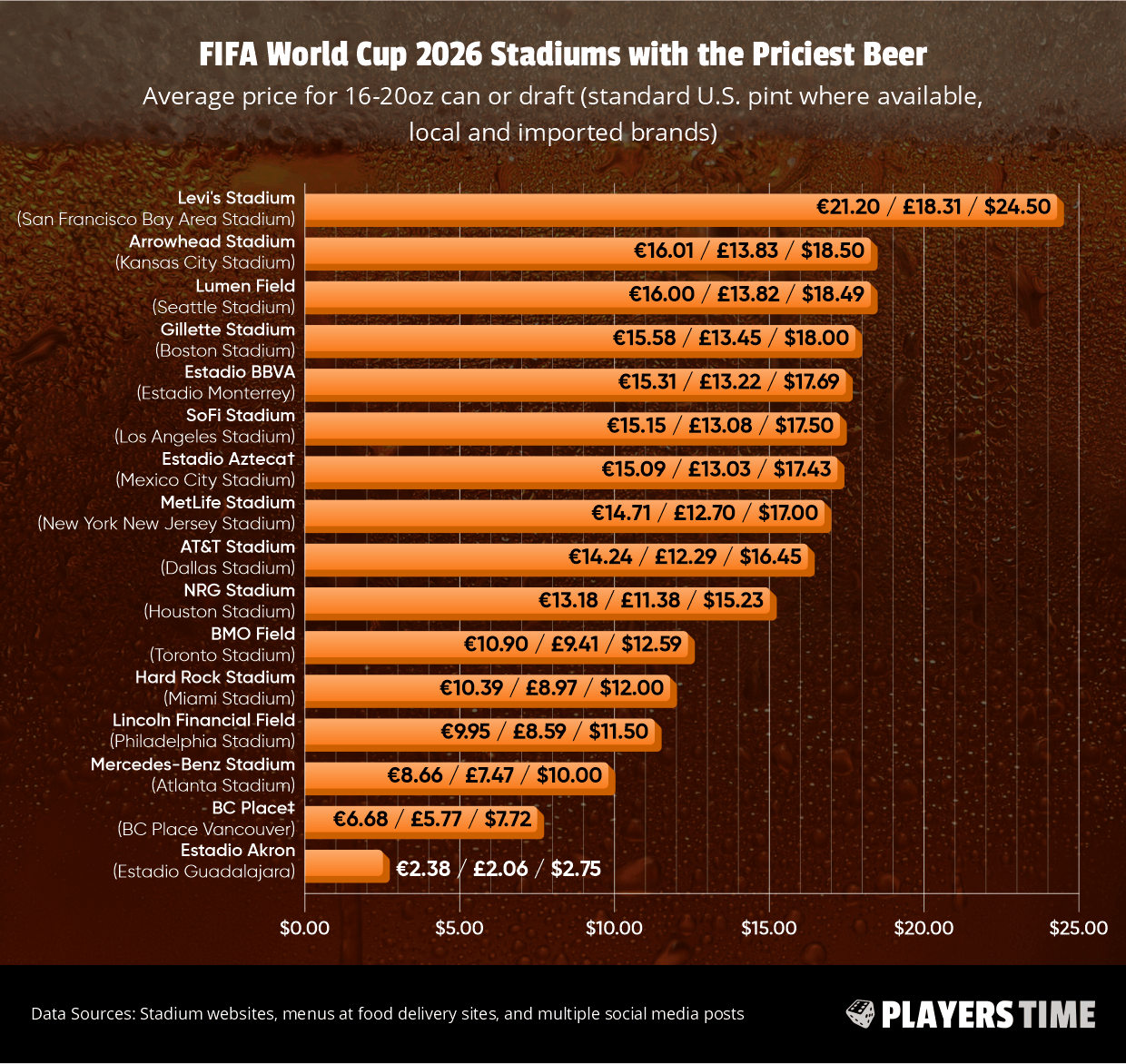
The 2026 FIFA World Cup is shaping up to be a tournament where even a simple beer can become a luxury purchase – but only in certain cities. Topping the price rankings is the San Francisco Bay Area Stadium (Levi’s Stadium), where a beer costs an average of $24.50, according to photos shared by supporters on social media. It is followed by the venues in Kansas City ($18.50), Seattle ($18.49), Boston ($18.00), Monterrey($17.69), Los Angeles ($17.50), Mexico City ($17.43), and the New York/New Jersey Stadium ($17.00). With prices approaching or exceeding $18 at several venues, many World Cup stadiums are set to become premium zones for matchday spending.
Further down the list, Dallas charges an average of $16.45 per beer, followed by Houston at $15.23, Toronto at $12.59, Miami at $12.00, Philadelphia at $11.50, and Atlanta at $10.00. Vancouver stands out as one of the more affordable host cities at $7.72 on average, while Guadalajara remains the most budget-friendly option at just $2.75. The stark contrasts suggest that the World Cup beer map is ultimately less about the tournament itself and more about where supporters happen to be sitting when they place their order, with a single drink in some stadiums costing nearly nine times as much as in others.
One Drink, Two Worlds:
Why a Pint Costs $13 in Some Cities and $1 in Others
Average price for domestic draft beer at restaurants, 0.5 litre
(in US Dollar, British Pound and Euro)
Beer prices around the world reflect what’s in the glass, but they also quietly mirror the cost of living, wage levels, and even how ‘expensive’ everyday life feels in different cities.
At the top end, cities like Dubai ($13.61), Reykjavik ($13.44), and Norway’s urban centres such as Trondheim, Oslo, and Stavanger (around $12-$13) sit in economies where high wages, heavy taxation, and elevated operating costs push everyday consumption upward. In these places, a pint is less about indulgence and more about the broader price of urban living where rent, services, and leisure all move in the same expensive direction.
Swiss cities like Lausanne, Basel and Geneva (over $10) and lifestyle hubs such as London ($9.34), Copenhagen ($9.26), and Melbourne ($9.25) reflect another layer: high-income economies where strong purchasing power coexists with persistent inflationary pressure in hospitality, real estate, and labour.
Then comes the $6-$8 ‘global middle’ – from New York and Paris to Tokyo and Amsterdam. This is the cost of beer in mature urban economies, where prices are stabilised around a shared cost baseline, shaped by tourism, regulation, and wage structures.
At the other extreme, cities like Bangkok, Bogotá, and Hanoi (often under $2) reveal lower cost-of-living, where cheaper labour, lower rents, and weaker currency pressures keep everyday consumption dramatically more accessible, turning beer into a mass social staple rather than a premium purchase.
Methodology
To compare the cost of beer at the different FIFA World Cup 2026 venues, the team at Playerstime researched recent prices from stadium websites, menus at food delivery sites, and multiple social media posts. We also did extensive online research into historic prices, searching for average prices at the past five World Cups, namely 2006 Germany, 2010 South Africa, 2014 Brazil, 2018 Russia, and 2022 Qatar.
For the prices of draft beer in cities around the world, we looked at figures from Numbeo, which are constantly updated. To improve comparability, extreme outliers and non-standard serving sizes were excluded where necessary, and prices were standardised to a typical 500ml/16oz (or equivalent) draft beer (cans and bottles were also taken into account where draft was not an option).