Words are weapons, tools, and sometimes, a show. In the arena of political conversation, few figures are as distinctive as U.S. President Donald Trump. His cadence, choice of words, and signature expressions make him easy to spot in any debate or interview.
Is Donald Trump’s way of speaking calculated simplicity, instinctive performance, or something in between?
Like him or not, one thing is difficult to dispute: he does not speak like a conventional politician. His interviews do not unfold as carefully layered policy briefings; instead, they move in bursts, circle back, and repeat.
To build the linguistic profiles of prominent political figures, the team at PlayersTime analysed a series of recent interviews through measurable linguistic indicators – total word volume, vocabulary range, sentence length, readability scores, lexical diversity, hedge frequency, and recurring three-word expressions. Rather than focusing solely on what he says, this profile emphasises how he says it.
34,022 Words Analysed: Trump Shows Lowest Readability Score Among U.S. and European Leaders Studied
Speaking at length is one thing, but what a leader chooses to say within that volume can reveal deeper patterns. In examining Donald Trump’s speech, repetition and recurring phrases suggest a communication approach that favours familiarity over breadth, immediacy over layered argument, and impact over subtlety. This raises the following question: is it a limitation of style, or a carefully honed method to ensure messages resonate and endure?
Volume vs. Variety
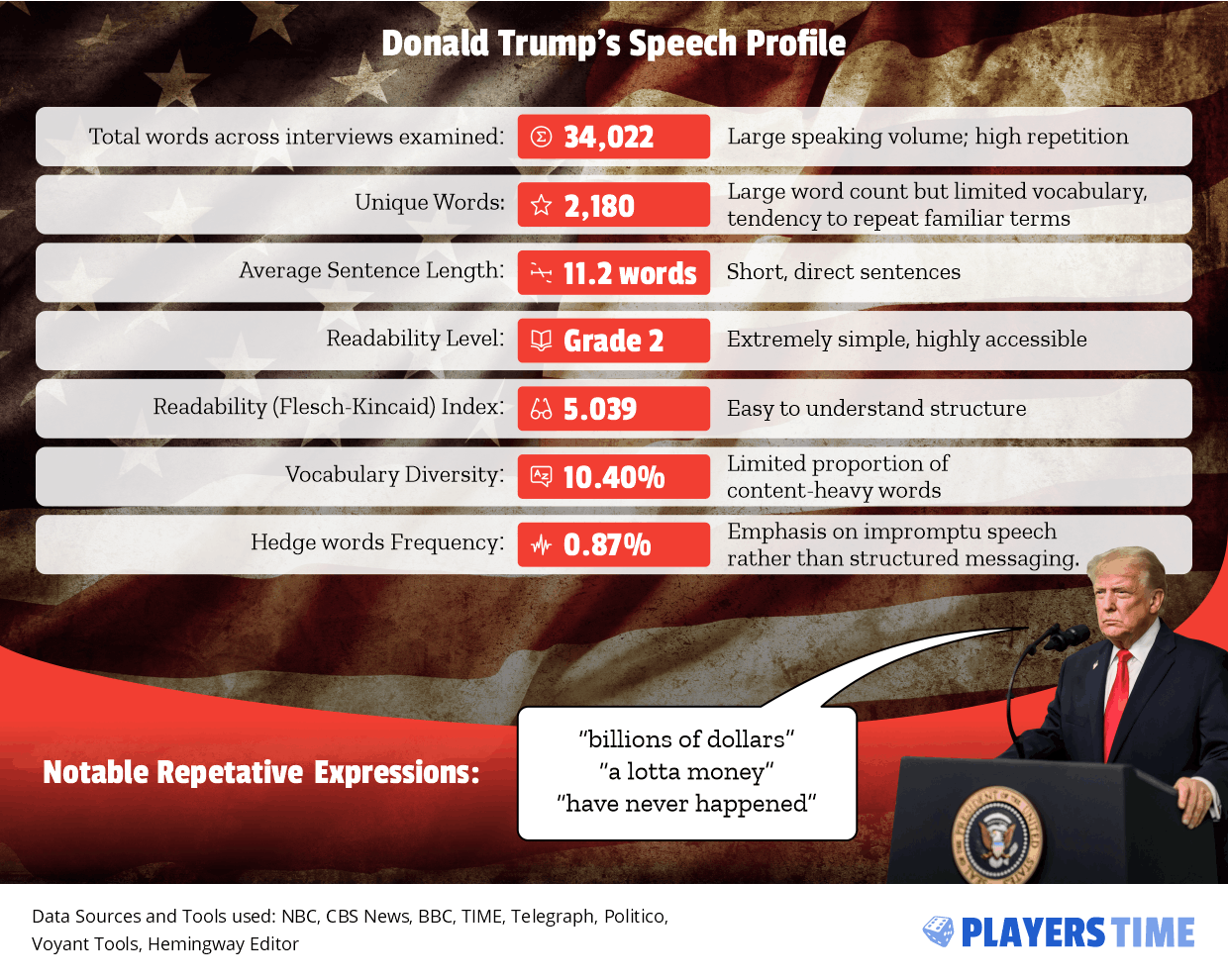
Across the three interviews examined, the incumbent U.S. President spoke a total of 34,022 words. That is a substantial volume, and with such output, repetition naturally occurs. Yet volume alone does not explain the patterns we see. Out of those 34,022 words, the unique ones are 2,180, producing a vocabulary diversity rate of 10.4%. In practical terms, this means the same words and phrases appear again and again, creating a concentrated linguistic palette rather than a broad one.
Vocabulary diversity measures the proportion of unique lexical words – nouns, verbs, adjectives, and adverbs, relative to the total number of words, excluding function words such as prepositions, conjunctions, and pronouns. Higher vocabulary density shows reliance on a smaller set of familiar words, often repeated to reinforce key ideas.
Is this a limitation or a strategy? Repetition strengthens familiarity. Familiarity strengthens recall.
A closer look at Trump’s most frequently used words shows a clear pattern. Everyday words like ‘know’, ‘people’, ‘think’, and ‘country’ dominate his speech, alongside conversational fillers such as ‘uh’ and ‘like’. Issue-driven words like ‘money’, ‘tariffs’, ‘war’, and ‘trillion’ recur steadily, reinforcing a narrow set of themes. Layered on top are signature three-word expressions – ‘billions of dollars’, ‘a lotta money’, ‘have never happened’, that function as verbal anchors.
Beyond frequency, a structural pattern emerges: topics are often framed in maximal terms. Outcomes are described as ‘great’ or ‘bad’, ‘never happened’ or ‘disaster’, rarely as moderate. Many narratives follow a consistent arc – ‘before me’ equals decline (‘I inherited’, ‘If I weren’t elected…’), ‘with me’ equals strength, wealth, or control (‘Now we’re respected again’). Phrases like ‘everybody knows’ or repeated references to large figures such as ‘billions’ and ‘trillions’ are used less to provide analytical precision and more to signal magnitude.
Sentence structure: Short, direct, and immediate
Donald Trump’s average sentence length is just 11.2 words, notably brief for political discourse. No sprawling constructions or multi-layered synthetic arguments are dominating these interviews. Instead, statements are compact, direct, and delivered in bursts, mimicking conversational speech patterns.
Short sentences reduce cognitive load and increase immediacy. They make the content easy to follow, keeping the audience engaged without requiring sustained attention. This style feels unscripted, instinctive, and close to everyday speech. Yet, it is also effective: concise phrasing ensures that points land quickly and memorably. Whether deliberate tactic or natural rhythm, this sentence structure is central to his distinctive style.
Readability and memorable phrasing
Donald Trump’s speech is strikingly straightforward. He uses short sentences and language that scores around a Grade 2 reading level, and a Flesch-Kincaid index of 5.039, a measure of how easy a text is to understand based on sentence length and word difficulty. As a result, complex ideas are broken down into short, punchy statements. Unlike conventional political rhetoric, which often relies on layered, rehearsed sentences, Trump favours plain language and frequent repetition of content-heavy phrases, making his speech immediately accessible to a wide audience. Frequent phrases such as ‘I think’ or ‘you know’ add conversational spontaneity, while repeated expressions like ‘billions of dollars’ or ‘a lotta money’ reinforce key points and project confidence. The result is speech that feels both relatable and authoritative, leaving a strong impression while remaining easy to follow.
The Linguistic Profile of Modern U.S. Presidents
How unusual is Trump’s linguistic style when placed beside other U.S. presidents? When comparing the leaders of the nation over the past 25 years, namely Joe Biden, Barack Obama, George Bush, and Donald Trump, the differences are not merely stylistic. They are structural.
Vocabulary Diversity: Range vs. Reinforcement
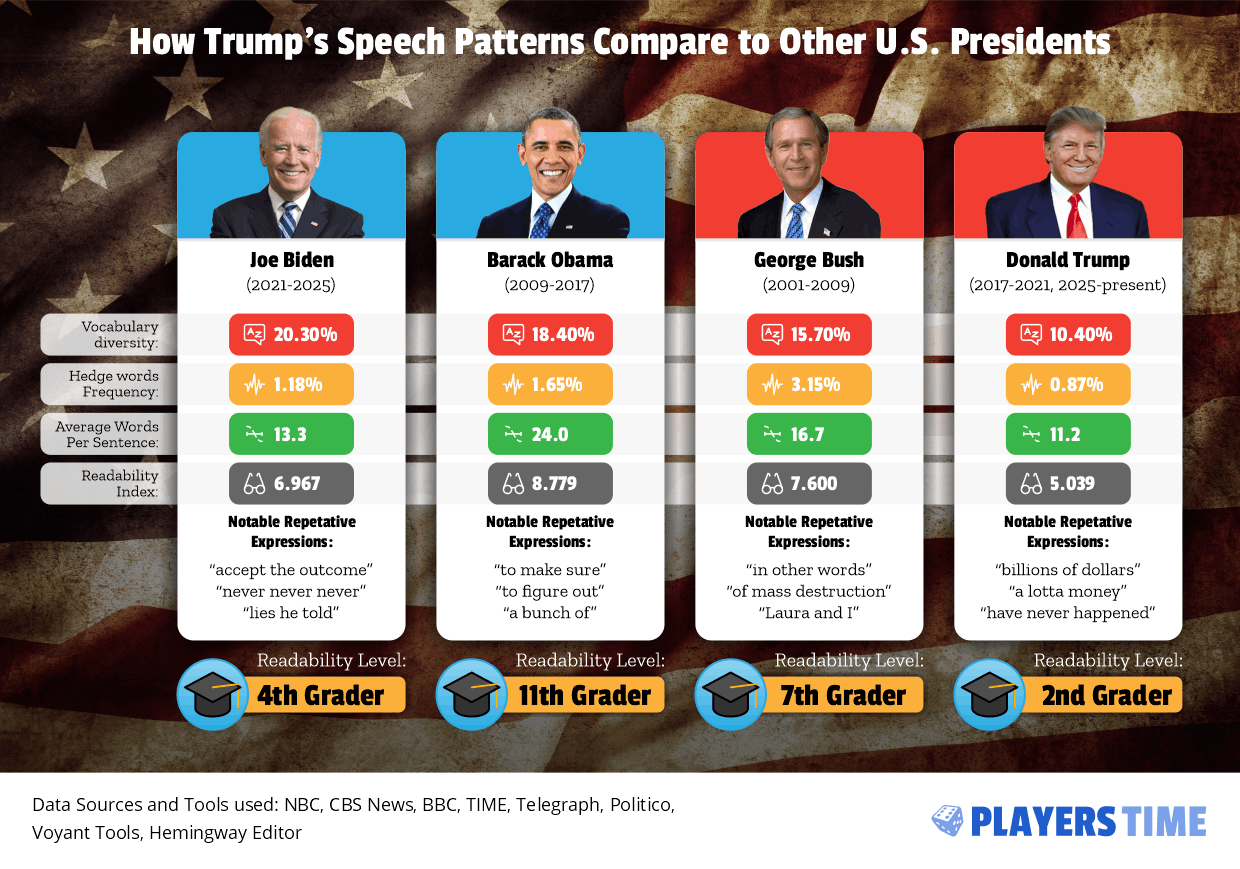
Trump’s vocabulary diversity stands at 10.40%, significantly lower than Biden’s 20.30%, Obama’s 18.40%, and Bush’s 15.70%. The gap is striking as Joe Biden, who, while in office, was often criticised for being the oldest sitting president in American history, uses nearly twice the proportion of unique words. Obama and Bush also operate within a broader lexical range.
What does that mean in practice? It means Trump relies more heavily on repetition. His language cycles through a tighter set of familiar words, reinforcing themes rather than expanding them. Biden and Obama, by contrast, introduce new terms more frequently, creating denser and more varied speech. Bush falls somewhere in between – simpler than Obama, but still more lexically varied than Trump.
Sentence Length: Brevity vs. Structure
Obama’s average sentence length reaches 24 words, more than double Trump’s 11.2 words. That difference alone reshapes the rhythm of speech. Obama’s sentences build, layer clauses, and develop ideas before landing the point. Trump’s sentences move quickly, often delivering a point in a compact burst before pivoting.
Biden and Bush, in the meantime, use between 13 and 16 words on average per sentence, sitting closer to the middle. They speak more concisely than Obama, but still use longer constructions than Trump.
Readability: Accessibility vs. Sophistication
The readability scores further sharpen the contrast. Trump’s speech registers at a Grade 2 level, making it structurally simpler than that of his peers. Biden’s language aligns with approximately a Grade 4 level, Bush’s with a Grade 7 level, and Obama’s reaches a Grade 11 level, the highest among the four.
Higher readability levels correspond with longer sentences and layered construction. Obama’s language reflects structural sophistication and a gradual argument-building process. Bush and Biden occupy the middle ground, balancing accessibility with moderate complexity.
Trump, by contrast, relies on shorter sentences and simpler syntax, producing language that requires minimal processing effort. Whether interpreted as clarity or oversimplification, the structural difference is measurable.
Within three presidencies, the rhetorical grade level of the Oval Office spans nearly a decade of educational difference. From a communication standpoint, lower readability makes a message easier to absorb. It removes friction and speeds up understanding. In that sense, Trump’s speaking style doesn’t just sit on the simpler end of the spectrum; it represents a clear shift in how political messages are delivered.
Structural Divergence in Transatlantic Political Speech
A clear structural pattern appears across Europe’s leading political voices: moderate-to-high vocabulary diversity, long sentence construction, mid-range readability levels, and measurable use of hedging.
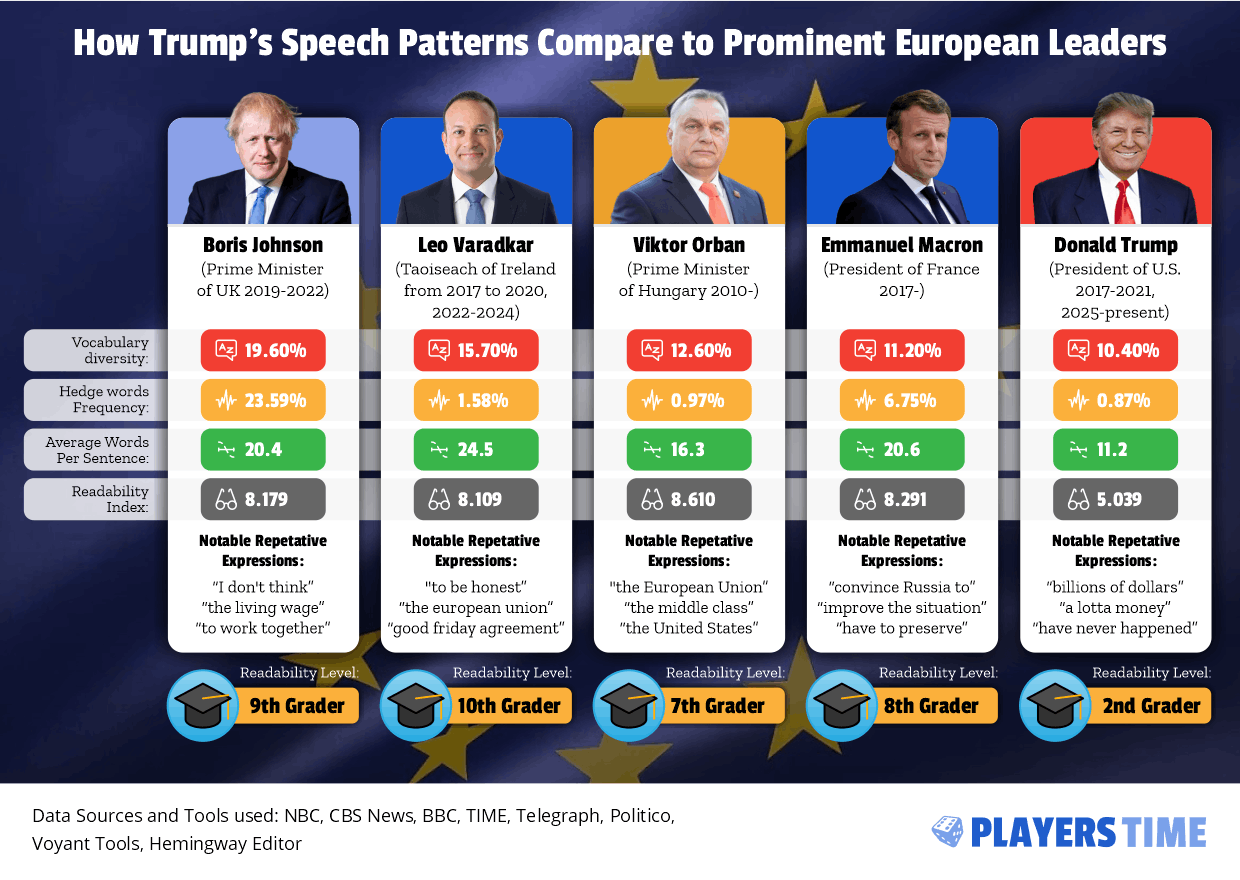
Among Europe’s prominent leaders, vocabulary diversity tends to cluster within a relatively tight range, from just over 11% to nearly 20%. Boris Johnson sits at the top end with 19.60%, followed by Leo Varadkar at 15.70% and Viktor Orban at 12.60%. Even Emmanuel Macron, the closest to the lower bound, registers at 11.20%.
Then comes Trump, at 10.40%, just below the European range.
The difference may appear small numerically, but structurally it matters. European leaders rotate through broader lexical fields, introducing new terminology and varying their phrasing as arguments develop. Trump, by contrast, concentrates his language around a tighter core of recurring words and phrases.
Compression vs. Construction
Across the European leaders examined, sentence construction tends to favour expansion. Leo Varadkar averages 24.5 words per sentence, the highest in the dataset, while Emmanuel Macron and Boris Johnson both hover just above 20 words, and Viktor Orban averages 16.3. Their speech patterns allow arguments to unfold within layered clauses, embedding context, qualification, and nuance inside single sentences. By contrast, Donald Trump’s average of 11.2 words per sentence sits well outside this European range.
This divergence carries over into readability. While European leaders cluster between Grade 7 and Grade 10 levels, Trump’s speech registers at Grade 2, a gap that signals more than stylistic preference. It reflects reduced syntactic density, fewer embedded clauses, and significantly lower processing demands.
In effect, European leaders construct arguments, while Trump compresses them. One approach privileges elaboration and structural layering, the other prioritises immediacy and speed of comprehension.
Methodology
This comparative analysis examined speech patterns across a selected group of high-profile political leaders: Donald Trump, Joe Biden, Barack Obama, George W. Bush, Boris Johnson, Leo Varadkar, Viktor Orban, and Emmanuel Macron. These figures were chosen because each served as a head of government or head of state, allowing for direct comparison within similar executive roles. All operated within the contemporary media landscape, where recorded interviews play a central role in shaping public communication.
For each politician, three high-visibility interviews were examined. The interviews were selected based on their national or international relevance, extended speaking time to ensure sufficient linguistic data and comparable unscripted or moderated Q&A formats. The transcripts were processed to capture natural speech features, including repetitions, incomplete sentences, and filler words, while ensuring consistency across speakers. Key linguistic metrics were calculated, such as vocabulary diversity, average sentence length, readability scores using the Hemingwayapp Editor and the Flesch-Kincaid index from Voyant Tools, hedge word frequency, and notable repetitive expressions.
The approach allowed us to quantify both the complexity and accessibility of each politician’s language, as well as their rhetorical style, from assertive statements to conversational digressions. By combining lexical, syntactic and rhetorical indicators, we captured how each politician communicates ideas, frames issues, and engages audiences. We also analysed recurring trigrams and thematic word patterns to identify signature expressions and stylistic habits.