
Tourist attractions sit at an unusual intersection of culture and commerce: part public good, part premium experience. Increasingly, the act of entering a museum, tower, or historic landmark resembles a transaction shaped as much by demand and branding as by preservation costs. Some sites remain symbolically open, while others have evolved into high-cost vantage points over cities, histories, and landscapes that were once freely encountered.
As millions of travellers head abroad during the busiest vacation period of the year, the team at PlayersTime set out to examine the cost of accessing some of the world’s most visited attractions. We analysed 200 popular destinations across museums and galleries, observation decks and towers, historic landmarks and archaeological sites, and castles, palaces, and religious sites. Alongside standard admission prices for international visitors, we collected data on discounted tickets, family offers, combination passes, and free-entry days available at normally paid attractions. By comparing prices within each category and across the dataset as a whole, we identified which attractions demand the highest admission fees, and where visitors can experience world-famous sites without opening their wallets.
The highest price of entry belongs not to a museum, observation deck, or palace, but to the Moai statues of Easter Island, where visitors must pay more than $100 to access one of the world’s most recognisable archaeological landscapes, a remote collection of monumental stone figures whose isolation has only added to their cultural mystique. It is followed by the Nazca Lines in Peru, although comparing the site with traditional attractions is not entirely straightforward, as the geoglyphs are best viewed from the air, making a sightseeing flight costing around $85 the practical equivalent of an entrance ticket. The observation deck at New York’s fourth tallest skyscraper, One Vanderbilt, rounds up the top 3, at over $83, competing directly with some of the world’s most remote heritage sites in terms of pricing power.
Key Takeaways:
- Observation decks are among the most expensive categories overall, occupying 11 of the global top 20 spots, despite offering experiences that often last less than an hour. Examples are One Vanderbilt, Top of the Rock, and Edge Hudson Yards in New York, which charge over $70 and Burj Khalifa in Dubai at roughly $55.
- The Louvre remains the most expensive museum to visit at roughly $37 for basic entry, nearly double the cost of institutions like the Van Gogh Museum in Amsterdam and the Galleria Borghese in Rome.
- The entrance fee of Topkapi Palace in Turkey ($65) is higher than admission to many globally famous sites, including Machu Picchu, Empire State Building, Sagrada Familia, and even the Palace of Versailles in France.
- The United Kingdom offers the largest number of free world-famous attractions in the study, with London alone offering seven, including the British Museum, Tate Modern, the National Gallery, Sky Garden, and Horizon 22.
The Attractions Commanding the Highest Ticket Prices in 2026
Across the world’s 20 most expensive tourist attractions, it is no longer age or cultural status that determines price, but the type of experience being sold. The Moai of Easter Island leads the ranking at $102.92, followed by Peru’s Nazca Lines at $85.00, where fully appreciating them effectively requires a helicopter flight rather than a standard ticket.
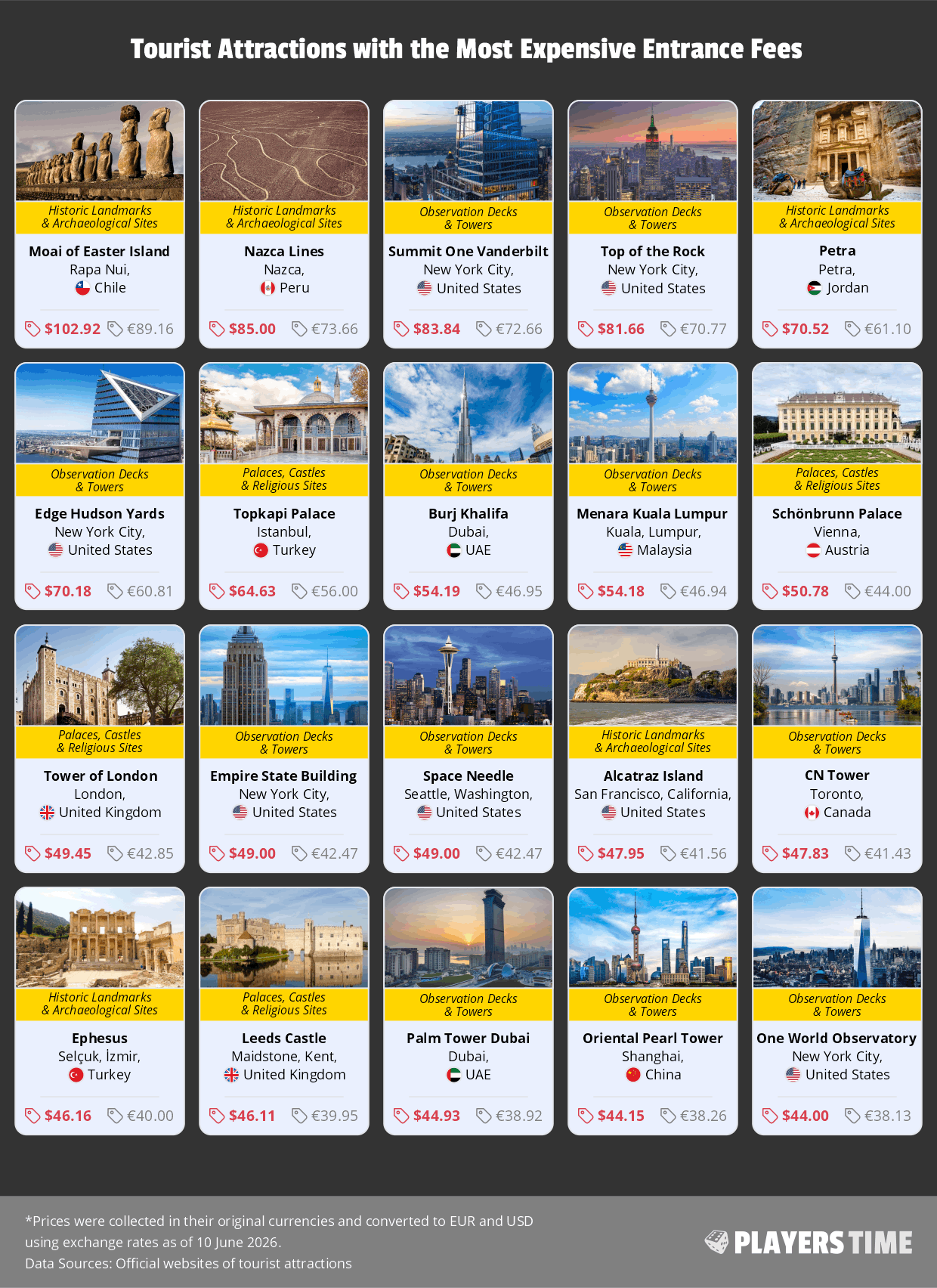
Immediately after this duo, a cluster of New York observation decks – SUMMIT One Vanderbilt ($83.84), Top of the Rock ($81.66), and Edge Hudson Yards ($70.18) – sit above globally recognised heritage sites such as Petra ($70.52), Topkapi Palace ($64.63), and Schönbrunn Palace ($50.78). Even within the same cities, pricing is heavily tiered, with children’s tickets at major observation decks still reaching $40-$60 and premium timed entries or bundled experiences pushing costs higher, narrowing the gap between standard and luxury access.
An interesting outlier is Topkapi Palace, which at $64.63 is priced higher than globally more ‘iconic’ landmarks such as the Burj Khalifa ($54.19), Schönbrunn Palace ($50.78), and even the Empire State Building ($49.00). By contrast, major archaeological sites like Ephesus in Izmir ($46.16) and historic castles such as Leeds Castle in Kent ($46.11) are lower in headline price, despite comparable or even greater historical significance.
However, low general admission prices do not necessarily translate into cheaper overall experiences, as many attractions distribute costs across guided tours, restricted access zones, audio guides, or supplementary exhibitions, meaning the true visitor spend is often only revealed beyond the base ticket price. Still, entry fees remain a useful benchmark for comparison, offering a consistent snapshot of how attractions position themselves in global pricing hierarchies.
The High Cost of Culture: The World’s Most Expensive Museums and Galleries
The most expensive museum in the dataset is the Louvre Museum in Paris, at $36.93 (€32) for standard entry, with a reduced European Economic Area price of €22 (~$25). However, this headline price does not reflect full accessibility dynamics: from October to March, the Louvre is free on the first Friday of each month (6:00 PM-9:45 PM), meaning one of the world’s most visited museums regularly shifts to zero-cost entry through tightly controlled evening access.
Museums & Galleries with the Highest Entrance Fees
- Louvre Museum
Paris, France$36.93
€32.00 - Museum of Modern Art
New York City, USA$30.00
€26.00 - The Metropolitan Museum of Art
New York City, United States$30.00
€26.00 - Uffizi Gallery
Florence, Italy$28.85
€25.00 - Rijksmuseum
Amsterdam, Netherlands$28.85
€25.00 - Museum Island Berlin
Berlin, Germany$27.70
€24.00 - Belvedere Museum
Vienna, Austria$26.54
€23.00 - Kunsthistorisches Museum
Vienna, Austria$25.39
€22.00 - NEMO Science Museum
Amsterdam, Netherlands$24.81
€21.50 - Munch Museum
Oslo, Norway$23.19
€20.09
Data Sources: Official websites of the tourists attractions
Two New York City institutions follow at $30 – the Museum of Modern Art and the Metropolitan Museum of Art. Both apply extensive discount structures, $22 for seniors and $17 for students, but unlike many European peers, they do not offer scheduled free-entry days. The next tier is led by the Uffizi Gallery in Florence and the Rijksmuseum in Amsterdam, at roughly $27-28, with the Rijksmuseum standing out for offering free admission for visitors under 18, while the Uffizi relies more on periodic free-entry days rather than permanent youth discounts.
Next we have two museums in Vienna, the Belvedere Museum and the Kunsthistorisches Museum, along with the NEMO Science Museum in Amsterdam and the Munch Museum in Oslo, ranging between $23-26. Free admission for visitors under 18 is widely adopted, while European residents often benefit from additional discounts that can exceed €10, and in some cases extend to free or heavily reduced entry for EU students. By contrast, non-European visitors are more likely to pay full price.
Almost every major European institution also uses structured free-entry systems, such as the first Sunday of the month (Uffizi, Brera), weekly evening slots (Guggenheim Bilbao, Munch Museum), or seasonal programs (Louvre, Vatican Museums). Outside Europe, pricing is generally either lower or more simplified: Asia ranges from about $5-$10 for major institutions like Tokyo National Museum or Mori Art Museum, while Latin America and Africa offer the lowest prices, with entries like the Egyptian Museum at $3.86 and the Museum of Tomorrow at $8.47.
The Cost of Visiting the World’s Ancient Wonders
This category features the world’s two most expensive heritage attractions: the Moai of Easter Island in Chile ($102.92) and Peru’s Nazca Lines ($85.00), both of which command premium prices due to their remote locations and unique archaeological significance. Petra ranks third at $70.52 for standard entry, covering the Main Trail, although visitors wishing to explore more extensive routes such as the Monastery or High Place of Sacrifice can face substantially higher costs through specialised access and guided experiences.
Historic Landmarks & Archaeological Sites with the Highest Entrance Fees
- Moai Statues of Easter Island
Rapa Nui, Chile$102.92
€89.16 - Nazca Lines
Nazca , Peru$85.00
€73.66 - Petra
Petra, Jordan$70.52
€61.10 - Alcatraz Island
San Francisco Bay, California, United States$47.95
€41.56 - Ephesus
Selçuk, İzmir, Turkey$46.16
€40.00 - Machu Picchu
Cusco Region, Peru$43.79
€37.93 - Chichen Itza
Yucatan, Mexico$40.02
€34.67 - The Roman Baths
Bath, United Kingdom$38.76
€33.58 - Angkor Wat
Krong Siem Reap, Cambodia$37.00
€32.07 - Stonehenge
Salisbury, United Kingdom$36.14
€31.32
Data Sources: Official websites of the tourists attractions
Further down the ranking, Alcatraz Island ($47.95), famed for its former prison and dramatic setting in San Francisco Bay, and Ephesus ($46.16), one of the best-preserved ancient cities of the Roman world, show how globally renowned heritage sites can still cost less than half the price of Easter Island.
Some of the world’s most celebrated heritage sites also appear surprisingly far down the ranking. Machu Picchu costs $43.79 to visit, while Stonehenge ($36.14), Pompeii Archaeological Park ($35.77), and the Acropolis of Athens ($34.62) all charge significantly less than the category leaders. Perhaps most strikingly, access to the Colosseum and Roman Forum costs just $20.77, making one of the world’s most visited archaeological complexes cheaper than many modern museums and observation decks.
At the quieter end of the ranking lie places where centuries of history can still be experienced for little more than the price of a coffee. In Philadelphia, Independence Hall, the room where both the Declaration of Independence and the U.S. Constitution were debated and adopted, can be visited for little more than a symbolic $1 processing fee. In Vietnam, the weathered brick towers of My Son Sanctuary, remnants of a kingdom that flourished centuries before European colonisation of the Americas, cost just $5.70 to explore. Meanwhile, Spain’s Segovia Aqueduct, whose towering Roman arches have stood watch over the city for nearly two millennia, can be visited for only $5.77.
Observation Decks & Towers: The Highest Prices for the Highest Views
No category reaches quite the same heights – literally or financially – as observation decks and towers. Dominating the ranking with 11 of the 20 most expensive attractions, these elevated viewpoints have transformed panoramic cityscapes into premium experiences. Much like airline tickets, admission often fluctuates by hour, season, and demand, with sunset and peak-time slots commanding the highest rates. To ensure a fair comparison, all prices in this category were standardised using admission to the highest accessible viewing level during peak daytime or evening hours, the moments when these urban vistas are most sought after.
Observation Decks & Towers with the Highest Entrance Fees
- SUMMIT One Vanderbilt
New York City, United States$83.84
€72.66 - Top of the Rock
New York City, United States$81.66
€70.77 - Edge Hudson Yards
New York City, United States$70.18
€60.81 - Burj Khalifa
Dubai, United Arab Emirates$54.19
€46.95 - Menara Kuala Lumpur
Kuala Lumpur, Malaysia$54.18
€46.94 - Empire State Building
New York City, United States$49.00
€42.47 - Space Needle
Seattle, Washington, United States$49.00
€42.47 - CN Tower
Toronto, Canada$47.83
€41.43 - Palm Tower Dubai
Dubai, United Arab Emirates$44.93
€38.92 - Oriental Pearl Tower
Shanghai, China$44.15
€38.26
Data Sources: Official websites of the tourists attractions
The ranking is overwhelmingly dominated by the United States, with New York City alone claiming the top three spots through SUMMIT One Vanderbilt ($83.84), Top of the Rock ($81.66), and Edge Hudson Yards ($70.18). Asia rounds out the top five, with Burj Khalifa in Dubai ($54.19) and Menara Kuala Lumpur ($54.18) charging similarly premium rates for access to their highest viewing platforms.
Other prominent entries include the Empire State Building ($49.00), CN Tower in Toronto ($47.83), and Oriental Pearl Tower in Shanghai ($44.15), all of which sit firmly within the upper tier of global observation experiences. Perhaps most striking is the position of the Eiffel Tower ($42.35), which, despite its global icon status and near-universal recognition, ranks notably below New York’s newer premium observation decks. A similar contrast appears with the Leaning Tower of Pisa ($23.08), emphasising how global fame does not always translate into higher entry pricing.
At the lower end of the ranking, prices fall dramatically, revealing how access to skyline views can range from luxury purchase to near-public utility. Cairo’s Burj Al-Qahira stands out as the cheapest paid observation experience at just $3.86, followed by Cologne’s KölnTriangle at $5.77, and Ho Chi Minh City’s Bitexco Financial Tower Skydeck at $9.12, where sweeping urban views remain accessible at a fraction of global averages.
Palaces, Castles & Religious Sites: The Economics of Heritage and Authority
The most expensive palace in the dataset is not found in the familiar royal capitals of Western Europe, but in Istanbul, where Topkapi Palace leads the category at $64.63, with little publicly defined structure of concessions visible. It is followed by Austria’s Schönbrunn Palace ($50.78), where imperial grandeur unfolds across both palace interiors and vast landscaped gardens, and where entry is carefully tiered, shifting from full adult admission to reduced child prices and separate palace-only access.
Palaces, Castles & Religious Sites with the Highest Entrance Fees
- Topkapi Palace
Istanbul, Turkey$64.63
€56.00 - Schönbrunn Palace
Vienna, Austria$50.78
€44.00 - Tower of London
London, United Kingdom$49.45
€42.85 - Leeds Castle
Maidstone, Kent, United Kingdom$46.11
€39.95 - Windsor Castle
Windsor, United Kingdom$42.77
€37.06 - Westminster Abbey
Westminster, United Kingdom$41.43
€35.90 - Palace of Versailles
Versailles, France$40.39
€35.00 - Doge’s Palace
Venice, Italy$40.39
€35.00 - Sagrada Família
Barcelona, Spain$39.01
€33.80 - Hagia Sophia
Istanbul, Turkey$38.31
€33.20
Data Sources: Official websites of the tourists attractions
The Palace of Versailles is priced at $40.39, yet the ticket opens the doors to some of the most emblematic spaces of French royal history, including the Hall of Mirrors, the King’s Grand Apartments, and the Gallery of Battles, as well as the wider Estate of Trianon. On the first Sunday of every month from November to March, the entire estate can be visited free of charge, briefly dissolving one of Europe’s most iconic heritage price tags into a moment of public access.
Other sites worth mentioning include Sagrada Família ($39.01), Hagia Sophia ($38.31), Prague Castle ($33.47), Edinburgh Castle ($31.41), Royal Palace of Madrid ($30.89), and Canterbury Cathedral ($26.06), each representing major centres of religious, royal, or architectural heritage. Despite their global recognition, they sit within a relatively moderate pricing band, suggesting a degree of standardisation across Europe’s most visited historic sites.
The most affordable experiences are found almost entirely in Asia, where access to centuries of imperial and spiritual heritage remains remarkably low-cost. Gyeongbokgung Palace in South Korea ($1.98), the Temple of Heaven in China ($2.22), and Japan’s Kinkaku-ji ($3.12), Ryoan-ji Temple ($3.75), Tōdai-ji Temple ($4.99), and Matsumoto Castle ($7.49) all offer entry for only a few dollars, portraying an utterly different philosophy of cultural access.
World-Famous Places Where Art, Culture, and Views Come Without a Ticket
Europe dominates the geography of free access, with the United Kingdom alone accounting for a significant cluster of globally recognisable institutions and spaces, including the British Museum, National Gallery, Tate Modern, Victoria and Albert Museum, Natural History Museum London, Sky Garden, and Horizon 22. London emerges almost as a ‘free-entry capital of global culture’, where major art, science, and skyline experiences sit side by side without a ticket barrier.
Europe extends beyond museums into layered historical landscapes such as Pont du Gard, Hadrian’s Wall, Cologne Cathedral, and Santiago de Compostela. Poland’s Auschwitz-Birkenau Memorial adds a different dimension entirely, a site where memory, rather than spectacle, defines its global significance.
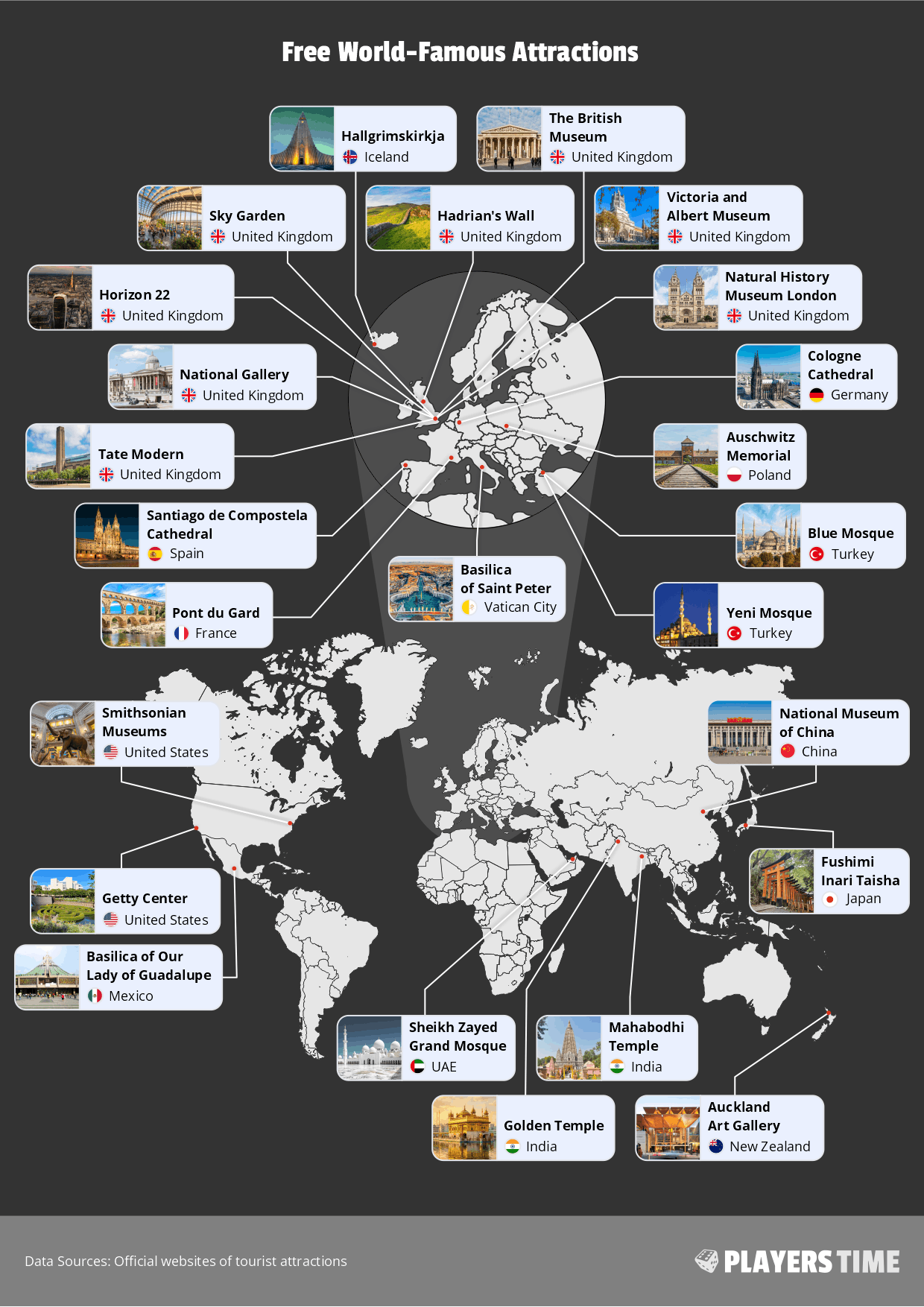
North America follows with a distinctly institutional profile, led by the Smithsonian network in Washington, DC, including the National Air and Space Museum and the National Museum of Natural History, alongside the Getty Center in Los Angeles, reinforcing the US model of large-scale publicly accessible cultural infrastructure.
Asia contributes a different kind of presence, dominated less by museums and more by living heritage sites and active religious spaces: Fushimi Inari Taisha in Kyoto, the National Museum of China in Beijing, the Sheikh Zayed Grand Mosque in Abu Dhabi, the Blue and Yeni Mosques in Istanbul, and India’s Golden Temple and Mahabodhi Temple. These are not curated experiences in the traditional sense, but continuously used sacred or civic spaces where accessibility is part of their identity.
In many cases, access itself becomes part of the meaning of those places – shaped not as a concession, but as a deliberate cultural choice. Public funding turns museums into civic infrastructure rather than commercial venues, religious openness keeps sacred spaces active and welcoming rather than enclosed, and preservation policies ensure that heritage sites remain part of collective memory rather than gated assets.
Global Tourist Attractions With Scheduled Free Admission Days
Free entry is rarely just a spontaneous act of generosity, it behaves more like a choreographed ritual, timed to the pulse of national holidays, cultural observances, and recurring calendar cycles that briefly ‘unlock’ some of the world’s most iconic heritage sites.
Across Europe, these openings feel almost like scheduled pop-culture drops on the calendar of history – predictable, anticipated, and quietly powerful. France, Italy, Spain, and Greece repeatedly align free admission with the ‘first Sunday of the month’ or with national milestone moments: Independence Days, Republic Days, Liberation commemorations.
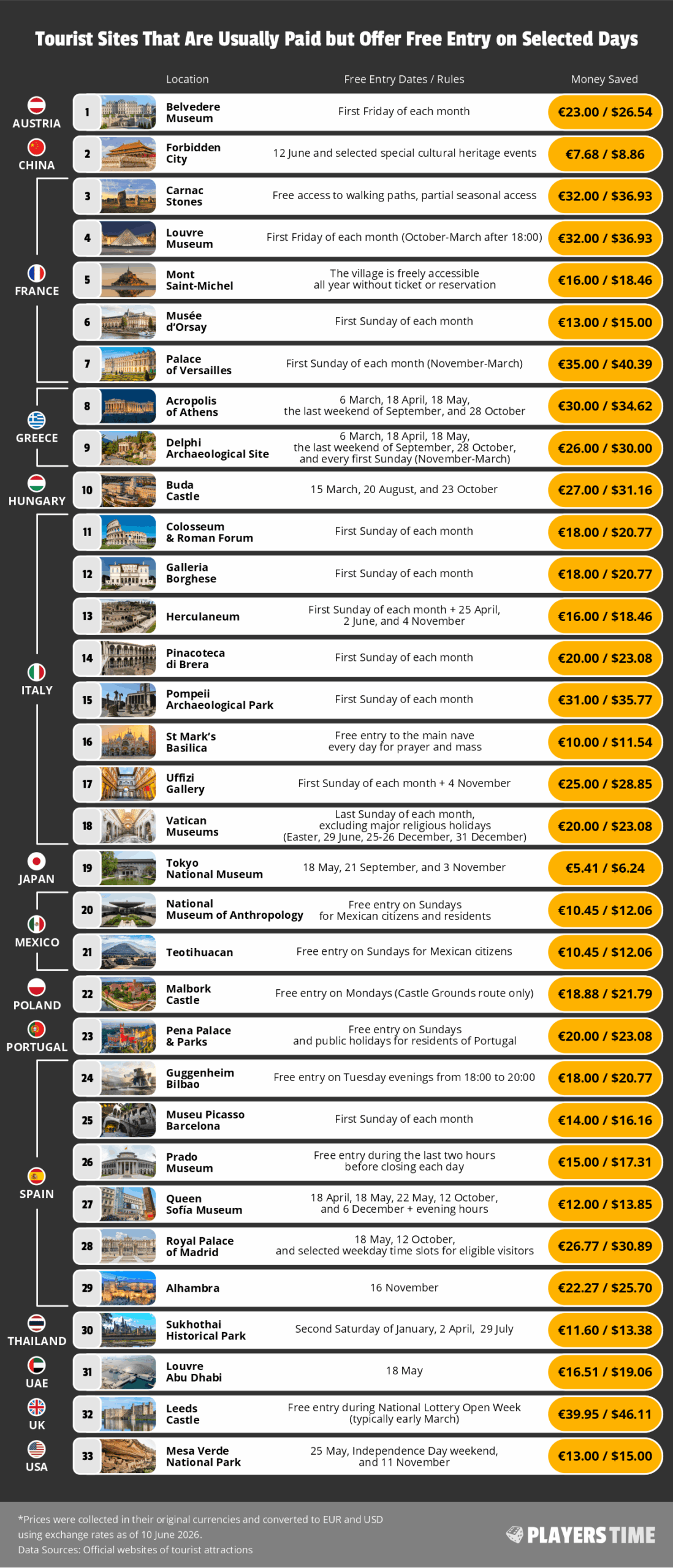
Italy, in particular, has systematised the experience almost like a cultural ‘season pass’ – a recurring Sunday where museums, ruins, and galleries collectively drop their entry fees at once. In theory, you could save close to $200 across major sites in a single day, though in practice it becomes more of a fantasy itinerary than a real one: physically impossible to collect it all in 24 hours, like trying to binge an entire streaming platform in one sitting while the city itself becomes the playlist.
In the United Kingdom, Leeds Castle opens during National Lottery Open Week, where a simple National Lottery ticket becomes the key, turning participation in a game of chance into temporary access to centuries of preserved history, outside the usual rules of heritage entry.
Elsewhere, access models vary more sharply: Asia links openings to cultural heritage days such as Japan’s Culture Day (3 November) and China’s Heritage Day (12 June), while the Americas rely on citizenship-linked Sundays in Mexico and federal holidays in the United States.
Methodology
We compiled a dataset of 200 of the world’s most visited and recognisable tourist sites, selected for their global popularity and cultural significance. These were then organised into four categories: Museums and Galleries; Historic Landmarks & Archaeological Sites; Observation Decks and Towers; and Palaces, Castles & Religious Sites.
For each site, we recorded the standard general admission fee (or the most commonly purchased ticket type, including flagship experiences where applicable) from their official websites. Alongside base pricing, we systematically extracted available concessions for seniors, children, and groups, as well as bundled or combo offers with nearby attractions where relevant. Prices were taken from official websites in local currencies for the period 15-20 June and converted into USD and EUR using exchange rates as of 10 June. Where data was unavailable for this period, exceptions were made: Machu Picchu tickets were not available until November, while the Colosseum and Roman Forum first available slots online were for July.
We also mapped patterns of free entry, including permanent free admission, scheduled free-entry days, and limited-time access windows tied to national holidays or cultural observances. This allowed us to identify not only which sites are free, but also when access temporarily opens across different regions.
Finally, we constructed both global and category-specific comparisons, ranking sites by admission cost and highlighting variation in pricing structures. The analysis also quantifies potential savings available through free-entry days, illustrating how much visitors could theoretically save depending on timing, eligibility, and location.
The analysis excludes amusement parks, extreme environments requiring specialist equipment such as deep-sea sites like the Mariana Trench, polar and expedition-only regions including Antarctica and Arctic research zones, space-related destinations such as orbital flights and space stations, temporary closed heritage sites under renovation or conservation, and event-only venues accessible only during festivals or private events.