In 2026, gaming is not just bouncing back – it is booming. After the so-called ‘video game winter’, playtime is rising, major releases are back on track, and players are spending more time in-game than ever.
Nowadays, gamers are starting younger and staying longer. Nearly half of gaming parents introduce children to games by age five, often through open-world titles like Minecraft and ROBLOX. As a result, gaming has evolved from a pastime into a full-fledged lifestyle.
With engagement surging and environmental impact a growing concern, the team at PlayersTime examined the hidden costs of gaming – electricity use, energy bills, and carbon emissions – across consoles, PCs, and top-played titles, revealing which platforms and games leave the heaviest footprint.
- Gaming PCs are the energy champs, and not in a good way. A hardcore gamer produces 261 kg CO₂/year, resulting in annual electricity costs of $119.44.
- Massive playtime leads to a massive carbon footprint. The most-played PC games, Dota 2 and League of Legends, emit around 200,000 tonnes of CO₂ per million players.
- ROBLOX dominates console playtime, but it also tops the charts in carbon emissions, producing roughly 2,500 tonnes of CO₂ annually per million players.
- China and the United States are home to the largest gamer populations in the world, producing millions of tonnes of gaming-related carbon emissions every year.
Gaming Devices Carbon Footprint
Platforms with the highest and lowest estimated energy-related emissions, based on kWh specifications
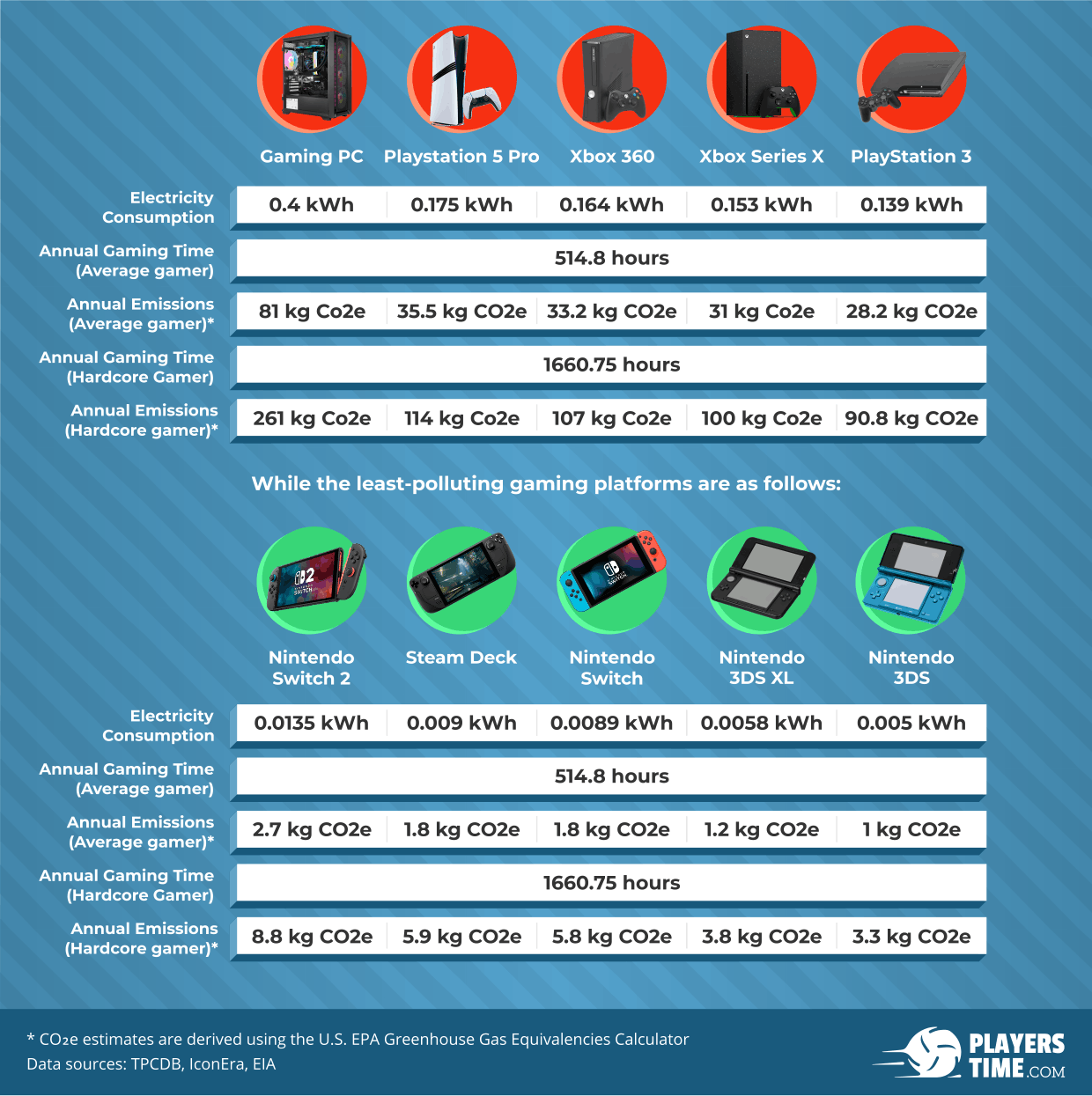
When it comes to electricity consumption, the gaming PC is the ultimate final boss, and not just in power draw. A decent high-end gaming rig today can set you back $1,500-$2,000 (€1,287-€1,717) or more just to build, and that is before you factor in upgrades, peripherals, and the electricity needed to keep it humming. Once you load a game, a high-usage PC setup can rack up more than 261kg of CO₂ a year, if you play an average of 32 hours a week – the equivalent of charging over 21,000 smartphones. Even for average players, PCs still generate roughly 81 kg of CO₂ annually, about the same as driving a standard petrol car for around 330 km, making personal computers the most power-intensive gaming setup among all analysed.
On the console side, power still comes at a price, and so does getting your hands on the hardware in the first place. High‑performance systems like the PlayStation5Pro and Xbox SeriesX sit at the top of the carbon emissions leaderboard, each capable of pushing past 100kg of CO₂ per year for heavy players. Interestingly, the SeriesX has recently popped up at one of its lowest prices yet, about $600 (€515) with a controller included on Amazon, as retailers clear out stock, giving gamers a rare break on one of the most powerful consoles available.
But even as occasional price dips make console ownership more tempting, older hardware has not aged gracefully. Consoles such as the Xbox360 and PlayStation3, released in 2005 and 2006, respectively, seem to match or even exceed the footprint of newer devices, owing to less efficient designs and higher power draw.
At the other end of the electricity chart, handheld consoles are the clear winners. Devices like the Nintendo Switch, Steam Deck, and Nintendo’s 3DS sip energy by comparison, producing only a fraction of the emissions even during extended gaming sessions. They may not boast cutting-edge graphics, but the data shows they are the most eco-friendly way to keep gaming. For players looking to minimise both their energy bills and carbon footprint, going portable is the smart play.
Gaming Platforms with the Highest Annual Power Costs
Based on a U.S. average electricity rate of $0.1798 per kWh
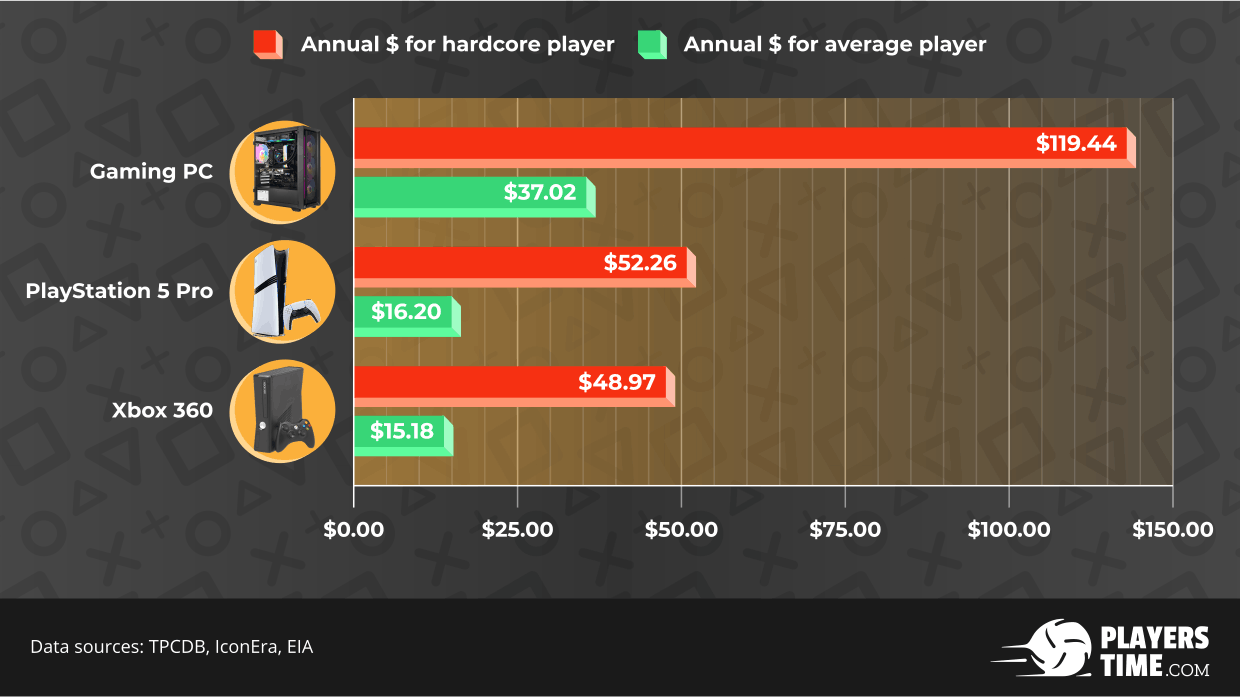
High-performance gaming does not just push your PC or console to its limits, it hits your wallet, too. With US electricity rates up more than 30% over the past five years, and continuing to rise in 2026, marathon sessions on a mid-range gaming PC can cost nearly $120 a year just to power your gameplay. Consoles are not off the hook either. The PlayStation 5 Pro and Xbox 360, the two most energy-demanding consoles, can tack on $50 or more annually to the electricity bill for heavy players. In just a few years, that could buy a pile of new games, a sleek headset, or even a weekend getaway, proving that your epic gaming habit carries a serious energy price tag.
Games with the Largest Energy Footprint
Selected from the Top 10 PC Games by Average MAU, with estimated energy impact
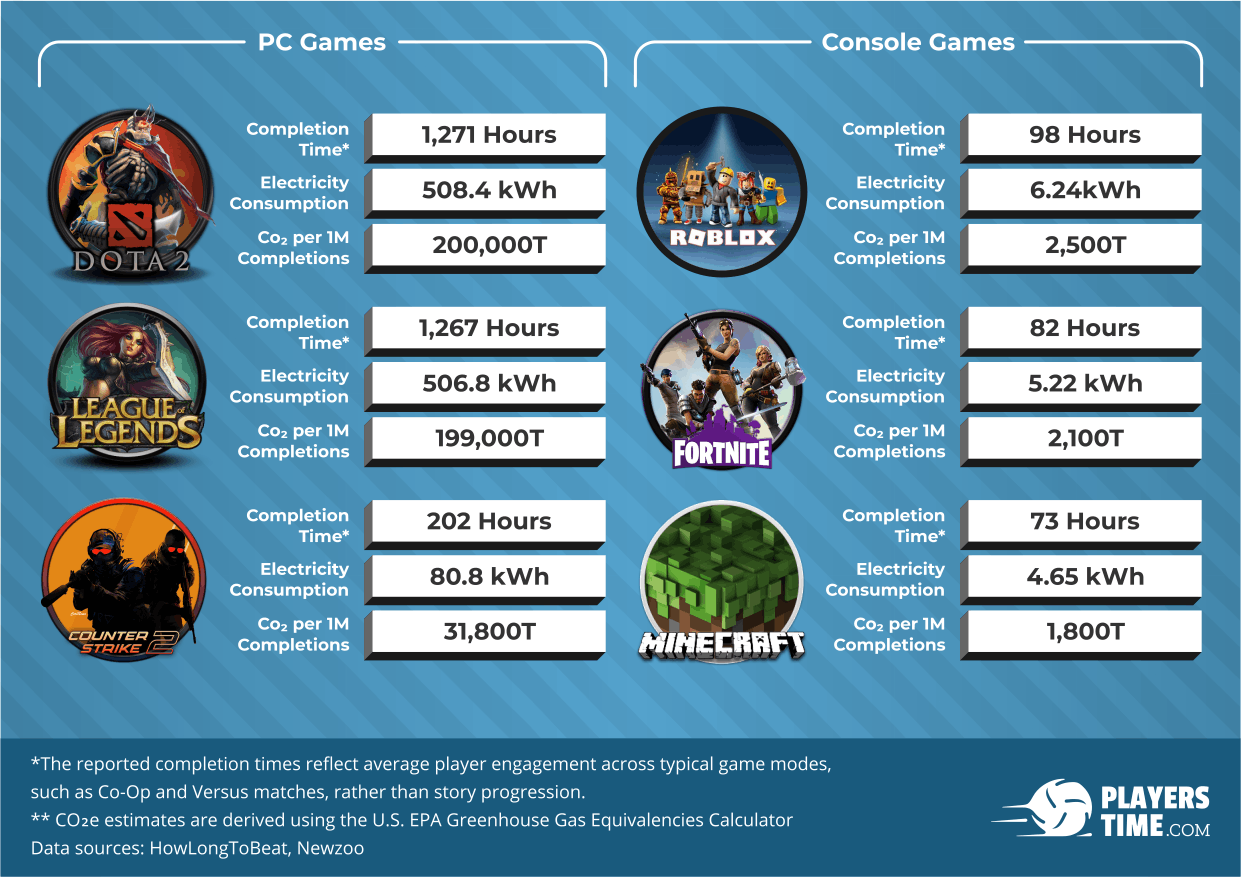
When it comes to carbon emissions, PC marathoners reign supreme. Games like Dota 2 and League of Legends keep players glued to the screen for hours on end, from casual sessions to the intense play seen in global tournaments watched by millions. Dota 2’s annual world championship, The International, draws massive audiences, with champions like Team Spirit and OG playing marathon sessions to claim the Aegis of Champions. Meanwhile, League of Legends’ annual World Championship sees iconic players like Faker grind countless hours to lift the Summoner’s Cup.
And here is the kicker: in order to compete at this elite level, players often log far more hours than the averages in the data, pushing their electricity bills and carbon footprint to stratospheric levels. Data shows average Dota 2 gameplay could stretch past 1,200 hours per player, according to user submitted times on game tracking website HowLongToBeat. This generates roughly 200,000 tonnes of CO₂ per million players, equivalent to greenhouse gas emissions from 46,667 gasoline-powered passenger vehicles driven for one year.Imagine those hours multiplied at the top tier, and suddenly the carbon bill is as epic as the gameplay.
On consoles, ROBLOX, Fortnite, and Minecraft generate between 1,800 and 2,500 tonnes of CO₂ per million players annually, not because they are technically demanding, but because gamers rarely log off. ROBLOX, the biggest contributor, functions less like a single game and more like a permanent online world where millions of kids and teens play, chat, and create every day, a level of constant engagement that has pushed countries like Australia to introduce new safety rules for under-16s. Fortnite follows a similar always-on model, functioning also as a cultural hub where brands like Balenciaga launch virtual fashion, boosting in-game experiences. When games become social spaces, shopping malls, and hangouts all at once, the hours and the emotional investment scale far beyond traditional play.
PC vs Console Players Worldwide (2025)
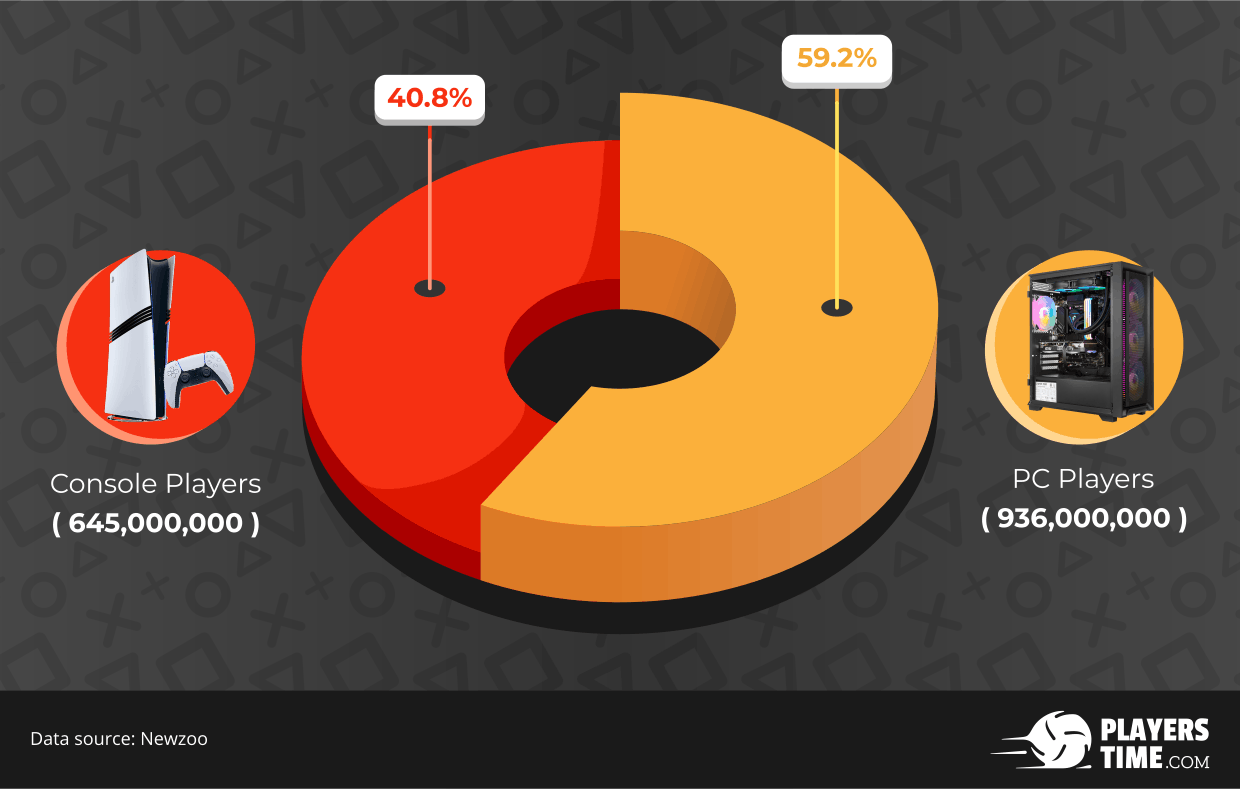
PC gamers outnumber console players worldwide, with 936 million PC players versus 645 million using consoles in 2025. When you factor in energy use, this adds up fast. The carbon emissions from PC gaming could total hundreds of millions of tonnes annually, easily 10 times higher than consoles. Scaling individual play across nearly a billion PC users, the global footprint of marathon sessions is enough to power tens of millions of homes for a year.
Top-Grossing PC Games Released in 2025 on Steam
Based on Gamalytic estimates of revenue, sales, and player data
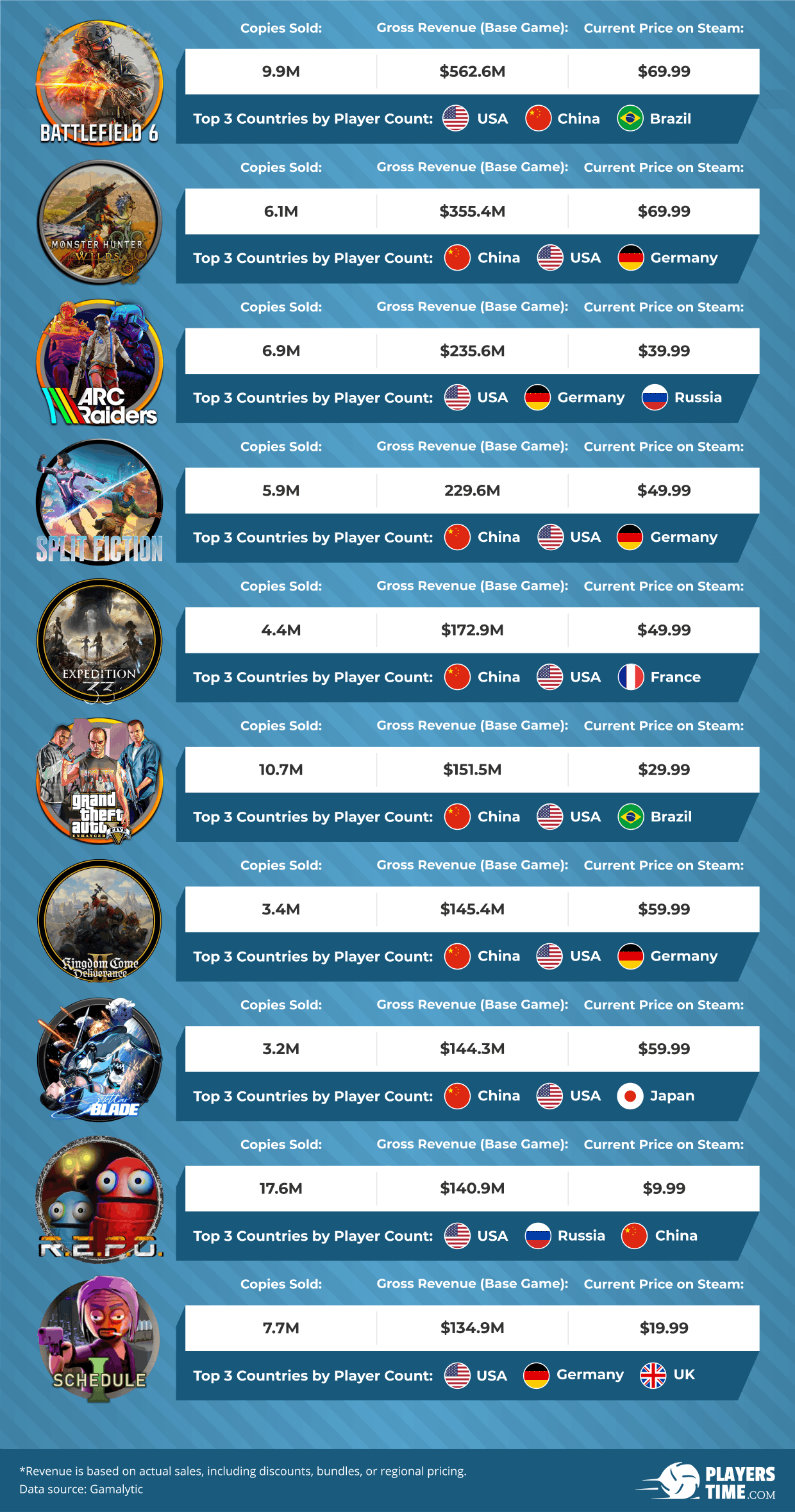
The biggest contributors to gaming’s global footprint for 2025 also happen to be the powerhouses of the gaming industry itself. According to Statista Market Insights, the USA remains the world’s largest gaming market, projected to surpass $140 billion in revenue in 2025, driven by a massive player base, high disposable income, fast Internet connection, and a deeply embedded PC, console, and esports culture. China follows behind, with industry reports estimating roughly $137.8 billion in gaming revenue, fuelled by its huge population, widespread broadband access, and a dominant mix of mobile and PC gaming.
These factors translate directly into player numbers. The USA and China dominate the player charts for 2025’s biggest PC titles, from Battlefield 6 and Grand Theft Auto V Enhanced in the US to Monster Hunter Wilds and Split Fiction in China. When millions of players combine long play sessions with power-hungry hardware, the result is predictable. These countries sit at the top of the global leaderboard for gaming-related energy use and CO₂ emissions.
Methodology:
The report makes use of multiple authoritative sources to provide a comprehensive view of gaming’s energy use, electricity costs, and carbon emissions across gaming platforms and popular game titles. Key inputs, including hardware power consumption, average usage, and electricity pricing, were sourced from TPCDP, IconEra, and the US Energy Information Administration. These figures were used to estimate annual energy demand and associated costs for consoles and gaming PCs, with carbon emissions calculated using the US EPA Greenhouse Gas Equivalencies Calculator.
To assess the impact of games at scale, player engagement and popularity data were extracted from Newzoo.com and used to identify the most played PC and console titles globally. Average completion and engagement hours were sourced from HowLongToBeat.com and applied as a proxy for typical gameplay duration. Additional context on market scale and regional player distribution for top-grossing PC releases in 2025 was drawn from Gamalytic.com.