Across Europe, lotteries are more than numbers on a page – they’re headline-making events where fortunes can be made in the blink of an eye. In the past year alone, EuroMillions repeatedly maxed out its €250 million jackpot, turning everyday players into instant multi-millionaires, while unclaimed prizes reminded everyone to double-check their old tickets. Despite mind-boggling odds – 1 in 139,838,160 for both EuroMillions and Eurojackpot – millions of people continue chasing that elusive combination of numbers capable of changing their lives overnight.
While hitting the jackpot is still a long shot, intriguing patterns emerge over time: some numbers appear far more frequently than others, and certain countries consistently produce more winning tickets per capita than others. With this in mind, our team at PlayersTime analysed thousands of draws across European and UK lotteries, including Eurojackpot, EuroMillions, UK Lotto, Thunderball, and Set for Life to reveal the luckiest and unluckiest numbers, streaking favourites and hidden sleepers, and the countries where players have hit jackpot gold.
The Most and Least Frequent Numbers in Eurojackpot
Launched in 2012, Eurojackpot quickly became one of Europe’s most beloved lotteries, bringing players from 18 countries together in the hunt for life-changing prizes. The game is simple but thrilling: players pick 5 numbers from 50, plus 2 Euro Numbers from 12, hoping their combination matches the draw. With jackpots climbing to €41 million and odds of hitting the top prize at 1 in 139,838,160, every draw is a high-stakes event that has Europeans on the edge of their seats.
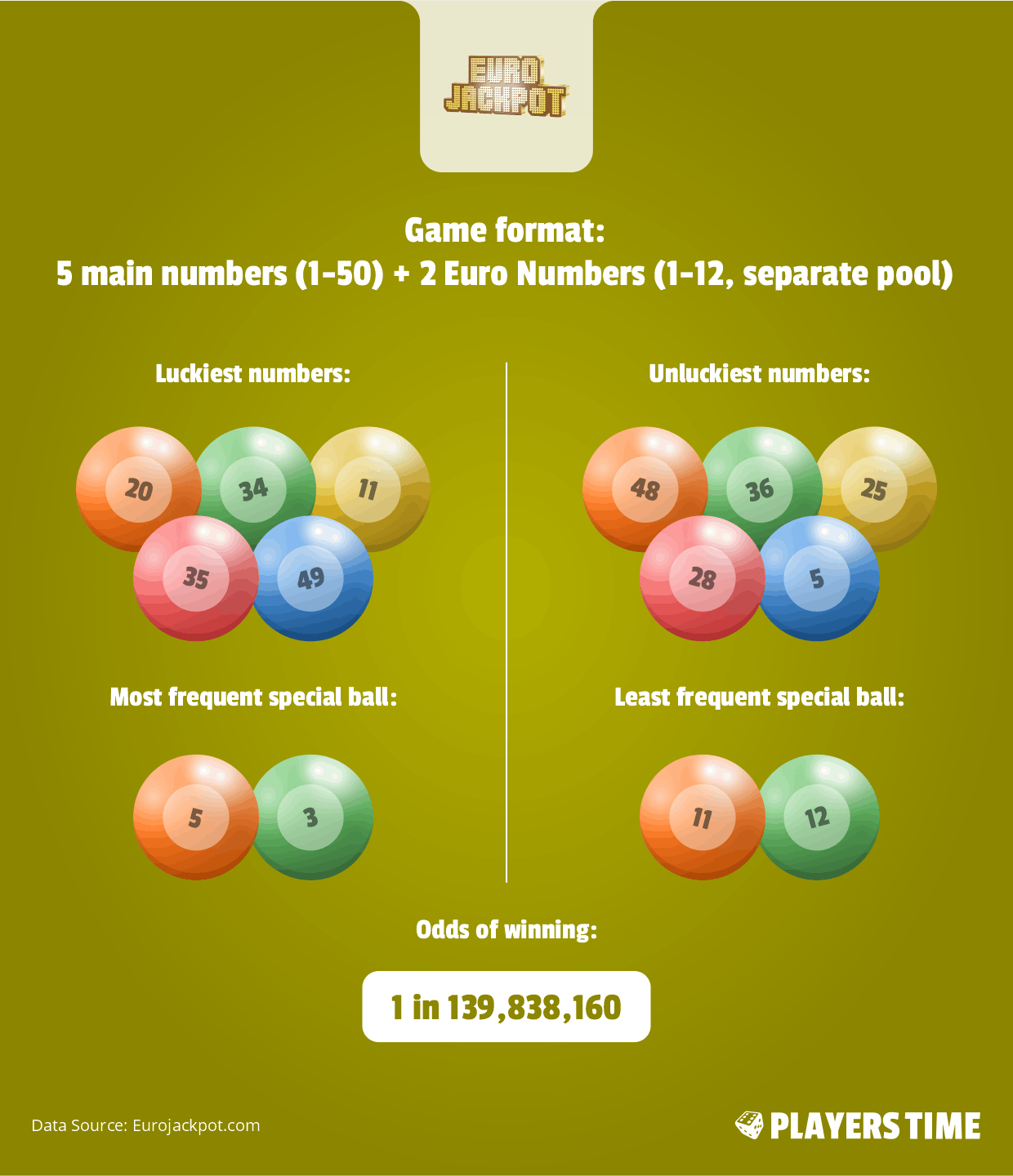
Since its launch, Eurojackpot wins have been unevenly distributed across Europe. Germany leads with 87 jackpot winners, followed by Finland with 19 and Denmark with 12, a reflection partly of population size and ticket sales. The €120 million top prize has been claimed several times, most recently on 23 September 2025, after a long rollover streak. The lucky winner, a Berlin resident, had purchased nine entries, totalling €19 for that draw. The winning numbers were 7, 8, 31, 32, and 33, along with Euro Numbers 10 and 11. Statistically, the odds of winning were about 0.000000715 %, meaning a player would need to cover over 139 million unique number combinations to guarantee a win.
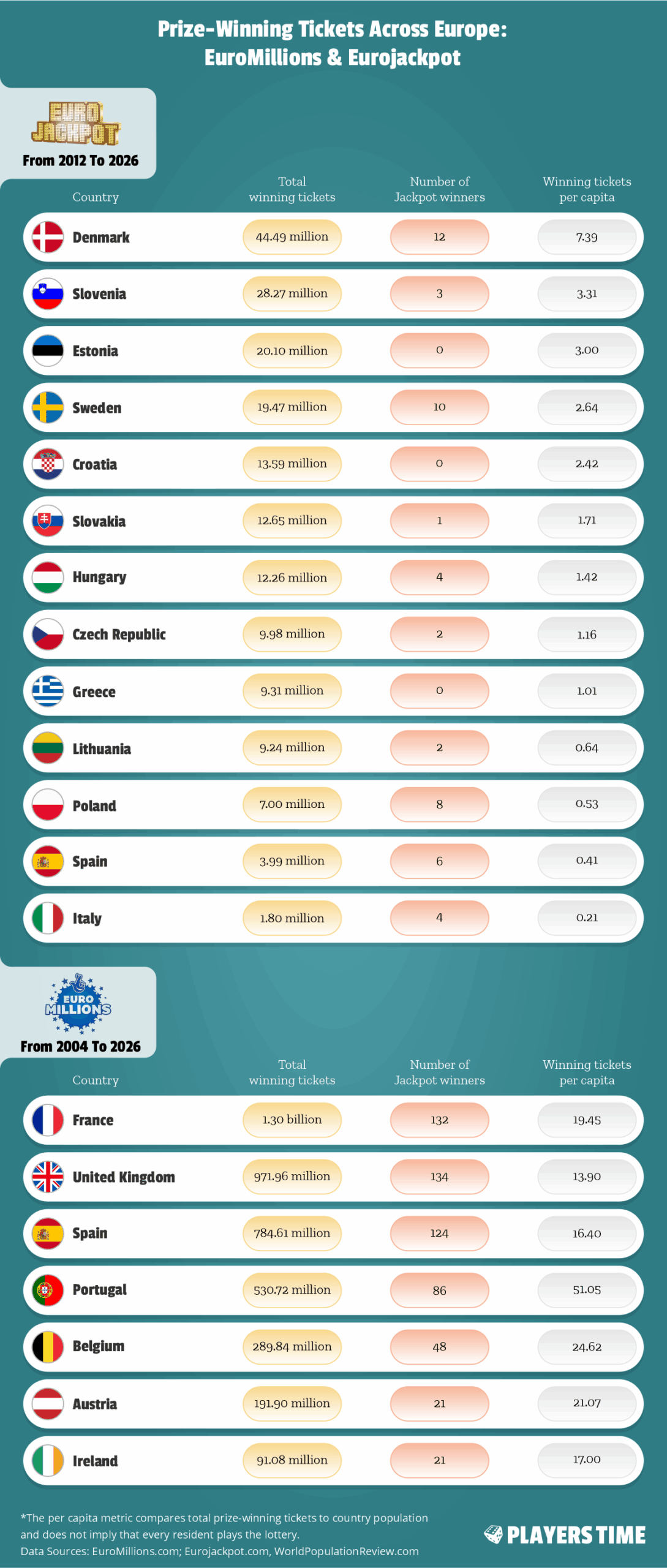
Looking beyond jackpot wins, Denmark stands out in overall success, recording more than 44.4 million winning tickets across prize tiers, equivalent to roughly 7.39 per capita, the strongest ratio among participating countries.
At the number level, historical draws reveal their own hierarchy. Among the main balls, 20, 34, 11, 35, and 49 have appeared most often, earning their reputation as the game’s ‘lucky’ numbers. On the other end, 48, 36, 25, 28, and 5 have been far quieter, emerging as long-term ‘unlucky’ outliers, appearing nearly 50% less frequently than the luckiest ones. In the special Euro Number pool, 5 and 3 lead in frequency, while 11 and 12 have appeared the least.
The Numbers That Dominate EuroMillions
Еstablished back in 2004, EuroMillions is widely regarded as Europe’s first major multi-country lottery, uniting players across the continent in pursuit of massive jackpots. Often seen as the precursor to Eurojackpot, it brings together players from nine countries: France, the UK, Spain, Portugal, Belgium, Luxembourg, Switzerland, Austria, and Ireland. Players try their luck by picking 5 numbers from a 50-number pool, plus 2 Lucky Stars from 12, in hopes of matching the draw exactly.

Between the first draw and February 2026, the most frequently drawn numbers have been 44, 42, 23, 19 and 29, each appearing between 213 and 219 times. On the other end, the unluckiest numbers are 22, 33, 46, 18 and 41, drawn less than 173 times for the same period. Interestingly, the numbers 44 (219 times), 42 (218), and 23 (217) appear 40% more frequently than the ‘unluckiest’ 22 (151) and 33 (167). In the Lucky Star pool, 3 and 2 lead with 381 and 380 appearances, while 11 and 12 remain rare.
Across nearly 1,920 draws, with jackpots climbing as high as €61 million, and odds of winning the top prize at 1 in 139,838,160, each EuroMillions draw has become a continent-wide spectacle. When it comes to jackpot wins, the UK leads with 134 top-prize winners, followed closely by France (132) and Spain (124). Portugal, meanwhile, stands out for the highest number of winning tickets per capita – 530,723,358 in total, which works out to roughly 51 wins per citizen.
The largest EuroMillions jackpot on record, €250 million, was most recently claimed in France on 19 August 2025 with winning ball numbers 24, 31, 34, 41, and 43 and Lucky Stars 6 and 8. This marked one of several €250 million capped jackpots in 2025, including a family syndicate in Ireland in June and an anonymous winner in Austria in March.
Europe’s Lottery Leaders: Total Wins, Per Capita, and Jackpot Rankings
The examples above illustrate that Europe’s lottery performance varies widely by country, with certain nations consistently standing out for their success or jackpot wins. Some countries punch above their weight in per capita wins, while others dominate the biggest prizes.
On the graph below, you can see how different countries compare, highlighting both smaller nations achieving surprising success and larger countries claiming the top jackpots.
The UK’s Luckiest Lottery Numbers: Lotto, Thunderball & Set for Life
Europeans may be chasing ‘Euro-sized’ jackpots, but the UK has plenty of lottery drama of its own. From the classic UK Lotto to the fast-paced Thunderball and the long-term dreams of Set for Life, British players follow their own rituals, rivalries, and streaks of fortune.
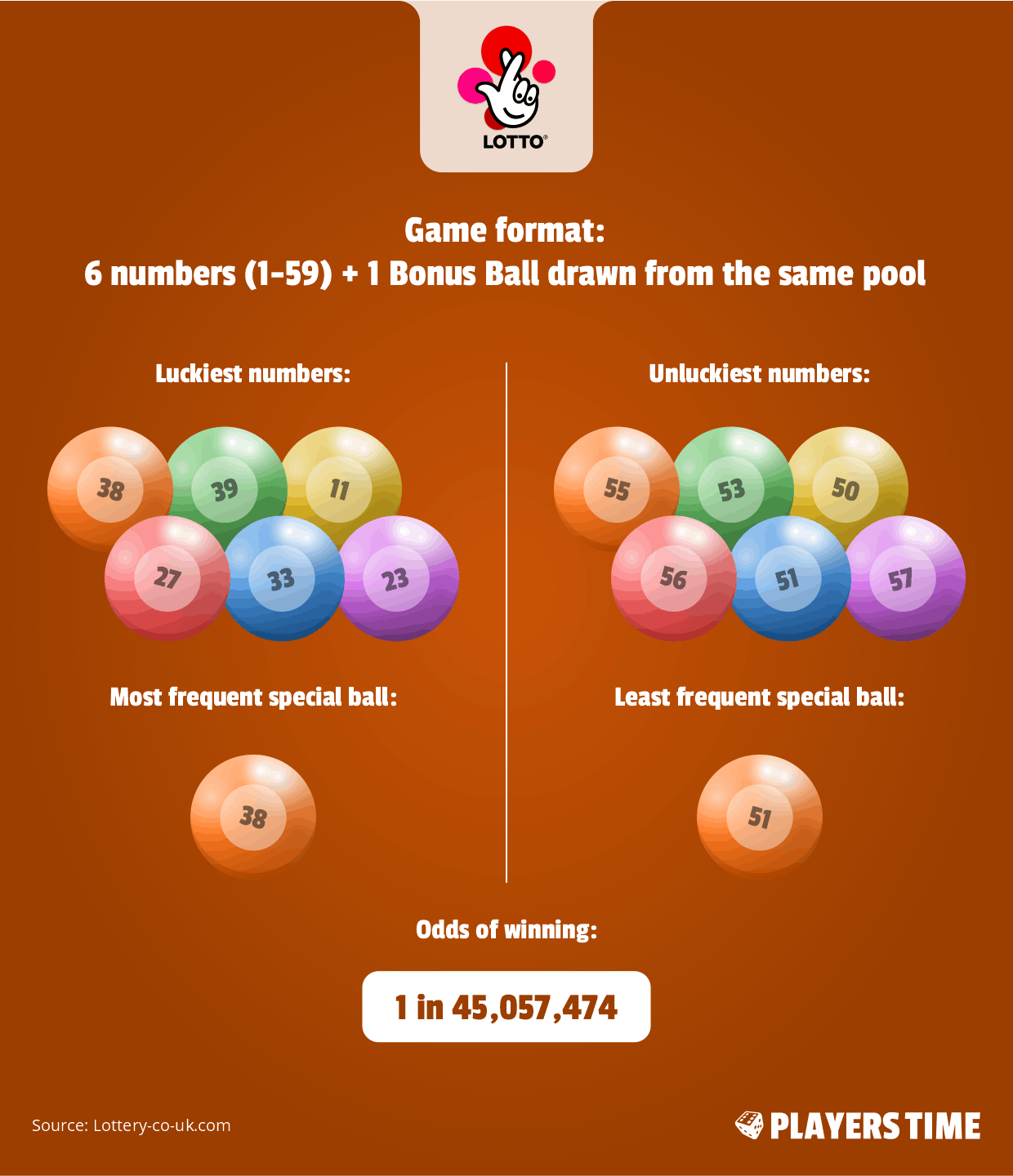
Lotto, the original game under the UK National Lottery franchise, remains the country’s most-played draw. Each Wednesday and Saturday, millions of players try their luck, selecting six numbers from 59, plus a Bonus Ball from the same pool, hoping the combination lines up. The starting jackpot can go up to £3.8 million (€4.4 million) and rolls over if not won, while odds of hitting the top prize stand at 1 in 45,057,474 across the 3,145 draws held to date. The largest single-ticket win, £35.1 million in April 2016, stands as proof of just how high the stakes can climb from a single set of numbers.
Since the 2015 rule change, which expanded the number pool from 49 to 59, historical data shows clear trends: the luckiest main numbers are 38, 39, 11, 27, 33, and 23, appearing most frequently, while 55, 53, 50, 56, 51, and 57 are the long-term ‘unlucky’ numbers. In the Bonus Ball category, 38 tops the ‘lucky’ chart with 81 draws, whereas 51 is the least drawn, appearing just 15 times.
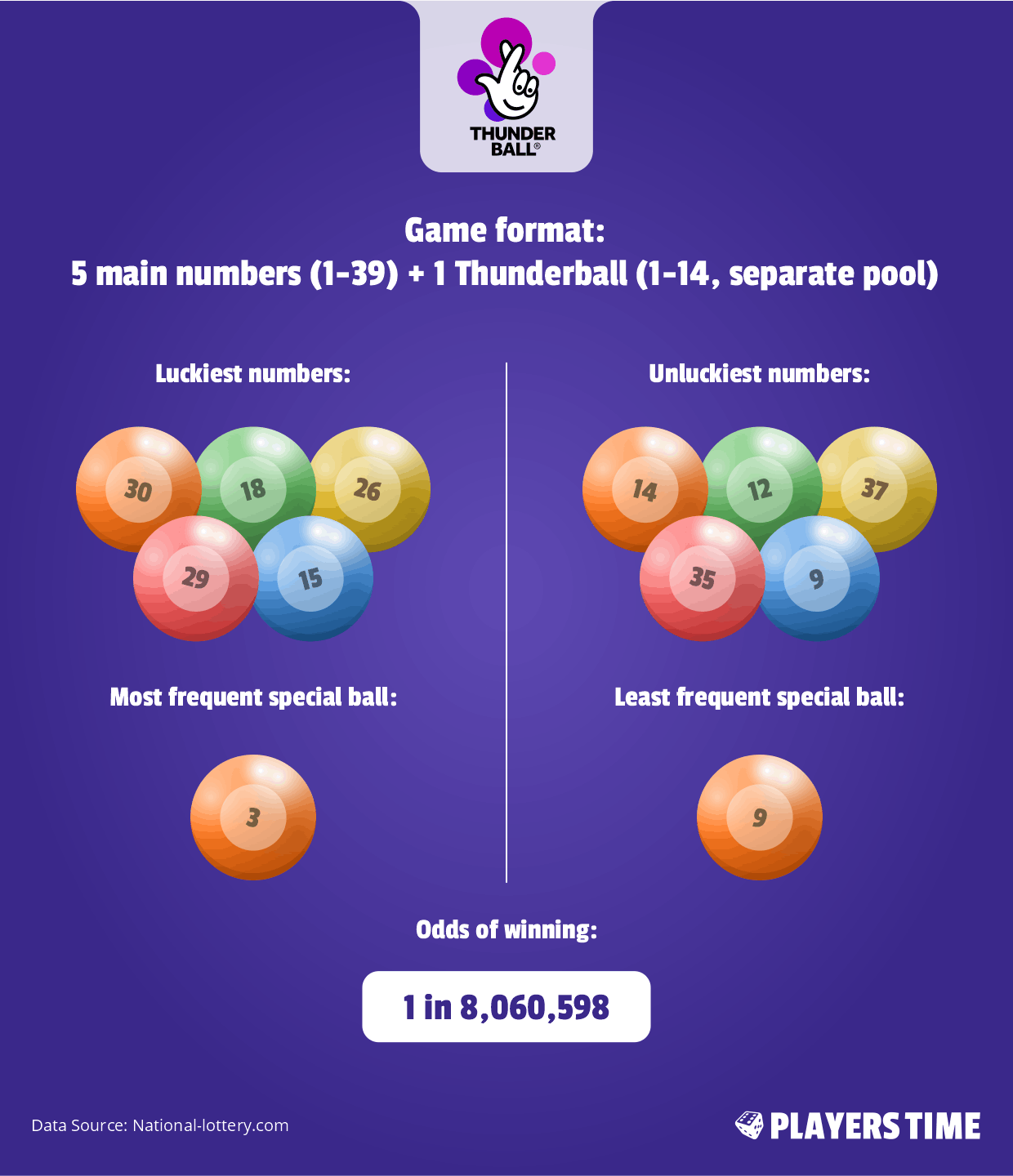
Thunderball offers a faster-paced alternative within the UK lottery lineup. With draws held four times a week and tickets priced at £1, players pick five main numbers from 39, following the 2010 rule change, plus one Thunderball from 14. Matching all numbers wins the jackpot. The top prize currently stands at £500,000 (€575,108), and with odds of 1 in 8,060,598 across 3,851 draws to date, the game balances relatively frequent draws with long-shot jackpot chances.
In late 2025, Thunderball delivered one of its most unusual outcomes: a player landed the £500,000 jackpot twice in the same draw after accidentally purchasing two identical tickets with the numbers 3, 15, 18, 26, 29 and Thunderball 3. She had reportedly considered voiding one of them, turning what could have been a near-miss into a rare double-win moment.
And moving the spotlight to the numbers, some of them just can’t stop appearing. 30 and 18 are the true streaking numbers, frequently showing up in draws and earning reputation as players’ lucky favourites. Meanwhile, 9 and 12 are the long-term sleepers, rarely making an appearance. In the special Thunderball pool, 3 is the star of the show, while 9 remains the elusive underdog.
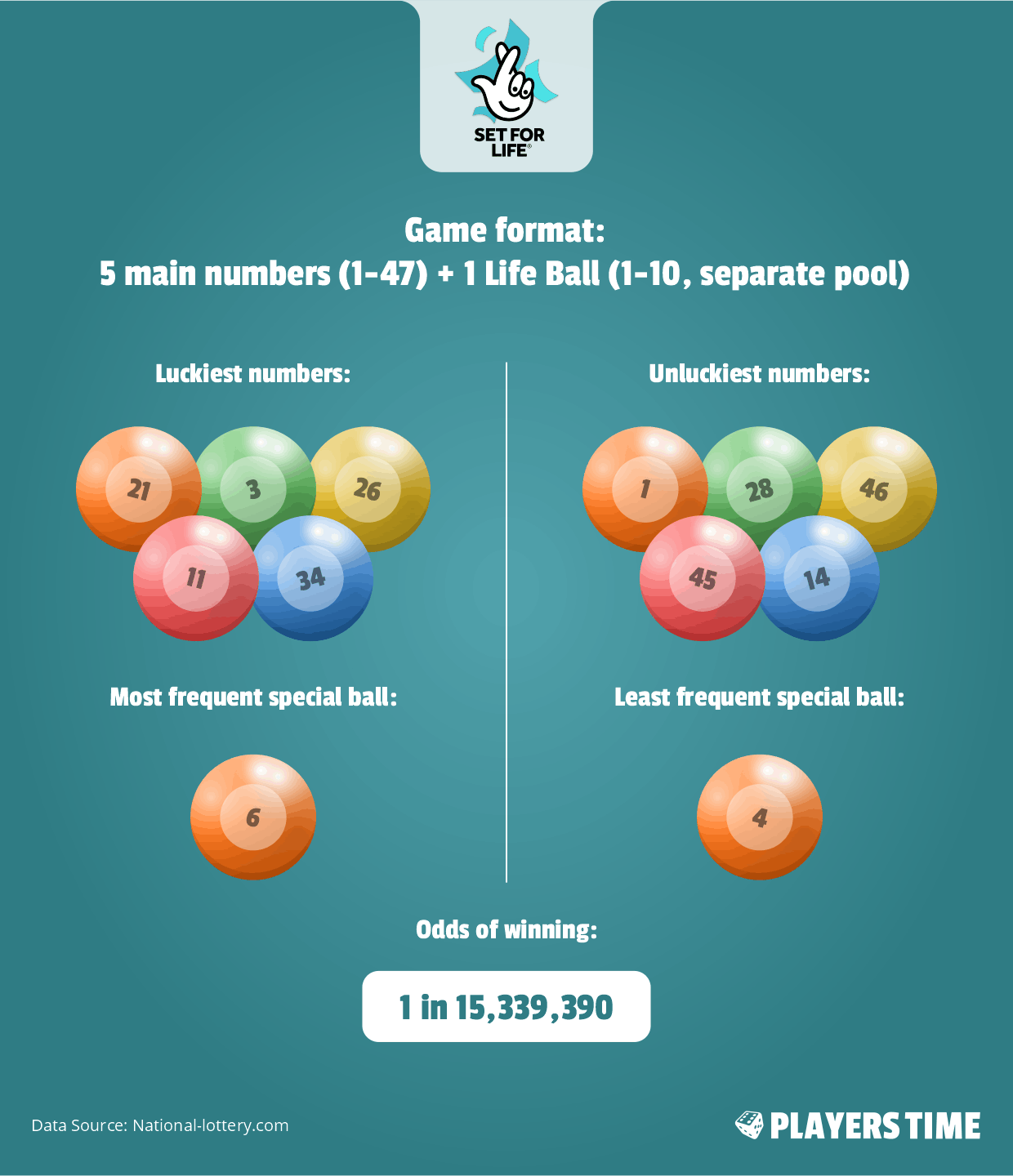
Set for Life held its first draw on 18 March 2019, offering a different take on the jackpot dream. Rather than a single lump sum, winners receive £10,000 (€11,502) every month for 30 years, turning a single ticket into long-term financial security. Draws take place every Monday and Thursday, and players choose five numbers from 47, plus a Life Ball from 10. Across 721 draws so far, the odds of landing the top prize stand at 1 in 15,339,390.
Towards the end of 2025, Set for Life made headlines when two lucky players hit the top prize in the same week with numbers 6, 18, 21, 25 and 34 and the Life Ball 10, securing two long-term annuity jackpots within days, a rare clustering for a game of this scale.
The draw data also reveals clear front-runners. 21 is the game’s standout streaking number, appearing 97 times, with 3 standing close behind with 94 draws. Meanwhile, 26 and 11 continue to feature regularly, reinforcing their reputation as reliable favourites. On the quieter side, 1 is the most notable sleeper with just 60 appearances, followed by 28 and 46 (62 each). In the Life Ball pool, 6 dominates with 88 draws, while 4 remains the least drawn ball at 60.
Methodology:
Historical draw results, number frequency data, jackpot totals and winner statistics for Eurojackpot, EuroMillions, UK Lotto, Thunderball, and Set for Life were sourced directly from their official websites. All figures reflect draws held up to 12 February 2026 and are based on each game’s current format unless noted otherwise. ‘Luckiest’ and ‘unluckiest’ numbers were determined by ranking balls according to total historical appearances.
Per-capita winner rates were calculated by dividing total winning tickets figures by national population estimates sourced from World Population Review using the most recent available data at the time of analysis. All stated odds refer to the probability of winning the top prize, as published by the respective lottery operators. Historical frequency patterns reflect past outcomes only and do not influence or predict future draws.