
Doomscrolling isn’t just a guilty pleasure, it’s the new normal in 2026. Algorithms thrive on outrage and emotion, shaping not just what we see, but how we feel. The payoff? A population that’s more plugged in than ever, but quietly burning out from the inside.
Billions now spend hours lost in digital spaces designed to hijack attention. While social media platforms, websites, and forums can be empowering, they are also quietly draining the life out of users. So here are a couple of ‘uncomfortable’ questions: Are we capable of recognising our reliance on constant media stimulation and feeds, and can we cut back on the unhealthy habit?
To try and provide answers, the team at PlayersTime conducted an online survey on the experiences and attitudes towards excessive Internet use, social media addiction, and consuming content that is generated by artificial intelligence. We found that while a significant majority believe they are addicted to social media, very few possess the ability or willingness to put down their phone. Instead, they’d rather watch a few dozen TikToks with the hashtag #digitaldetox.
Key Findings from the Survey:
- 51% of participants spend 3+ hours on social media daily, including 18.2% who spend over 5 hours. The share of people who are on social media for 3 hours or more a day climbs to 78.6% for GenZers, and plunges to 7.5% for Baby Boomers.
- 78% spend 5 hours or more surfing the Internet daily, be it for work or for pleasure. A significant share of users are also chronically online: 21% admit to being online for more than 8 hours every day.
- 46% admit to always checking their phone right after waking up every morning, while over half (55.3%) say they get their news from social media platforms daily. Meanwhile, 54.8% catch themselves scrolling mindlessly on social media at least once a day.
- Women are more likely than men to admit they are addicted to social media, with 61% of women saying that versus only 41% of men. The share of men and women saying social media often distracts them from their responsibilities or their work, however, is comparable – 62% of men and 61% of women admit to this.
Survey Demographics
Breakdown by Gender & Age
| Generation | Count | Share |
|---|---|---|
| Gen Z (18-29) | 532 | 35.3% |
| Millennials (30-45) | 639 | 42.3% |
| Gen X (46-61) | 271 | 18.0% |
| Baby Boomers (62-80) | 67 | 4.4% |
868
57.5% of total
641
42.5% of total
To better understand how deeply digital habits are shaping everyday behaviour, we conducted an online survey of 1,509 adults, with most participants hailing from North America, the United Kingdom, and Continental Europe. The findings point to a level of engagement that goes well beyond casual use, suggesting that what was once considered heavy usage is quickly becoming the norm.
Being Chronically Online: The New Normal for Gen Z
*Survey among 1,509 adults conducted online between April 20 and April 25
Barely 3.38% of survey participants say they spend less than 2 hours online every day, while 18.75% say they spend between 2 and 4 hours. Another 32.54% of respondents report spending 5-6 hours online; nearly a quarter (24.06%) opt for an even longer period of Internet use, 7-8 hours, every single day.
Note that when choosing their answer, participants might consider their online activity while at work, or they may not. This may be key to understanding the rest of the answers in this first question of the survey: around 10.4% spend 9-10 hours online every day; 5.96% say they are online for 11 to 12 hours, while another 4.90% admit to being constantly online, picking the last possible option – more than 12 hours a day.
Less than 2% Spend No Time on Social Media
*Survey among 1,509 adults conducted online between April 20 and April 25
Social media seems to have become more addictive than ever, as news feeds, stories, and reels keep users hooked for hours. More than half of respondents (51%) spend at least three hours a day on social media, with nearly one in five (18.6%) exceeding five hours – figures that rise sharply among younger users.
Gen Z stands out as the most engaged group, with a substantial portion spending well over three hours a day (78.57%), while Baby Boomers remain far more moderate, often staying below one to two hours. Nearly 6% of them say they don’t use social media at all, while 50.75% spend a maximum of one hour on these platforms daily.
Gender differences are less pronounced overall, though women show slightly higher interest in social media platforms – 52% of women admit to being on social media for 3 hours or more every day, against 51% of men. Meanwhile, only a very small fraction of respondents report spending little (5.7%) to no time on social media (1.52%), suggesting near-universal adoption. Taken together, the results paint a reality where social platforms occupy a significant share of daily attention, particularly among younger users.
Users in 2026 Start and End Their Day on Their Phone
5 minutes of waking up?
*Survey among 1,509 adults conducted online between April 20 and April 25
The results reveal how deeply social media habits are embedded in daily routines, particularly in the first moments of the day. Nearly 82% of respondents check their phone within five minutes of waking up, including 45.8% who say they always do so. Only a very small minority, just 1.4%, never reach for their phone immediately, suggesting that for most people, digital engagement begins almost instantly each morning. This turns into a habitual loop, where checking updates, messages, or news becomes an automatic start to the day rather than a conscious choice.
A similar pattern emerges when looking at mindless scrolling. More than half of respondents (54.7%) admit they catch themselves scrolling without noticing the passage of time either every day or several times a day, with another 20.5% experiencing this occasionally. Only about one in ten say this never happens to them. These findings suggest that social media use is not only frequent but often unconscious: users aren’t choosing to be online but rather drifting into it without thinking.
to view news or current events?
*Multiple-choice question, survey among 1,509 adults conducted online between April 20 and April 25
When it comes to pre-sleep habits, a large share of users remain plugged in right up until bedtime. The biggest group (41.3%) spend 15 minutes to an hour on their phones, consuming news or current events, while another 25.1% extend that to one or two hours, effectively turning late-night scrolling into a routine. Only 12.7% say they never engage in this behaviour, suggesting that for most people, digital content is the last thing they interact with before sleep.
Social Media Interferes with Responsibilities and Even Work
*Survey among 1,509 adults conducted online between April 20 and April 25
Social media distractions appear to be a near-universal challenge, cutting across genders and all age groups. Around 62% of men and 61% of women say social media distracts them from work or responsibilities often or very often, suggesting the issue is widespread rather than isolated. The real divide emerges across generations: among Gen Z, more than 90% report frequent distractions, compared to just under 60% of Millennials, while the figures drop sharply for older groups. It seems that, for younger users in particular, distraction is not the exception – it is increasingly part of the daily workflow.
Nearly Half Admit to Being Addicted to Social Media
*Survey among 1,509 adults conducted online between April 20 and April 25
When asked directly whether they feel addicted to social media, responses reveal a striking divide across both gender and age. Over half (61.1%) of women say they feel addicted, compared to 40.6% of men, pointing to a noticeable gap in how dependency is perceived or experienced. The generational contrast is even sharper: among Gen Z, nearly three in four (74.1%) say yes, while this drops to 44.1% for Millennials, and just 18.5% for Gen X, suggesting that younger users are far more likely to recognise – or admit to – addictive behaviour.
At the same time, a meaningful share remains uncertain, particularly among Millennials, indicating some ambiguity around what ‘addiction’ actually means in a digital context. Still, the overall picture is difficult to ignore: for a large portion of users, especially younger ones, social media is no longer just a habit – it is something that increasingly feels hard to control.
Being Online for Hours: Draining to Us & Our Devices
*Multiple-choice question, survey among 1,509 adults conducted online between April 20 and April 25
When asked how online content makes them feel, respondents overwhelmingly point to emotional strain rather than enrichment. The most common response is feeling overwhelmed (63.4%), followed by anxiety about negative events (52.8%), suggesting that much of what people consume online is perceived as heavy, alarming, or difficult to process. A significant share also reports feeling distressed (38.5%), showing that digital environments are often emotionally taxing rather than neutral or uplifting.
Beyond immediate stress, the data hints at deeper psychological effects. Around one in three respondents (33.9%) say online content makes them feel inadequate, while 28.2% feel isolated, pointing to the social comparison and disconnection that can emerge from prolonged exposure to curated or negative content. Put simply, this isn’t just about bad news; it’s about how being consistently plugged in can chip away at people’s sense of wellbeing without them fully realising it.
after long periods online?
*Multiple-choice question, survey among 1,509 adults conducted online between April 20 and April 25
When asked how they feel after long periods online, respondents paint a picture that is hard to ignore. The dominant emotions are negative, with 64.4% saying they feel tired and exhausted, and 56.5% reporting burnout, overwhelm, or difficulty focusing. A further 45.7% feel drained, while nearly 40% describe themselves as sleepy or lethargic – clear signs that extended screen time is taking a tangible toll on both energy and attention. Physical symptoms are also common, with over a third experiencing dry eyes and headaches, reinforcing that the impact is not just mental but physiological as well.
What’s particularly telling is how few people associate long online sessions with something positive. Barely 2.5% say they feel content or happy, and even fewer report feeling productive or informed. At that point, the results raise an uncomfortable question: if most people consistently walk away feeling worse, why do they keep going back?
Doomscrolling: A Foolproof Recipe for Anxiety
*Survey among 1,509 adults conducted online between April 20 and April 25
Doomscrolling is more than just a trendy term: it is a real-life habit far more harmful than helpful. A majority of respondents (54.9%) say they feel more anxious after scrolling aimlessly through news, feeds, and short videos, while another 18% report being in a worse mood, meaning nearly three-quarters walk away feeling emotionally burdened. Interestingly, roughly one in five (20.9%) feel more informed, suggesting that the perceived ‘benefit’ of staying updated is relatively limited. In contrast, the neutral group is extremely small, just 6.2% say doomscrolling makes no difference.
In other words, doomscrolling isn’t just passive consumption; it’s an experience that actively shapes how people feel. And if most users consistently come away more anxious than informed, it is time to ask ourselves: Is staying plugged in actually keeping us informed, or just keeping us on edge?
Breaking the Cycle: 9 of 10 Want a Change
*Multiple-choice question, survey among 1,509 adults conducted online between April 20 and April 25
When asked what they would change about their digital lives, most respondents point to a lack of control rather than a lack of awareness. A significant share (64.1%) say they want to stop scrolling mindlessly, while 61% admit they would like to spend less time online but can’t, suggesting habits that feel difficult to break. At the same time, many are frustrated with the content itself – 44.7% want to ignore rage bait, and 38.1% wish they could better spot misinformation. Perhaps most telling is that just 10.1% say they are satisfied with their digital life, leaving the vast majority wanting change. It seems less like a personal choice and more like a system people feel caught in.
Content in 2026: Entertaining, Harmful & Fake
The risks of fake content, especially in news, go well beyond simple misinformation. False or misleading stories can distort public understanding of major events, influence political opinions, and in some cases even impact elections or financial markets. Repeated exposure also erodes trust in legitimate journalism, making it harder for people to distinguish credible reporting from manipulation. Over time, this creates a fragmented information environment where facts become contested, leaving audiences more vulnerable to fear-driven narratives and coordinated disinformation campaigns.
*Survey among 1,509 adults conducted online between April 20 and April 25
When it comes to trust, most users are no longer taking online content at face value, but that doesn’t mean they feel confident navigating it. A majority (53.7%) say they often question whether content is real or trustworthy, with another 11.6% doing so almost always, pointing to a persistent sense of doubt. Even among the rest, nearly a third (30.4%) question content at least sometimes, leaving very few who rarely or never do.
In other words, scepticism is now the default, but it’s not necessarily a sign of media literacy so much as uncertainty. People know there’s a problem, but they’re still wading through it anyway. When asked which types of content they trust the least, respondents point overwhelmingly to social media (54.9%), with another 21.4% specifically distrusting news shared on these platforms. Traditional news ranks much lower at 11.3%, suggesting that while trust is eroding, it is still significantly stronger than the faith in content circulating on social feeds. In effect, people seem to recognise that the platforms they use most are also the ones they trust the least – a contradiction that speaks to how deeply embedded, yet problematic, these digital environments have become.
Most People Still Get Their News from Social Media
*Survey among 1,509 adults conducted online between April 20 and April 25
When it comes to news consumption, social media is firmly at the centre of how people stay informed, despite the fact that they barely trust it. A majority of respondents (55.3%) say they get their news from social platforms daily, with another 27.2% doing so several times a week, leaving very few who rarely or never rely on them. In effect, social media is no longer just a source of news, it has become the default channel through which many people experience current events.
At the same time, attitudes toward AI-generated content, which has quickly spread all over social media platforms, are overwhelmingly negative. Nearly two-thirds (64.4%) say they dislike it because it feels deceptive, while another 20.7% find it frustrating, and 10.4% express concern. Only a tiny minority say they are comfortable with it, suggesting that while people are heavily reliant on digital platforms for information, they are increasingly uneasy about what they are actually consuming – and who, or what, is creating it.
How Doomscrolling Is Rewiring the Human Brain
The human brain is designed to detect threats – not process an endless stream of them. Yet that is exactly what modern feeds deliver. When exposed to a constant flow of alarming or emotionally charged content, the brain does not distinguish between real danger and digital stimuli – it reacts to both. Over time, this keeps the nervous system in a prolonged state of alert. Stress hormones remain elevated, attention fragments, and emotional regulation weakens. What was once a survival mechanism becomes a liability in an always-on information environment.
Digital fatigue isn’t just about screen time, it’s about unresolved stimulation. People are absorbing vast amounts of information, but rarely reaching closure. The result is a kind of cognitive debt: mental energy is spent, but never fully recovered. The data reflects this imbalance. Large portions of users now spend 5-8 hours a day online, yet report feeling disconnected rather than engaged. In other words, more input is no longer translating into more value.
Rewiring the Brain Even During Sleep
Sleep is becoming collateral damage. Doomscrolling before bed doesn’t just delay rest, it disrupts it. The brain remains active, emotionally engaged, and unable to fully transition into recovery mode. For younger users, the impact is even more pronounced. Nearly half report poorer sleep tied directly to late-night content consumption, suggesting that what happens online doesn’t stay online; it carries into the body.
A Silent Threat to Children
For children, the stakes are higher. Unlike adults, they are developing inside these systems, not adapting to them. The rise of highly stimulating, algorithm-driven content raises serious concerns about attention, learning, and long-term cognitive development. In February, The New York Times wrote about how the algorithm on YouTube increasingly promoted AI-generated videos aimed at toddlers and preschoolers. Although these clips are often presented as educational, many resemble the repetitive, brightly coloured format popularised by CoComelon. Critics argue that such content may offer limited educational value, instead exposing young viewers to overstimulating and fragmented material that can shape a less coherent perception of the world.
The long-term implications are about to be assessed. Psychologists and neuroscientists at the University of North Carolina note that more data is needed to determine the lasting effects of this rapidly expanding wave of AI-generated children’s content, even though its repetitive and highly engaging nature appears inherently addictive.
At the same time, new research is beginning to highlight potential risks linked to prolonged digital exposure in early life. Studies from Karolinska Institutet in Sweden and Oregon Health & Science University have identified a significant association between increased screen time and diagnoses of Attention Deficit Hyperactivity Disorder (ADHD).
Digital Reset: Is It Possible?
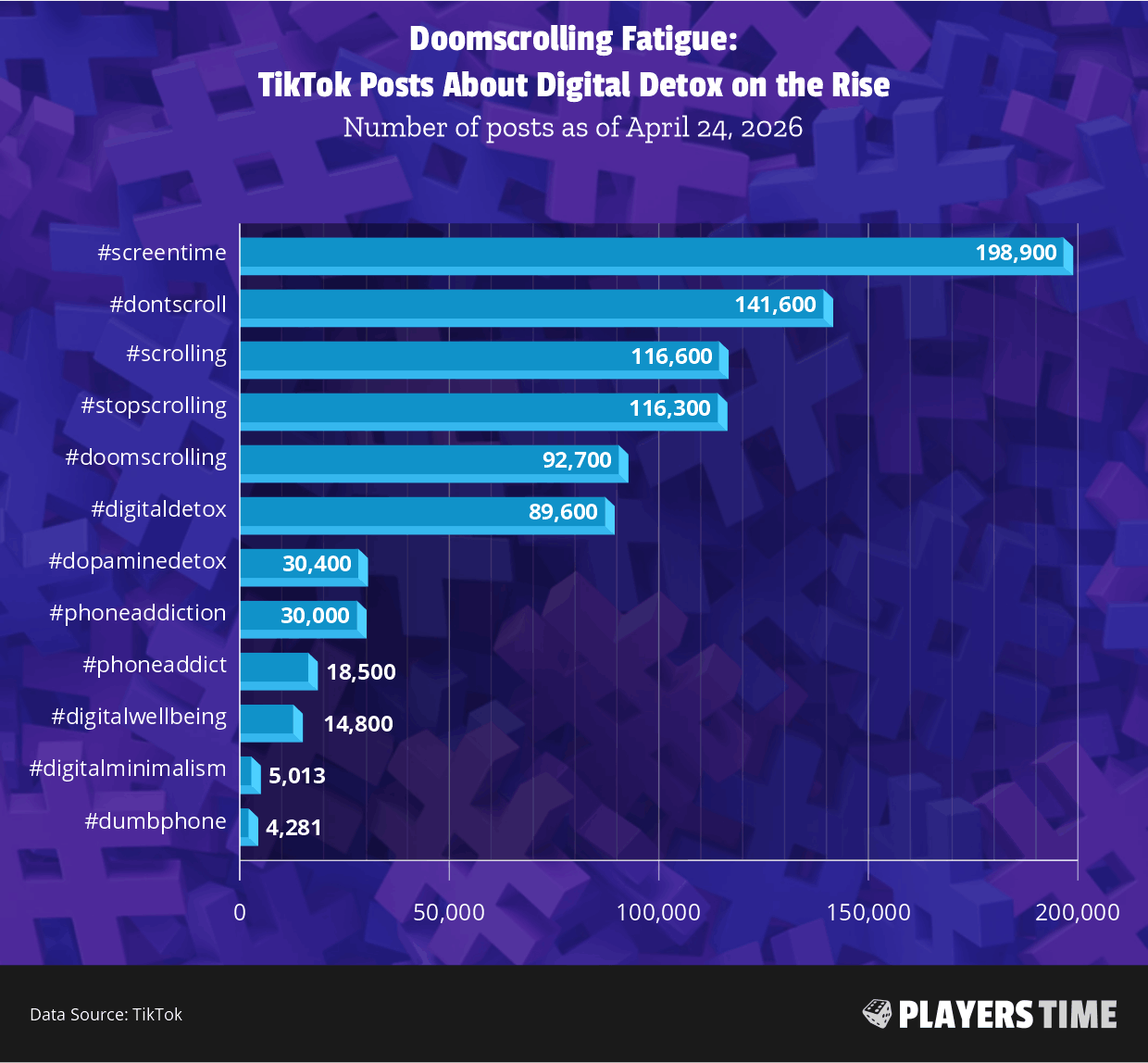
Overwhelmed by a constant flood of digital content after the turbulent events of 2025, people are reaching a turning point – seeking to step back from the digital world. Search trends reflect this shift, with Google and TikTok queries increasingly focusing on terms such as ‘digital detox’, ‘doomscrolling’, and related topics. These phrases act as a mental stop button, signalling that the relentless stream of alarming news has become too heavy to process.
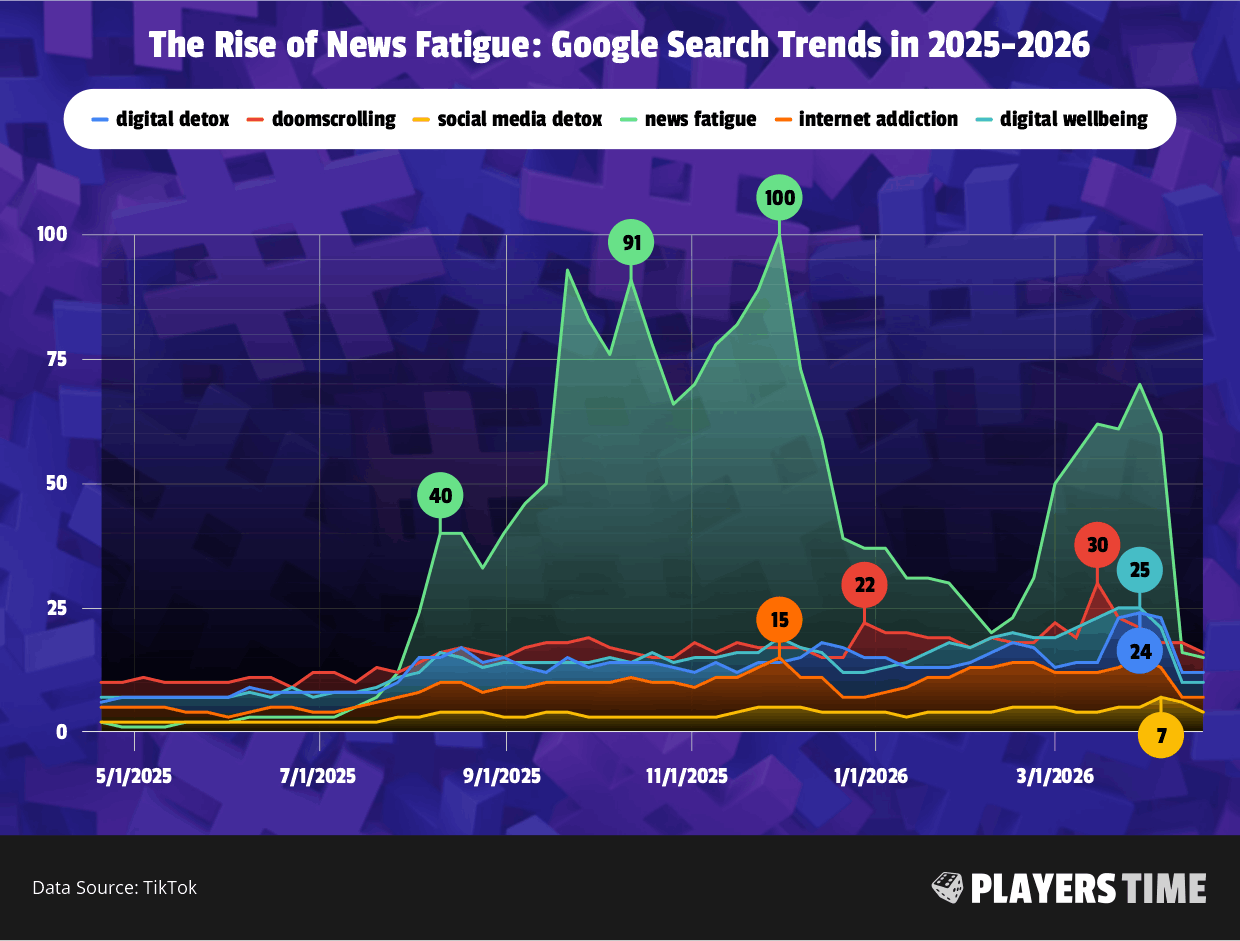
Google search data from late 2025 and early 2026 shows that ‘news fatigue’ reached the highest volume, corresponding with record-high levels of news avoidance: 42% in the U.S. and 46% in the UK.
On TikTok, interest in digital wellbeing is also growing: ‘digital detox’ appears in over 80,000 posts, while ‘digital wellbeing’ features in 13,800 posts, with the trend continuing to expand. Related topics include time limits, screen-time management, and strategies to disconnect from devices.
Experts emphasise reconnecting with nature, replacing fast-paced, overstimulating content with real-life experiences, spending time with friends and family, and engaging in favourite activities – simple but effective steps to promote wellbeing and restore balance.
Methodology
This report examines the growing impact of social media and online content consumption on wellbeing, with a particular focus on patterns of excessive use and emotional strain across different demographics. It explores how digital engagement varies by generation and how these habits are increasingly reflected in levels of fatigue, distraction, and perceived wellbeing.
The team at PlayersTime commissioned MarketsChain to conduct an online survey that captures self-reported behaviour and attitudes toward social media use, doomscrolling, and digital dependency. More than 3,000 people above the age of 18 were approached, of whom 1,509 agreed to participate. The survey was conducted between April 20 and April 25, 2026, with participants asked to share their age and gender and answer 15 questions related to their digital behaviour. Central to the analysis, the poll provides insight into how often users are online, how they feel after prolonged exposure, and how digital habits intersect with work, sleep, and emotional state.
To complement these findings, the report also incorporates external data from Google Trends and TikTok, helping contextualise shifts in search behaviour and public interest in topics such as ‘digital detox’ and ‘doomscrolling’.