

What is to happen to the future of music when a machine can already drop a track, build a fanbase, and cash in like a rising pop star, without ever stepping into a studio? AI-generated music is no longer a futuristic remix of the industry. It’s here, it’s streaming, and it’s starting to look like the next big money move in the digital world.
AI-generated music is creating a new divide in the music industry: on one side are real artists whose work is shaped by years of learning, practice, and creative labour, and on the other are AI-driven creators who can produce music through software-powered systems that lower the barrier to entry. While this shift is already changing what counts as artistic value, it is also opening a more commercial conversation about who benefits financially, how much these songs can earn, and whether the streaming economy is rewarding true musicianship or simply the fastest route to monetizable content.
As AI tools make it easier to produce and distribute songs, the question is no longer just whether a human made it, but what that music is worth. The team at PlayersTime analysed the revenue of AI-generated artists across Spotify and YouTube, using available streaming and audience data to estimate earnings and identify the names turning synthetic music into a measurable business. By also looking at genre patterns and release timing, we aimed to capture not only the financial upside of this trend, but the wider shift it represents for the music industry.
Key Takeaways:
- Top AI artists reach hundreds of millions of streams and generate multi-million dollar earnings, with Mikeeysmind alone surpassing 514.7 million Spotify streams and an estimated $2.06 million in Spotify revenue.
- Estimated earnings of AI-driven music releases total around $7 million on Spotify solely from their top 10 tracks versus $3 million on YouTube across all video uploads.
- The majority of top songs were released in 2025, with several already exceeding tens of millions of streams within a short timeframe, showing how quickly this type of content can generate attention.
The New Music Industry
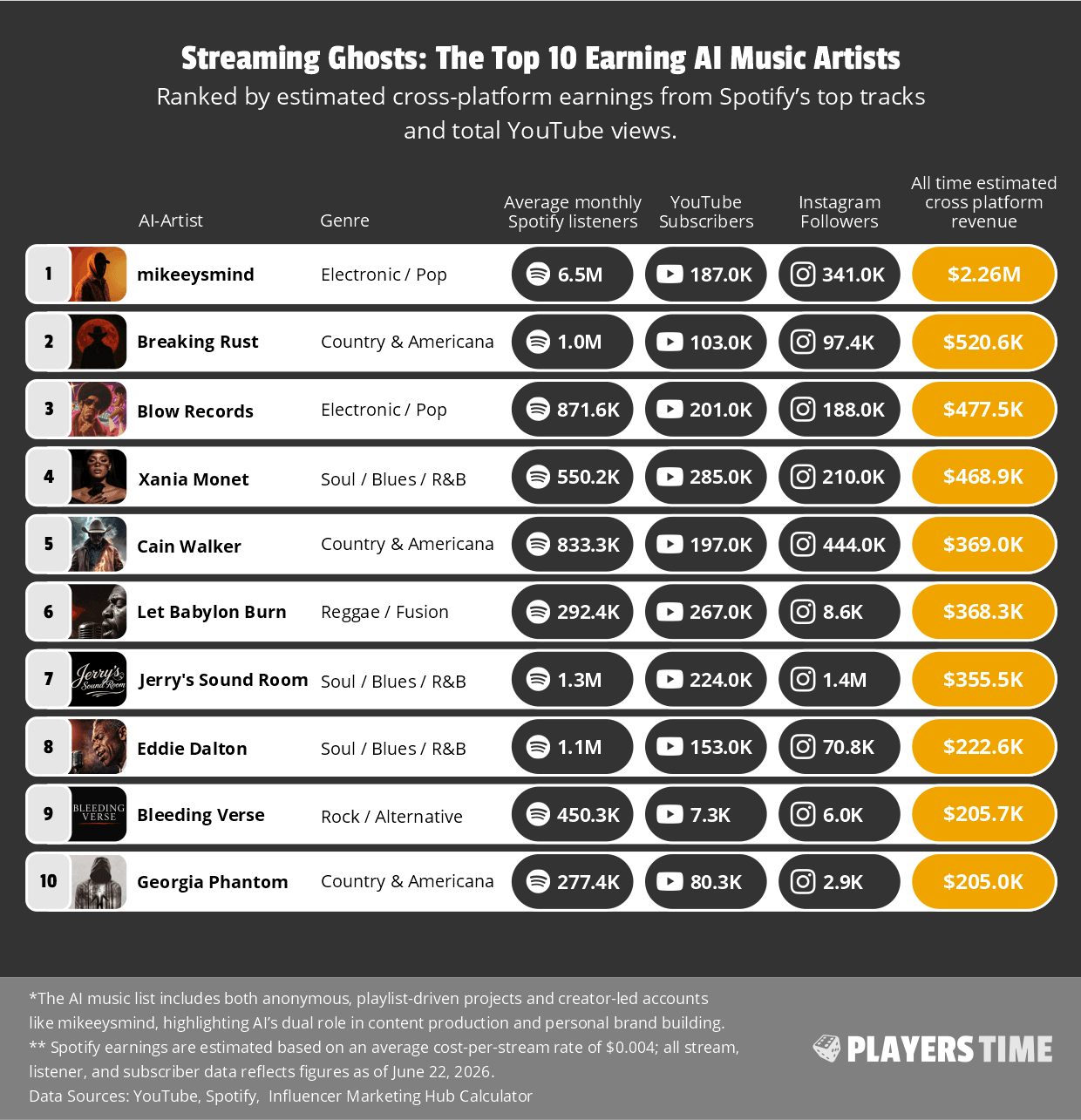
The first wave of AI music is already here. Some of the projects in this space are fully synthetic and keep the identity of the person or team behind them out of sight, while others are more open about the fact that AI plays a central role in the creative process. Together, they show how this new corner of music can operate either as a faceless streaming machine or as a personal brand built in public, adding another layer to the debate over authenticity, authorship, and who gets to claim the spotlight.
Mikeeysmind, the AI music project created by Swedish producer Mikael Daghighi, is the undisputed front-runner, with 6.5 million monthly Spotify listeners, 187,000 YouTube subscribers, 341,000 Instagram followers, and an estimated $2.26 million in cross-platform revenue. Built around a constant stream of genre-blending releases, remix energy, and playlist-ready tracks, it has become a polished internet-native music sensation. Some of his songs have gone even further, surfacing on radio rotations and spreading widely across TikTok and Instagram videos, which only reinforces how far this AI-driven creator has pushed beyond streaming into full-on pop-culture circulation.
Breaking Rust is second on the list, the clearest example of how the AI country genre is turning into a real streaming business, with 1 million average monthly Spotify listeners, 103,000 YouTube subscribers, 97,400 Instagram followers, and estimated all-time cross-platform revenue of $520.613. The project emerged in 2025 and quickly gained attention with the album Resilient and the track ‘Walk My Walk’, which reached the top of Billboard’s Country Digital Song Sales chart, making it one of the most visible AI music breakouts to date. Its cowboy persona, synthetic visuals, and no-verifiable-human-front-footprint identity give it a polished country-star image, but it is entirely built through generative AI tools rather than the traditional musician-to-fan journey.
Rounding out the top three, Blow Records is the more mysterious, algorithm-friendly hitmaker in the ranking, but the revenue numbers are striking: 871.571 average monthly Spotify listeners, 201,000 YouTube subscribers, 188,000 Instagram followers, and an estimated $477.522 in total cross-platform revenue. Online coverage describes Blow Records as an AI-generated entity rather than a traditional label or human artist, with its breakout track ‘Predator de Perereca’ turning into a TikTok-powered sensation and helping push the project to more than 45 million streams in 2025.
The entries beyond the top tier also show that AI music is not locked into one genre or one audience shape. Xania Monet, Cain Walker, Let Babylon Burn, Jerry’s Sound Room, Eddie Dalton, Bleeding Verse, and Georgia Phantom all sit within a revenue band of roughly $205,000 to $369,000, proving that synthetic music can monetise across Soul, Country, Reggae, Electronic, and Rock formats. Together, they suggest that the real business story is not just about who has the biggest following, but about which AI projects can turn platform attention into stable earnings across Spotify and YouTube.
Spotify versus YouTube: Two Engines of Growth
Ranked by Spotify monthly listeners as of June 2026
- mikeeysmindSpotify Debut Year: 2019Streams514.7 MEstimated Revenue$2.06 MMonthly Listeners6,509,487
- Owen JamesSpotify Debut Year: 2026Streams21.3 MEstimated Revenue$85.4 KMonthly Listeners2,043,367
- ZionRaySpotify Debut Year: 2025Streams43.7 MEstimated Revenue$174.3 KMonthly Listeners1,325,073
- Red VillageSpotify Debut Year: 2025Streams32.2 MEstimated Revenue$128.7 KMonthly Listeners1,319,446
- Jerry’s Sound RoomSpotify Debut Year: 2025Streams51 MEstimated Revenue$204 KMonthly Listeners1,290,007
- Broken TrailsSpotify Debut Year: 2025Streams14.8 MEstimated Revenue$56.7 KMonthly Listeners1,270,241
- Eddie DaltonSpotify Debut Year: 2026Streams34 MEstimated Revenue$135.6 KMonthly Listeners1,135,612
- The Naughty JukeboxSpotify Debut Year: 2025Streams20.4 MEstimated Revenue$81.7 KMonthly Listeners1,097,516
- Morgan LunaSpotify Debut Year: 2024Streams12.7 MEstimated Revenue$50.7 KMonthly Listeners1,058,106
- Breaking RustSpotify Debut Year: 2025Streams90.2 MEstimated Revenue$360.6 KMonthly Listeners1,005,686
* Spotify earnings are estimated using an average cost-per-stream rate of $0.004. Stream counts reflect only the top 10 tracks shown, and estimated revenue is calculated solely from these streams.
Data Source: Spotify
All data reflects figures as of 22 June 2026
We looked at the AI accounts pulling the most Spotify attention as of June 2026, showing which names are turning streams into revenue and how far this new wave has already moved from novelty into business. Among the current top performers are mikeeysmind, whose 514.7 million streams from his top 10 tracks have translated into an estimated $2.06 million in Spotify revenue solely from his top 10 most popular hits, followed by Breaking Rust, which has generated 90.2 million streams and about $360,641 since 2025. Other high earners include Jerry’s Sound Room, ZionRay, Red Village, and Eddie Dalton, all of whom have turned strong listener volumes into six-figure earnings within just a few years of activity.
As Spotify tightens its rules around impersonation and fraudulent uploads, the platform is being forced to draw a clearer line between legitimate AI experimentation and deceptive content, while independent projects monitoring AI-generated slop show that the conversation is expanding beyond streaming alone.
Ranked by cumulative YouTube views across each channel
- mikeeysmindYouTube Debut Year: 2023Subscribers187 KEstimated Revenue$207.2 KTotal Views134,893,135
- Let Babylon BurnYouTube Debut Year: 2025Subscribers267 KEstimated Revenue$254.5 KTotal Views123,151,259
- Xania MonetYouTube Debut Year: 2025Subscribers285 KEstimated Revenue$229.1 KTotal Views108,433,524
- Morgan LunaYouTube Debut Year: 2025Subscribers186 KEstimated Revenue$48.7 KTotal Views88,801,185
- Georgia PhantomYouTube Debut Year: 2025Subscribers80.3 KEstimated Revenue$109.3 KTotal Views82,034,882
- Breaking RustYouTube Debut Year: 2025Subscribers103 KEstimated Revenue$160 KTotal Views80,903,627
- Tennessee ReaperYouTube Debut Year: 2024Subscribers107 KEstimated Revenue$150.5 KTotal Views75,592,511
- Jerry’s Sound RoomYouTube Debut Year: 2025Subscribers224 KEstimated Revenue$151.6 KTotal Views69,823,870
- Blow RecordsYouTube Debut Year: 2024Subscribers201 KEstimated Revenue$134.1 KTotal Views61,646,114
- Cain WalkerYouTube Debut Year: 2025Subscribers197 KEstimated Revenue$126 KTotal Views57,457,790
Data Sources: YouTube, Influencer Marketing Hub Calculator
All data reflects figures as of 22 June 2026
If Spotify is where AI music converts attention into revenue, YouTube is where it expands into identity, visibility, and long-term audience growth. The platform operates under its own rules around impersonation, misinformation, and synthetic content, and as AI-generated music becomes more sophisticated and widespread, issues of disclosure, originality, and monetisation are getting harder to overlook. That’s what makes YouTube such a critical space to experience this new wave of content: it prioritises engagement patterns like retention, repeat viewing, and channel momentum, which allow AI projects to evolve from isolated tracks into recognisable digital brands.
At the top rankings of the platform, the data already reflects this dynamic in action. Mikeeysmind emerges as the clear benchmark, leading across nearly every metric and platform. With 134.9 million total views and an estimated $207,235 in YouTube revenue, the project stands out as the strongest AI music presence on the chart, while Let Babylon Burn and Xania Monet both reinforce how quickly AI music can build scale on YouTube. Let Babylon Burn has drawn more than 123 million views and generated an estimated $254,530 in revenue, showing the strength of its audience reach, but Xania Monet is the more recognisable breakout, with 108.4 million views, 285,000 subscribers, and an estimated $229,102 in earnings. Her top-performing song, ‘How Was I Supposed to Know?’, helped push the project into wider attention and made Xania one of the most visible AI-generated names in the current music industry.
Beyond the top tier, a broader group of creators, including Morgan Luna, Georgia Phantom, Breaking Rust, Tennessee Reaper, and Jerry’s Sound Room, demonstrates that this is not an isolated trend.
Where AI Music Earnings Come From
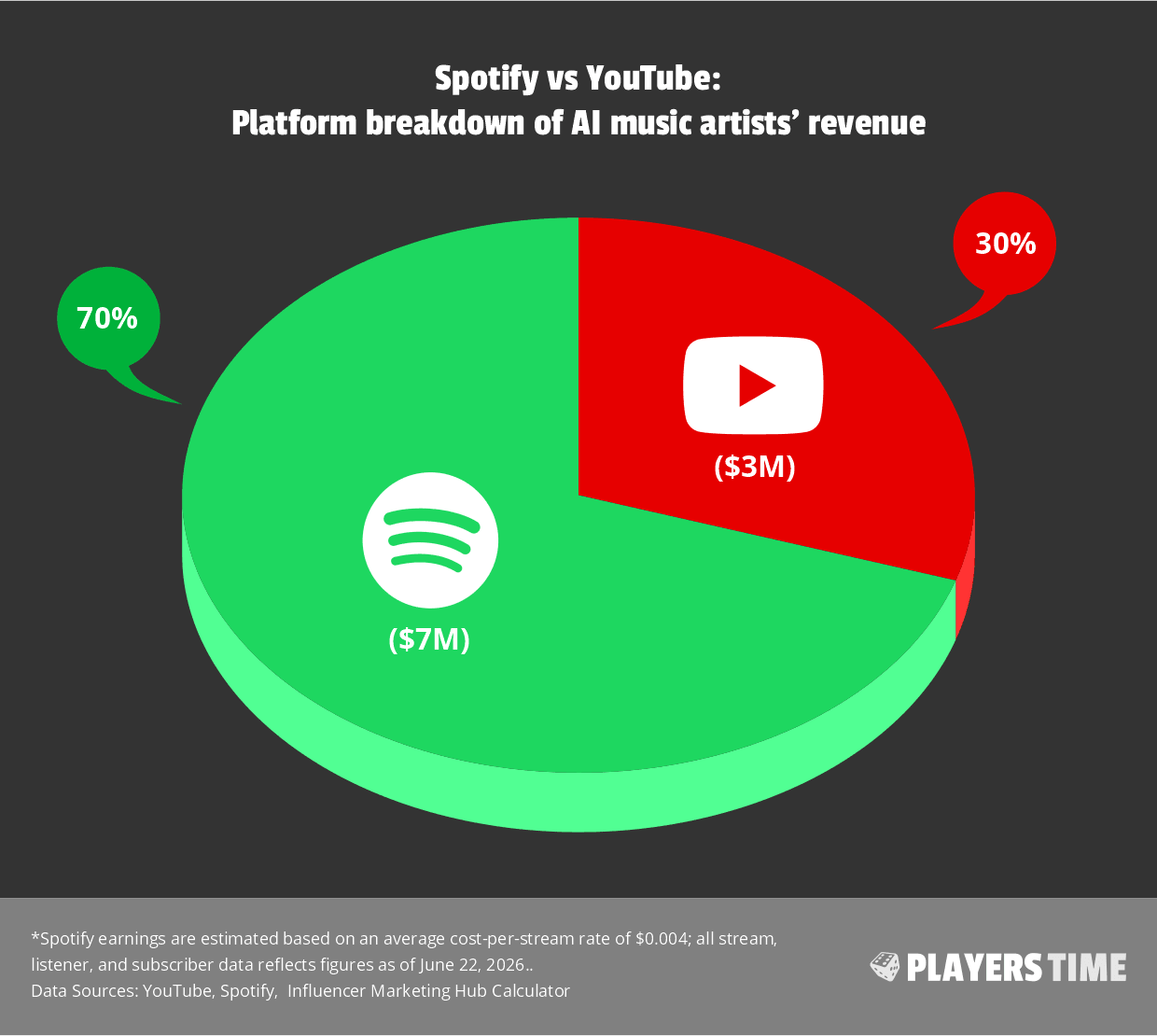
Here is the twist: based on our calculations, there is a surprising gap at the heart of the AI music boom, and it flips the narrative most people expect. While AI artists are blowing up on YouTube, the real money, at least for now, is still coming from Spotify. Our estimates show roughly $7 million in Spotify revenue versus about $3 million from YouTube. It is important to note that Spotify revenue estimates are based solely on the top 10 tracks per artist, whereas YouTube revenue reflects the full performance of each channel’s total video output. As a result, Spotify earnings are likely understated in comparison, and the overall revenue split should be interpreted as directional rather than absolute.
The split reveals how this new wave actually works. YouTube is where AI music goes viral, where channels grow fast, visuals and personas take shape, and projects start to feel like real artists. But Spotify is where those projects convert into consistent income. One platform builds the hype, the other cashes it in.
Behind the scenes, it is all powered by AI songmaking tools like Suno and Udio, making it easier than ever to launch and scale an AI music project. But as the space accelerates, it is also running into a growing legal storm, with major labels pushing back through lawsuits over copyright, training data and artist identity.
AI Music’s Biggest Streaming Hits
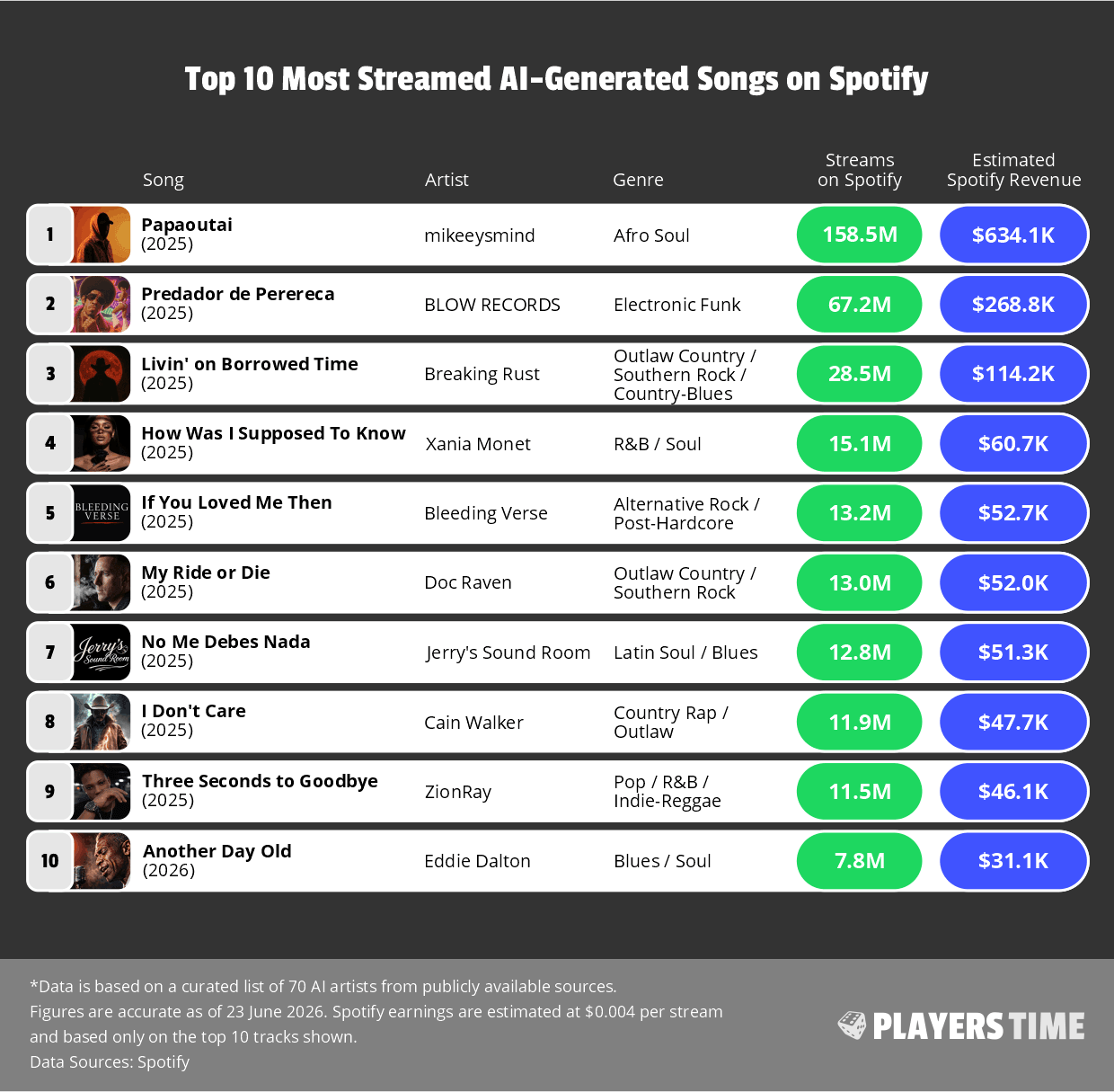
And when you zoom in on the songs themselves, the numbers start to feel even more surreal with AI currently producing full-on hits. Leading the ranking is mikeeysmind’s ‘Papaoutai’, released in 2025, which has raked up a staggering 158.5 million streams on Spotify, translating to an estimated $634,117 in revenue, and firmly establishing itself as the benchmark for AI-generated success.
Beyond this successful hit, BLOW RECORDS’ ‘Predador de Perereca’ (2025), an electronic funk outlier, has already pulled in 67.2 million streams and an estimated $268,806 in revenue, while Breaking Rust’s ‘Livin’ on Borrowed Time’ leans into outlaw country and southern rock to reach 28.5 million streams and over $100,000 in revenue. Across the list, 2025 dominates as the breakout year, with nearly every top-performing track released within the same 12-month window.
What stands out just as much as the numbers is the range. From Xania Monet’s R&B-driven ‘How Was I Supposed To Know’ (15.1 million streams, $60,000 revenue) to Bleeding Verse’s post-hardcore ‘If You Loved Me Then’ (13.2 million streams, $52,689 revenue), followed by Doc Raven’s dark country track Ride or Die’ (13.02 million streams, $52,080 revenue), and Jerry’s Sound Room blending Latin soul and blues on ‘No Me Debes Nada’ (12.8 million stream, $51,339 revenue), AI music isn’t sticking to one universal formula. Even niche hybrids like country rap (Cain Walker’s ‘I Don’t Care’, 11.9M streams) and indie-reggae crossovers (ZionRay’s ‘Three Seconds to Goodbye’, 11.5M streams) are finding sizable audiences.
Looking at newer entries like Eddie Dalton’s ‘Another Day Old’ (2026), already nearing 8 million streams, reinforces the same trend. Success in AI music isn’t isolated, it’s replicable. Across the board, tracks are reaching scale, generating revenue, and sustaining listener interest, pointing to a model that’s quickly moving beyond experimentation.
From Experiment to Ecosystem
AI-generated artists are already pulling in millions of streams and generating real revenue across platforms, suggesting the quiet emergence of a parallel music economy operating inside the mainstream streaming world.
At the same time, listener perception is evolving just as quickly. A recent Deezer and Ipsos survey found that 97% of listeners struggle to reliably distinguish between AI-generated and human-made music in blind tests. Meanwhile, AI-generated content is already accounting for a growing share of new uploads on streaming platforms, outpacing the speed at which industry rules and definitions are being updated.
Together, these trends make one thing clear: AI music is no longer on the edges of the music industry; it’s already part of it. The question now isn’t whether it exists, but how platforms, rights-holders, and audiences decide to make sense of it.
In that sense, the distinction between human and synthetic music is becoming less of an industry question and more of an everyday reality. Whether it’s a café playlist, a beach bar set, or a track playing in the background of a casual moment, AI-generated music is increasingly likely to be part of the soundscape, often without listeners ever actively noticing.
Methodology
This study is based on a manually curated dataset of AI-generated music artists compiled from widely accessible online articles and public sources by the PlayersTime team. From this, a list of 70 AI artists was created. For each artist, key metrics were collected across Spotify and YouTube, including streams, monthly listeners, views, and subscriber counts where available.
Earnings from Spotify were estimated by multiplying streams by $0.004, based on the platform’s reported payout range of $0.003-$0.005 per stream. In addition, YouTube earnings were calculated using the Influencer Marketing Hub Calculator. Artists were then ranked across key performance indicators, and genre classifications were sourced primarily from YouTube channel descriptions, with supplementary online references used when necessary.