
Over the past decade, the superhero movies haven’t just dominated global cinema, they have reshaped it, turning once-niche comic-book adaptations into some of the most lucrative entertainment products in history. With the rise of shared universes, Marvel and DC films have become defining releases of modern cinema, accumulating billions across the box office, streaming platforms, and merchandise. Yet, the landscape is shifting. Production budgets are rising, audience tastes are fragmenting, and global markets are playing an increasingly decisive role in a film’s financial outcome.
This prompted the team from PlayersTime to take a deeper look at how these films actually perform across the world. We analysed the top-grossing Marvel and DC titles released within the last decade by using datasets from Box Office Mojo and The Numbers. We compared production budgets, lifetime revenue, and returns across 84 countries. Using publicly available country population figures, we also calculated box office revenue per capita to uncover where audiences are truly obsessed with superhero movies.
Key takeaways:
- Marvel dominates globally, earning 78.6% of superhero movies box office revenue versus DC’s 21.4%
- Excluding the Domestic Market (North America), China claims the highest overseas box office for all 52 movies at $3.22 billion
- Joker (DC) and Deadpool (Marvel) earned more than ten times their budgets, making them standout high-return hits
Top 10 Countries where superhero movies
have generated the most box office revenue
Based on their gross box office revenue generated from DC and Marvel movies between 2015 and 2025
*Domestic Market includes the USA, Canada, Puerto Rico, and Guam
Data Sources: Box Office Mojo, the-numbers.com, IMDB, Marvel.com
One trend is unmistakably clear: the Domestic Market, comprising the United States, Canada, Puerto Rico, and Guam, remains the main financial engine of superhero cinema. Between 2015 and 2025, it generated more than $11.50 billion in box office revenue for Marvel titles, far surpassing every international territory, and another $3.54 billion for DC films.
China sits firmly as the leading overseas market, contributing $2.66 billion to Marvel’s totals, followed closely by the United Kingdom and South Korea, each delivering over $1 billion over the past decade. Notably, the audience in the UK is the only one in Europe to break into the global top five markets for these films, highlighting its outsized impact compared to much larger population markets.
Across the board, the chart shows how superhero movie genre success now relies on a broad international base rather than a handful of traditional strongholds. Even outside the top markets, the genre performs with striking consistency. Mexico and Brazil, for instance, will soon reach $1 billion in box office revenue for Marvel Studios movies. In France, these films have earned $814.72 million over the past decade, while in Australia, they have grossed $738.47 million. In Germany and Japan, Marvel titles have also attracted huge crowds and ticket revenues of over $500 million.
DC movies follow a similar pattern on a smaller scale, with domestic revenues bringing in $3.54 billion for DC titles, earnings from China coming at $561.65 million, and figures from the UK, South Korea, Mexico, and Brazil totalling $1.30 billion in box office revenue. South Korea, in particular, displays a sharp split in audience preferences: DC titles earned about $186.18 million over the past ten years, compared with $1.11 billion for Marvel releases, about six times more, the largest gap among the top 10 markets.
Box Office Comparison: DC Studios vs. Marvel Studios
Based on the gross box office revenue generated from DC and Marvel movies between 2015 and 2025
Data Sources: Box Office Mojo, the-numbers.com, IMDB, Marvel.com
Our analysis shows that Marvel undeniably crushes the global box office with roughly 78.6% ($4.3 billion) of the total revenue of all 52 superhero movies we looked at, while DC is left with a noticeably smaller share – 21.4% ($15.9 million). This disparity is partly explained by output volume: between 2015 and 2025, Marvel released 33 films compared to DC’s 18, reflecting a deliberate strategy to sustain audience engagement. On at least seven occasions, Marvel even released titles in direct competition with DC releases, consistently outperforming its rival in head-to-head matchups.
Nonetheless, recent DC releases demonstrate the studio’s capacity to make a significant impact. Aquaman proved the power of international appeal back in 2018, while Superman (2025) is currently outperforming Marvel’s Fantastic Four: First Steps (2025) in domestic opening figures and early global grosses. These successes indicate that, although Marvel dominates in scale and consistency, DC can still leverage headline productions to capture audiences’ attention, and make а meaningful impact in the global superhero landscape.
Countries Spending the Most on Superhero Movies Per Capita
Ranked by box office revenue of 52 movies per 1,000 people between 2015 and 2025
*Domestic Market includes the USA, Canada, Puerto Rico, and Guam
**Russia/CIS, Serbia/Montenegro, and South Africa/Nigeria, and Central America are excluded from the map, as the source provides only aggregated totals for these country groups.
Data Sources: Box Office Mojo, the-numbers.com, IMDB, Marvel.com
It is certainly interesting to see where superhero movies make the most money overall, but a more telling sign of people’s devotion to the superhero genre (and for movie theatres as a whole) is the films’ box office revenue per capita. The results prove to be surprising, as Hong Kong rockets to the top with a massive $47,018 in box office revenue per 1,000 people, followed by Iceland, the United States, and Canada, all pulling in well over $38,000 per capita. Australia is not far behind, proving that the superhero hype hits just as hard in the Southern Hemisphere with $37,210 in revenue per 1,000 people. The hotspots on the map reflect the areas where the enthusiasm over superheroes is not just strong – it is blockbuster-level dramatic.
A second wave of high engagement markets stretches across Europe, from the UK and Norway to France and Switzerland, each generating between $14,000 and $27,000 per 1,000 residents. South Korea shines as the biggest superhero movie fan base in Asia with $25,116 spent on Marvel and DC titles per capita, echoing its impressive totals in the earlier chart.
Meanwhile, China appears much less enthusiastic, simply because per capita math favours smaller nations. In reality, China is indeed a cinematic powerhouse with more than 80,000 cinema screens, the most of any country on Earth. Overall, the data shows that per capita hype often peaks outside the world’s largest markets, revealing a cluster of smaller countries where audience engagement is unusually strong.
Top 10 Marvel and DC Movies Ranked by Worldwide Gross (2015-2025)
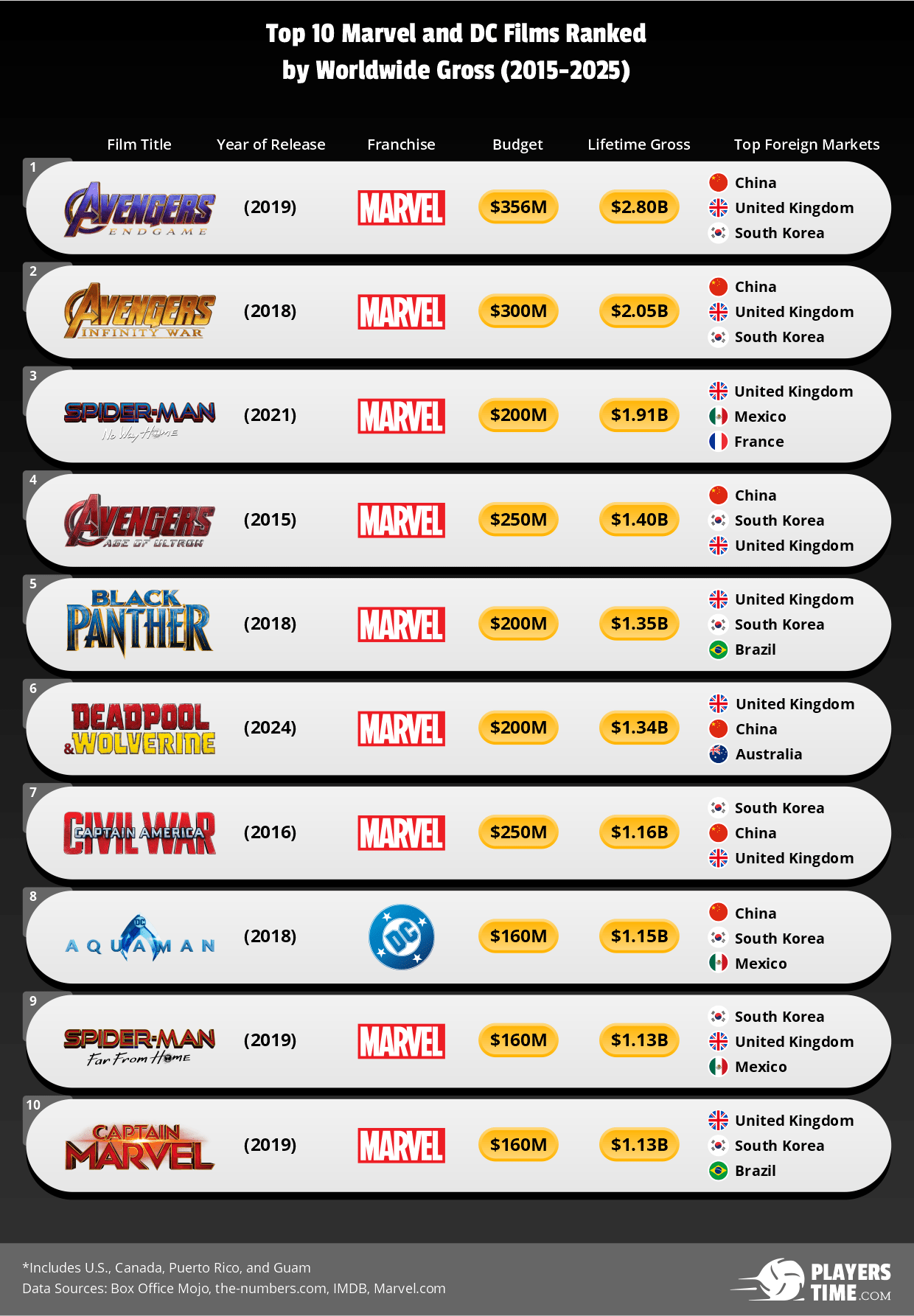
Nine of the ten highest-grossing superhero movies of the past decade are Marvel productions, while the only DC entry in the top ten is Aquaman, which ranks 8th with a lifetime gross of $1.15 billion. Directed by James Wan, Aquaman stood out with its visually spectacular underwater world, charismatic performance by Jason Momoa, and a lighter, adventurous tone that appealed to a wide international audience, despite being unable to reach the astronomical heights of Marvel’s ensemble blockbusters like Avengers: Endgame or Spider-Man: No Way Home,.
Avengers: Endgame remains the highest-grossing superhero film ever, raking in over $2.8 billion worldwide with its emotionally charged, universe-shifting finale. Its predecessor, Infinity War, had already crossed $2 billion, proving audiences crave ambitious, interconnected storytelling with massive ensemble casts. Both titles drew enormous international audiences, with China, the United Kingdom, and South Korea consistently among the top-grossing foreign markets.
Spider-Man: No Way Home follows, surpassing $1.9 billion with its multiverse crossover, blending heart, humour, and nostalgia at a time when theatres were still recovering. The movie performed exceptionally well overseas too, with the United Kingdom, Mexico, and France leading its international revenue, showing that even during a period of reduced theatrical attendance, certain markets remained fiercely engaged with marquee superhero releases.
Meanwhile, Black Panther stands out as a blockbuster whose domestic success exceeded its international performance with its $700 million box office domestic figure. In the United States, it became a cultural milestone powered by massive social momentum and widespread media attention. Overseas, though still successful, it didn’t generate the same level of fervour, highlighting how a film deeply rooted in American cultural themes can resonate differently around the world.
Blockbusters Around the Globe: Top Movies by Country
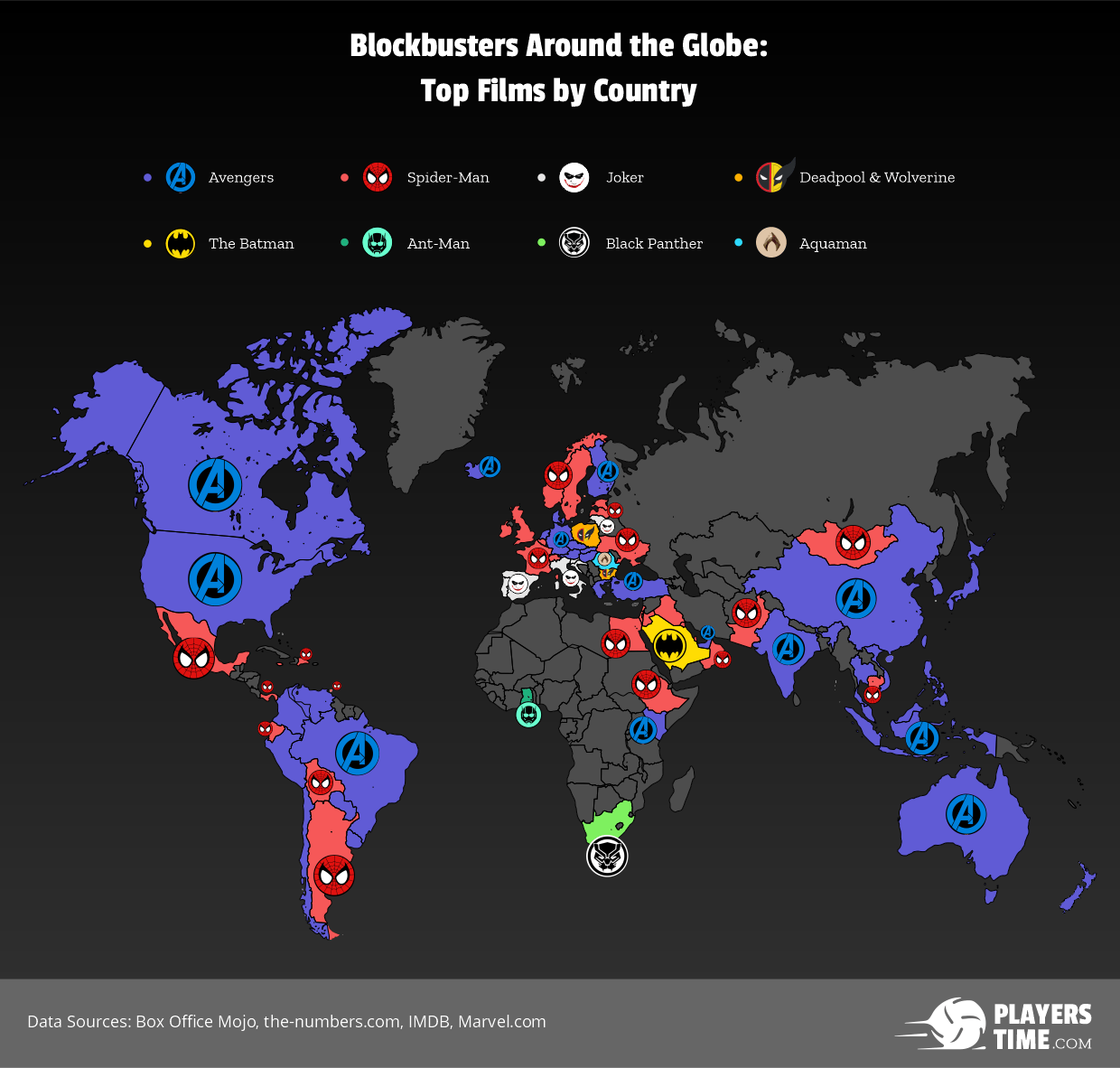
A closer look at the box office data over the past ten years paints a lively, comic book panorama of movie loyalties, showing how far superhero fandom stretches across the globe. The Avengers and Spider-Man both emerge as true global favourites, appearing across continents from Europe to Asia, South Africa to the Pacific, each carving out broad, overlapping territories of devoted fans.
Around them, regional standouts like the Joker in parts of Europe (Spain, Italy, and Portugal), The Batman in Saudi Arabia, and Deadpool & Wolverine in Poland and Bulgaria, add splashes of personality, while Black Panther anchors South Africa with its own cultural resonance.
Rather than crowning a single champion, the map celebrates a world where different heroes lead in different regions, turning global box office preferences into a vibrant mosaic of fandom.
The Movies That Generated the Biggest Profit Relative to Their Budget (2025)
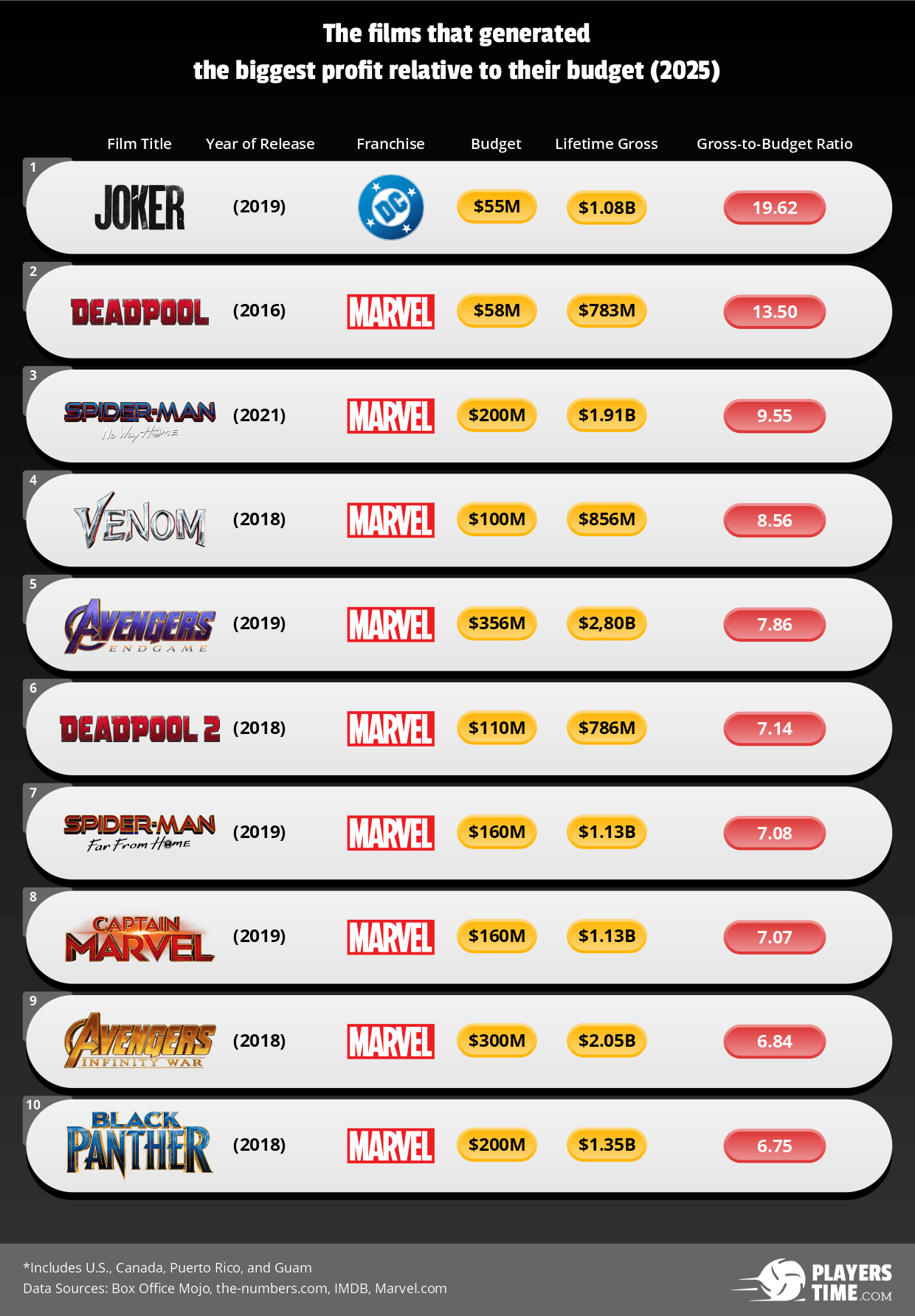
Turning from the audiences to the productions themselves reveals the fascinating mechanics of Hollywood success. Take 2019’s critically acclaimed movie Joker: a modest $55 million budget blossomed into a staggering $1.08 billion global box office, making it the most successful production among those we looked at. Its jaw-dropping budget-to-revenue ratio of nearly 20 demonstrates that bold, character-driven storytelling can deliver massive blockbuster returns. It proves that audiences crave fresh, daring takes on the superhero (and antihero) genre. Joaquin Phoenix’s Oscar-winning performance only highlights the appetite for artistry alongside spectacle.
Deadpool offers another revelation: with a slightly lower budget-to-revenue ratio of 13.5, this edgy, irrelevant antihero adventure, paired with modest spending with massive fan buzz to deliver impressive profit mainly driven by audiences’ taste for wit and originality.
Meanwhile, Marvel’s juggernauts Avengers: Endgame ($356 million) and Spider-Man: No Way Home ($200 million) dominate in sheer scale and global revenue. Yet, even these billion-dollar hits can’t match the profit punch of smaller, smarter-budgeted films, highlighting a key insight: in Hollywood, audacious ideas and clever spending often pay off bigger than raw blockbuster spectacle.
Mapping Modern Fandom
Superhero movies have evolved into a cross-continental passion. While dominating markets like China, the UK, and South Korea deliver massive box office power, the smaller, high-engagement ones (think Hong Kong or Iceland) illuminate the true depth of devotion.
This isn’t just geography, it’s a dynamic map of modern fandom. By connecting with these fervent markets, studios turn superhero movies into both a cultural landmark and a global business victory. Audiences no longer just watch, they help shape which ‘heroes’ rise and reign across the globe.
Methodology:
This analysis draws on multiple authoritative sources to provide a comprehensive view of superhero movies’ performance from 2015 to 2025. Key metrics, including production budgets, lifetime gross box office revenue, release dates, and domestic and international profits were sourced from Box Office Mojo and The Numbers. Franchise classification and verification of Marvel and DC titles were cross-checked using IMDb and Marvel.com.
To assess audience engagement relative to population size, we incorporated country population data from World Population Review to calculate per capita revenue. This approach enables the identification of markets where superhero-themed films generate disproportionately high returns relative to their population, highlighting regions with particularly strong fan engagement and market efficiency.