
Remote work is no longer a niche lifestyle. In recent years, the number of digital nomads has surged, with more than 40 million people worldwide now working while travelling. Armed with a laptop and a reliable Internet connection, these remote professionals are turning cities around the world into temporary bases, swapping traditional offices for cafes, coworking spaces and short-term rentals.
But freedom comes with a big question: where should you actually go? For digital nomads, the best cities tend to offer a careful balance of affordability, safety and quality of life. To find out which European destinations deliver the best value in 2026, the team at PlayersTime analysed the 35 most visited cities on the continent, comparing key everyday expenses such as accommodation, groceries, broadband Internet, and public transport alongside safety levels to identify the places where remote workers can live, work and explore without overspending.
Key insights:
- Central Europe is the sweet spot for digital nomads, with Kraków, Warsaw, Prague and Budapest occupying four of the top five positions, offering an unbeatable mix of affordable accommodation, cheap food, reliable Internet and physical and social safety.
- Dubrovnik ranks as the safest city in our dataset with an 82.23 safety index, while Warsaw has the most affordable monthly expenses for accommodation, food, transport, and Internet, coming at around €1,265.
- The highest monthly expenses are in Dublin (€4,725), Reykjavik (€4,673), and Amsterdam (€4,192).
The Cost of Being Online in European Cities
across the 35 most-visited cities in Europe
Comparison of monthly broadband prices
and average connection speeds (Mbps) ranked by cost.
(€14.92/mo)
(387.7 Mbps)
(€75.84/mo)
Lower Price
Higher Price
Data Sources: Numbeo.com Speedtest.net
Cities in Central and Eastern Europe offer some of the best value for money when it comes to cheap, yet fast and reliable Internet access, combining relatively low monthly broadband prices with competitive connection speeds. Warsaw (€0.06 per Mbps), Kraków (€0.06), and Budapest (€0.07) deliver the lowest cost per Mbps in the dataset while still offering average speeds of over 250 Mbps, comparable to many Western European cities.
By contrast, several Western and Northern European destinations rank among the most expensive in terms of price-per-speed ratio. In Brussels (€0.42 per Mbps), Internet costs per Mbps are around six times higher than in the most affordable cities, while Berlin (€0.40) and Bruges (€0.38) are roughly five to six times more expensive.
The priciest broadband packages overall, however, are in the Icelandic capital of Reykjavik, where, on average, residents pay €74.23/month to be online. The lowest rates (for speeds of 60 Mbps or more) are in Istanbul, just €15.58/month.
Monthly Public Transport Pass Prices in European Cities
across the 35 most-visited cities in Europe
Standard adult monthly transit pass costs (€) across European cities.
Data Sources: Official public transport authority websites for each city; prices converted to euros.
Public transport costs vary dramatically across Europe, with monthly passes in some cities costing more than ten times as much as in others. Prague offers the cheapest monthly pass in the dataset at €22.56, closely followed by Barcelona (€22.80) and Budapest (€23.08), making public transport particularly affordable across parts of Central and Southern Europe.
At the same time, several major Western European capitals are significantly more expensive. London stands out with a monthly pass costing €297.16 for Zones 1-4, more than 13 times the price in Prague, while Amsterdam (€172) and Copenhagen (€136.52) also rank among the priciest cities for everyday commuting.
Safety Levels Across European Cities
across the 35 most-visited cities in Europe
Comparison of safety levels across the most popular European cities.
Data Sources: Numbeo.com
Safety varies widely across Europe’s top destinations, but Dubrovnik stands out with the highest score of 82.23 (according to a Numbeo Safety Index on a 1-100 scale), making it the safest city in our dataset. The Croatian coastal town benefits from very low crime rates, a compact, walkable historic centre, well-lit streets, and a strong community presence, all of which contribute towards a greater security for residents and visitors alike.
By contrast, some large Western European cities score much lower, highlighting a trend where smaller or mid-sized destinations often outperform major metropolises in perceived safety. Dubrovnik’s score is nearly double that of the French city of Lyon, which has the lowest safety levels on our list at just 40.87.
Airbnb Nightly Rates Across Europe
across the 35 most-visited cities in Europe
Estimated monthly cost based on average nightly room rates (€)
Data Sources: Airbnb
The price comparison of city stays across Europe tells an interesting story of demand, tourism, and local lifestyle. Central European cities like Prague and Warsaw remain gems for digital nomads, with room costs averaging €35/night, offering historic charm and modern comforts at bargain prices.
Meanwhile, in Western and Northern Europe, prices skyrocket, with Dublin and Reykjavik leading the ranking for most expensive accommodation with over €4,000 per month. Reykjavik’s premium (€138/night) reflects its small size, booming tourism, high standard of living, and a limited number of centrally located apartments. Amsterdam (€124/night) and Paris (€117/night) also stand out, where old city layouts, high international demand, and strict housing regulations push short-term rental prices to sky-high levels.
Interestingly, some Southern European cities, like Lisbon and Seville, offer a sweet spot of charming neighbourhoods and affordable Airbnb stays for just around €1,500 per month. The appealing outdoor style, from waterfront strolls in Lisbon to the orange tree-lined plazas of Seville, makes everyday life more enjoyable, creating a closer connection to the outdoors alongside affordable living and solid infrastructure.
Grocery Costs Across European Cities
across the 35 most-visited cities in Europe
Based on average cost (€) of standardised shopping bag containing commonly available groceries across the selected cities.
Data Sources: Numbeo.com
Everyday food prices remain one of the strongest indicators of value for remote workers, especially when viewed on a monthly basis. For this reason, we checked the average prices of several types of food, placing them in a virtual basket aimed at displaying a typical monthly consumption for a single person. Our shopping basket includes common everyday groceries, from fresh produce and dairy to meat and staple items, essentially what a digital nomad might buy to cook meals for a week, scaled to reflect typical monthly spending.
Our comparison shows that Eastern and Central European cities such as Istanbul and Kraków offer some of the lowest monthly grocery costs in the ranking, fitting into a budget of up to €150, reflecting a broader pattern where groceries in this part of the continent can be more than 50% cheaper than in more expensive cities like Paris or Copenhagen.
Following the upward trend in Western and Northern Europe, cities like Milan (€291.36), Nice (€305.72), and Reykjavik (€387.84) top the list for grocery costs, with standard shopping bags running €40-€50 higher than in more affordable destinations. This is consistent with broader price data showing that food and everyday consumer goods in these regions generally run above the European average, due in part to higher labour costs and living standards. Note that these are the costs for just a handful of grocery items rather than an exact representation of monthly food consumption.
Europe’s Best Cities for Digital Nomads in 2026
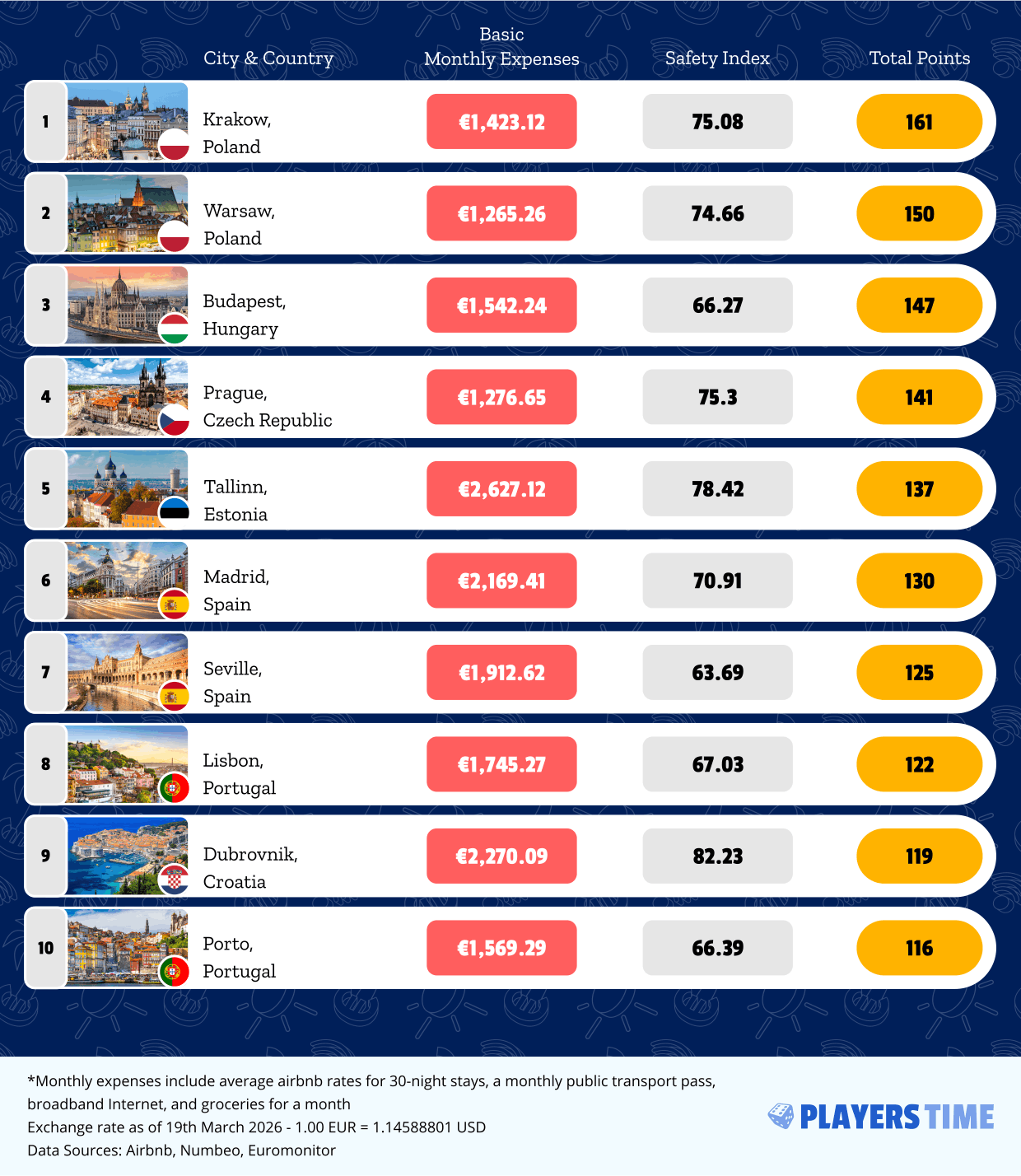
For the cost-related categories, cities were given from 1 to 35 points, with cheaper cities receiving more points and expensive cities receiving fewer points. Safety was scored in reverse, with safer cities earning more points. Internet performance was assessed by combining both price and speed, with each city receiving a combined score from 1 to 35 based on its average ranking across these two metrics. The category scores were then summed to produce a total score for each city, ranging from a minimum of 5 to a maximum of 175 points.
Kraków, Poland
Kraków tops our 2026 ranking of the best cities for digital nomads in Europe with 161 points in total, emerging as one of the strongest value-for-money destinations in the entire ranking. The Polish city combines relatively low accommodation prices, inexpensive Internet packages and the lowest food costs among the cities in the top 10, with our grocery basket coming at just €148.48/month.
Accommodation in Kraków remains accessible compared to many major European destinations, with an Airbnb room averaging €1,228 per month, while Internet packages cost around €16.16 per month. Public transport is also affordable at roughly €30.55 for a monthly pass, keeping the city’s combined costs at a competitive €1,423.12.
Beyond the numbers, Kraków offers something many digital nomads look for: a walkable historic centre, vibrant café culture and a growing tech and startup scene. With a safety score of 75.08, the city blends medieval charm with modern convenience, making it an increasingly attractive base for remote workers.
Warsaw, Poland
Warsaw sits second on our ranking with a total score of 150 out of 175, standing out for its affordability, particularly when it comes to everyday living costs. For digital nomads watching their budgets, Warsaw performs particularly well when it comes to food and connectivity. The cost of our grocery basket comes to €156.04/month, one of the lowest figures among all cities analysed, while broadband costs just €15.89 per month.
Public transport is slightly pricier than in some neighbouring Central European cities, with a monthly pass costing €42.30, but the city compensates with strong infrastructure and a solid safety score of 74.66. Add a growing startup ecosystem, modern cafés and plenty of coworking spaces, and Warsaw increasingly feels like a low-key digital nomad hotpot where remote workers can stay productive without paying Western European prices.
Budapest, Hungary
Budapest takes the third position with 147 points, offering digital nomads a smart mix of affordability, convenience and lifestyle perks. With a combined cost of €1,542.24/month across accommodation, food, Internet and transport, it remains one of the most affordable cities in the top 10. Public transport offers particularly good value, costing just €23.08 per month, while broadband packages average €19.09, keeping connectivity costs low for remote workers.
Location is another bonus. Sitting in the heart of Central Europe, Budapest is perfectly placed for quick weekend getaways to Vienna, Prague, Bratislava or Kraków. Combine that with its lively social scene, affordable eats, and historic charm, and it is clear why Budapest is a low-cost, high-style hub for digital nomads.
Prague, Czech Republic
Prague follows closely behind, ranking fourth with 141 points, thanks to its sweet spot between affordability, safety, and infrastructure. With combined costs for Airbnb (€35/night), groceries, Internet, and transport (€22.56/month) totalling €1,276.65, the Czech capital remains one of Europe’s most budget-friendly hubs for digital nomads. The city’s safety score of 75.3 and reliable broadband make it easy to work remotely, while its 7.5 million annual visitors show it is a proven tourist hotspot.
Tallinn, Estonia
Tallinn ranks fifth, showing that a smaller city can punch above its weight: while accommodation is on the pricier side at €2,413.45 per month, the city compensates with a high safety score (78.42), reliable Internet, and a well-developed tech ecosystem.
Estonia is a pioneer in remote work policies, having launched one of the first digital nomad visas and the innovative e-Residency program, which allows global professionals to run EU-based businesses entirely online. Nearly all government services are digital, making life seamless for newcomers and giving remote workers a rare blend of flexibility and convenience.
Tallinn also offers a thriving coworking and café culture, from modern hubs to creative spaces like Teliskivi Creative City. Add in the charm of its UNESCO-listed Old Town and vibrant startup scene, and it’s clear why the city combines productivity, lifestyle, and connectivity, a perfect base for those working while exploring Europe.
Madrid, Spain
Madrid lands at number six with 130 points, showing that a city doesn’t need to be cheap to win over digital nomads; it is about Latin vibe, connectivity, and lifestyle. With estimated combined costs of €2,169.41, accommodation averages €63.14 per night, and public transport is highly efficient at €32.70 per month, making it easy to get around the city without breaking the bank.
Connectivity extends beyond the office. High-speed Internet, one of Europe’s best public transport systems, and easy flights via Madrid-Barajas Airport make the city a hub for exploration. Combined with a strong safety score of 70.91 and a growing international community, Madrid offers the perfect mix of culture, convenience, and social life for digital nomads seeking a European base.
Seville, Spain
Seville scores 125 points, making it Europe’s second most appealing Spanish city within this ranking. Airbnb rooms average €1,658.28/month, while a monthly public transport pass costs €35.30, keeping day-to-day living affordable as you explore the city’s vibrant streets.
Food costs remain moderate too at €187.28 a month, bringing Seville’s combined cost indicators to €1,912.62. The Spanish gem records a safety score of 63.69, helping it maintain a competitive balance between affordability and quality of life. As the capital of Andalusia, the city attracts remote workers looking for a warmer climate and historic surroundings without the higher costs often associated with larger Spanish destinations.
Lisbon, Portugal
Lisbon, one of the last entries in the ranking with 122 points out of 175, maintains its reputation as one of Europe’s favourite hubs for remote workers. While the Portuguese capital attracts millions of visitors every year, costs remain relatively manageable compared with many Western European cities. An Airbnb room averages €1,497.93/month, while a monthly public transport pass costs around €40, helping keep everyday expenses within reach for digital nomads settling in for a longer stay.
Beyond the numbers, Lisbon offers a lifestyle that is hard to replicate elsewhere in Europe. With its mild climate, walkable hills, ocean views and thriving international community, the city has become a natural meeting point for digital nomads from around the world. Combined with a safety score of 67.03, Lisbon manages to blend affordability, atmosphere and accessibility into a destination that remains firmly on the digital nomad map.
Dubrovnik, Croatia
Dubrovnik ranks ninth overall, standing out as the safest city in the entire dataset with a safety score of 82.23. External studies have even named it one of the safest destinations in Europe, thanks to exceptionally low crime levels and minimal growth in crime rates in recent years. The city’s compact historic centre, strong community presence and visible security in tourist areas all contribute to this reputation. Visitors often report feeling comfortable walking through Dubrovnik’s marble streets and historic squares even late at night. Not to mention the size of the city likely contributes to its overall safety and supportive, closely-knit community: Dubrovnik’s population is just over 40,000, making it the smallest entry on our list.
However, the city’s popularity comes at a price. Accommodation averages €2,020.34/month, one of the highest figures among the top-ranked cities. Still, relatively moderate food costs and transport prices keep Dubrovnik competitive overall, particularly for digital nomads who prioritise safety and lifestyle alongside affordability.
Porto, Portugal
Porto, closing out the top 10, may not draw the same crowds as Lisbon, but this slightly gritty yet charming city is carving out a niche for digital nomads. Airbnb rooms average the modest €1,309.66/month, a monthly transport pass around €60, and monthly groceries hover near €165.92, keeping everyday living costs very manageable. Internet sits at €33 per month, ensuring smooth remote work from the city’s riverside cafés and creative hubs.
Methodology
To identify the best European cities for digital nomads in 2026, our team at PlayersTime analysed 35 of the most visited cities in Europe, based on tourism data from Euromonitor International. Each city was evaluated across several key factors that are particularly relevant for remote workers: accommodation, food, costs, Internet prices, public transport and safety.
Accommodation prices were sourced from Airbnb, where listings were filtered to private rooms. We calculated the average nightly rate from a sample of 30 listings in each city, then multiplied by 30 days to reflect a monthly accommodation cost.
Food costs, broadband costs and safety scores were derived from Numbeo, while Internet speed data was taken from Speedtest.net. Public transport prices were collected from the official websites of city transport operators and reflect the average cost of a standard monthly transit pass. In cases where transport prices were listed in local currencies, these were converted to euros using the exchange rate as of 11 March 2026 to ensure consistency across all cities. Additionally, where multiple zoning options were available for monthly passes, a mid-range zone option was selected to provide a balanced and comparable estimate, avoiding both the lowest price (limited zones) and full-network pricing.
To compare everyday grocery expenses, we also created a standardised grocery basket using Numbeo data (average prices from thousands of users over the past year). The basket includes common items that are widely available across European supermarkets, with amounts estimated per week:
- Bread – 2 loaves
- Local cheese (1kg)
- Milk (1 liter)
- Eggs (1 dozen)
- Boneless chicken breast (2 kg)
- Apples (1 kg)
- Bananas (1 kg)
- Oranges (1 kg)
- Tomatoes (1 kg)
- Potatoes (1 kg)
- Onions (1 kg)
- White Rice (1 kg)
Each city received points for every category based on its relative performance within the dataset, with lower costs and higher safety levels translating into higher scores. These scores were then combined to produce the final ranking of Europe’s best cities for digital nomads in 2026.