
In 2026, a destination’s global appeal is shaped less by guidebooks and more by how often it appears on feeds, in searches, and in the constant circulation of images online. When a single influencer post sent thousands of visitors to a Mallorcan cove built for a hundred, or turned Hallstatt, a village of 780 people, into a daily stop for tour buses full of photographers, it became clear that Instagram had quietly rewritten the rules of what makes a place desirable.
With billions of users scrolling daily and nearly half of travellers reporting that destinations fail to live up to what they saw online, the global visibility has never been more consequential or competitive. To map who wins the attention race, the team at Players Time developed a bespoke Instagrammability Score, combining search demand with hashtag volume across Instagram and TikTok to rank the world’s most digitally visible destinations.
Key Takeaways:
- With an Instagrammability score of 100, Dubai tops the ranking of the most photographed cities in the world. It has been tagged 147 million times on Instagram and more than 43 million times on TikTok.
- Barcelona records 97 million tagged posts alongside 23 million monthly global Google searches, nearly seven times the search demand of Dubai. No other city in the dataset comes close, making Barcelona the most actively searched destination.
- Burj Khalifa is the most tagged (10.1 million posts) and most searched landmark on the Internet, with over 1.1 million monthly Google searches, more than double the Eiffel Tower (662,000) and ahead of the Grand Canyon (696,000).
Burj Khalifa: The Most Viral Landmark in 2026
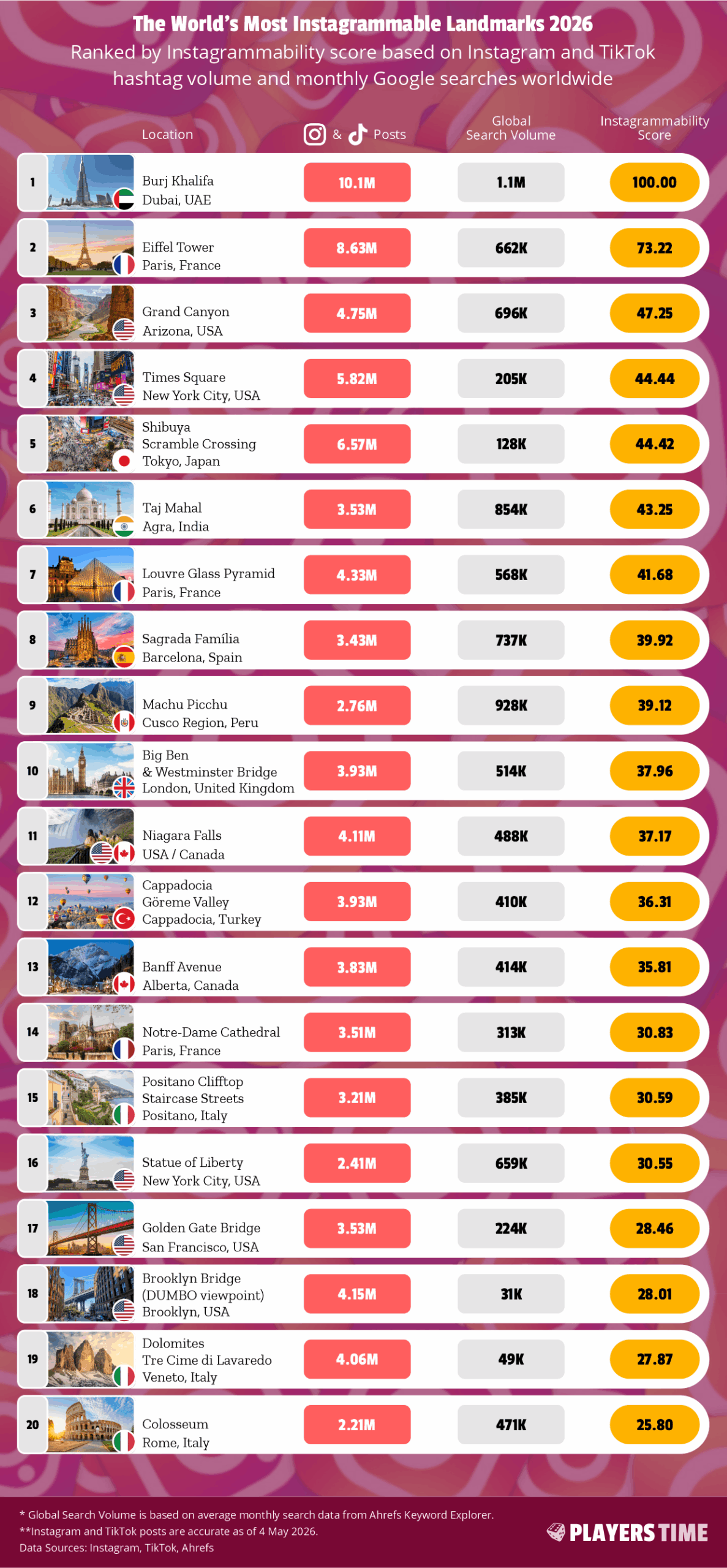
At the top of the 2026 global landmarks ranking sits the Burj Khalifa, not an ancient wonder or centuries-old monument, but a modern building completed in 2010 that has managed to outphotograph everything else on Earth. With a score of 100, over 10 million tagged posts, and 1.1 million monthly searches, the 828-metre tower redefined vertical construction and became the world’s most Instagrammable landmark in the same way Dubai became a global tourist destination: by building something the world had never seen before. The Eiffel Tower follows in second place with an Instagrammability score of 73.22, a result that will surprise no one, but whose consistency across both social media and search reflects the endurance of certain global icons.
Beyond the top two, the ranking reveals a more layered geography of attention. Europe accounts for 8 of the top 20 landmarks, making it the most heavily represented region in our ranking, with places such as the Sagrada Família and the Colosseum reflecting this strong presence through search volumes ranging from around 313,000 to 737,000 monthly queries and millions of social media posts. Meanwhile, the Taj Mahal and Machu Picchu rank even higher, with search interest between roughly 854,000 and 928,000 and similarly strong engagement across social platforms, showing how both cultural heritage and digital popularity converge at scale.
Some places earn their position not through outstanding architecture or cultural significance, but through experience alone. At Tokyo’s Shibuya Scramble Crossing, with up to 3,000 people crossing at once, the experience is the landmark, generating over 6.57 million posts from within the flow itself. New York’s Times Square operates in much the same way, an environment rather than a destination, producing 5.82 million posts from a space so visually intense that putting out your camera becomes instinct.
Perhaps the most revealing detail in the ranking is the Brooklyn Bridge’s DUMBO viewpoint, which has generated over 4 million posts on Instagram alone despite modest search demand. It is less a planned destination than a passing moment, one people photograph almost reflexively, adding to a figure that keeps rising regardless.
What Drives Instagrammability Across Cities
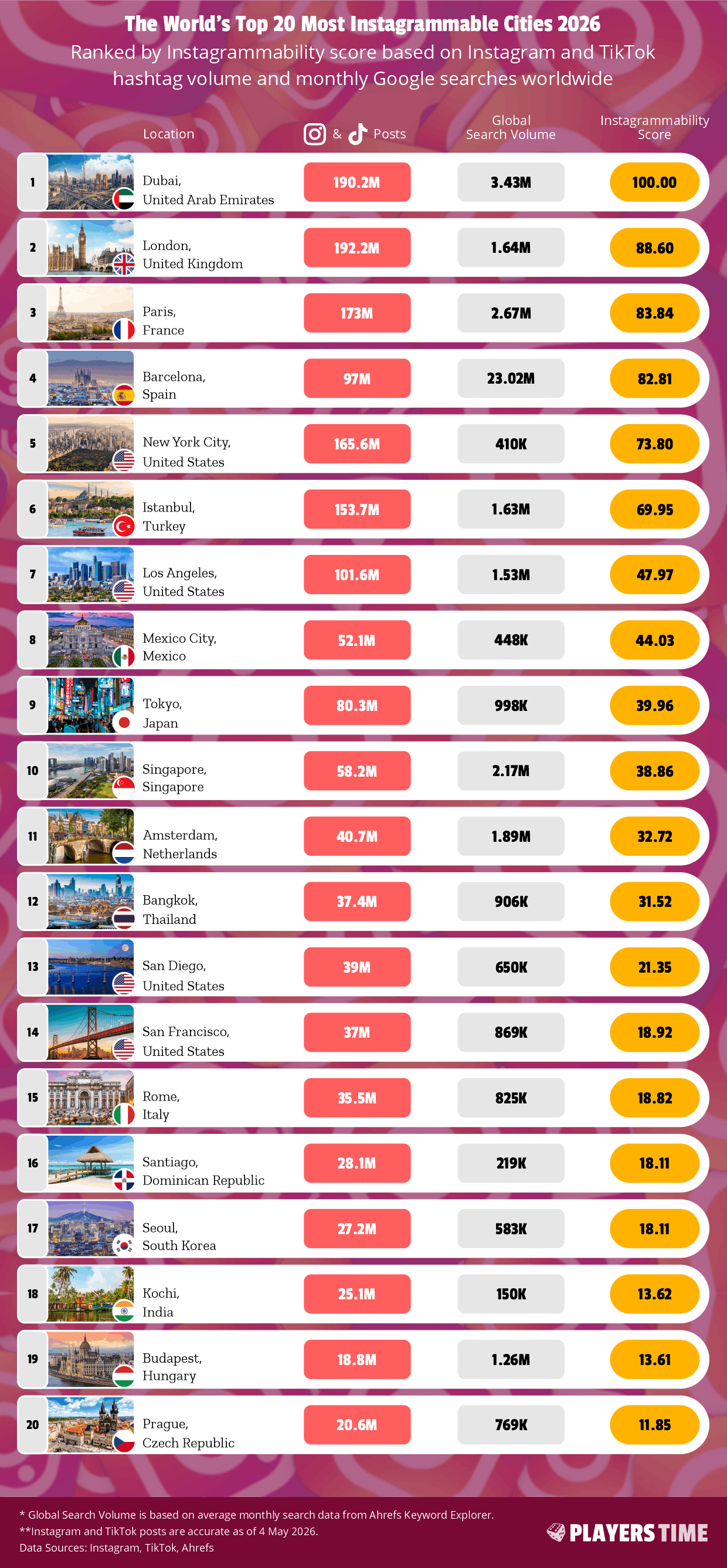
Urban destinations dominate the 2026 Instagrammability ranking, where cities operate less as individual landmarks and more as complete visual ecosystems shaped by density, lifestyle, and scale. At the top, Dubai leads with a score of 100, supported by over 190 million Instagram and TikTok posts and 3.43 million monthly searches, positioning it as the global reference point for luxury-driven travel content.
London and Paris follow closely, reinforcing the continued dominance of established global capitals. London records the highest hashtag volume with 192.2 million posts, while Paris maintains a strong balance between social visibility and consistent search demand. Barcelona, meanwhile, stands out with 97 million posts and 23 million monthly Google searches, a combination that reflects something deeper than tourism, a city that has become one of the defining travel obsessions of the moment. New York City also ranks among the top performers, with 165.6 million posts highlighting its enduring presence across platforms.
Beyond the leading group, the ranking reveals a strong European concentration, but also a number of less expected entries. Cities like Istanbul continue to perform at scale, with 153.7 million posts, yet others, including places like San Diego, Santiago, or Kochi, appear despite having a far lower global profile. This points to a clear disconnect between recognition and visibility. Instagrammability is not limited to the most famous cities, but extends to places that perform strongly on visual platforms, regardless of how widely known they are.
Hidden Wonders: The Most Instagrammed Offbeat Destinations
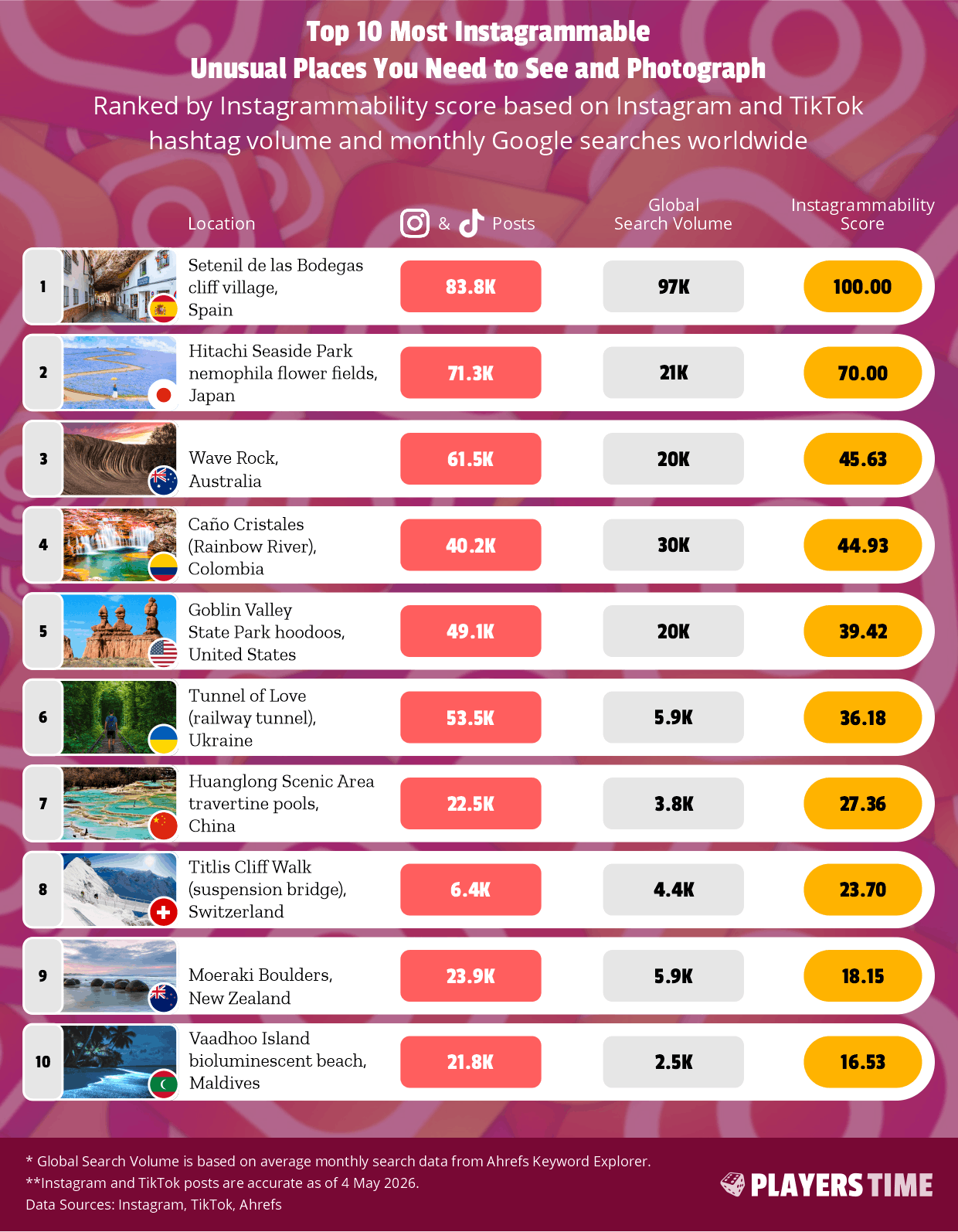
The top spot in the world’s most Instagrammable unusual places in 2026 belongs to Setenil de las Bodegas, a small Spanish town where, for centuries, houses have been built directly into overhanging rock faces, creating surreal streetscapes, that appear as if they were made up inside someone’s mind rather than real. Its score of 100 reflects a rare balance: enough people searching for it to signal genuine global curiosity, and enough tagged content to confirm it delivers on the visual promise.
Japan’s Hitachi Seaside Park takes second place on the strength of something as simple, and as fleeting, as flowers. Every spring, its hills turn an almost unreal shade of blue as millions of nemophila blooms open simultaneously, producing images so saturated they routinely get mistaken for digital edits. With just 21,000 monthly searches on Google, it remains relatively undiscovered outside Asia, which may not last much longer.
Wave Rock in Australia and Cano Cristales in Colombia, a river that runs simultaneously red, yellow, green and blue during its seasonal peak, round out the top four, demonstrating how geological oddities translate directly into social media staying power. Goblin Valley in Utah follows closely, its hoodoo-covered terrain generating nearly 50,000 tagged posts despite modest global search interest, while Ukraine’s Tunnel of Love, a railway line swallowed entirely by arching trees, sustains a quietly devoted following with 53,500 posts and just 5,900 monthly searches.
China’s Huanglong Scenic Area, with its vivid travertine pools cascading across a mountain valley, and Switzerland’s Titlis Cliff Walk, Europe’s highest suspension bridge, occupy the lower-middle of the ranking, both generating limited search volume but retaining strong niche visual appeal. At the foot of the table, New Zealand’s Moeraki Boulders and the bioluminescent beach of Vaadhoo Island in the Maldives close out the list.
Mapping Global Instagrammability
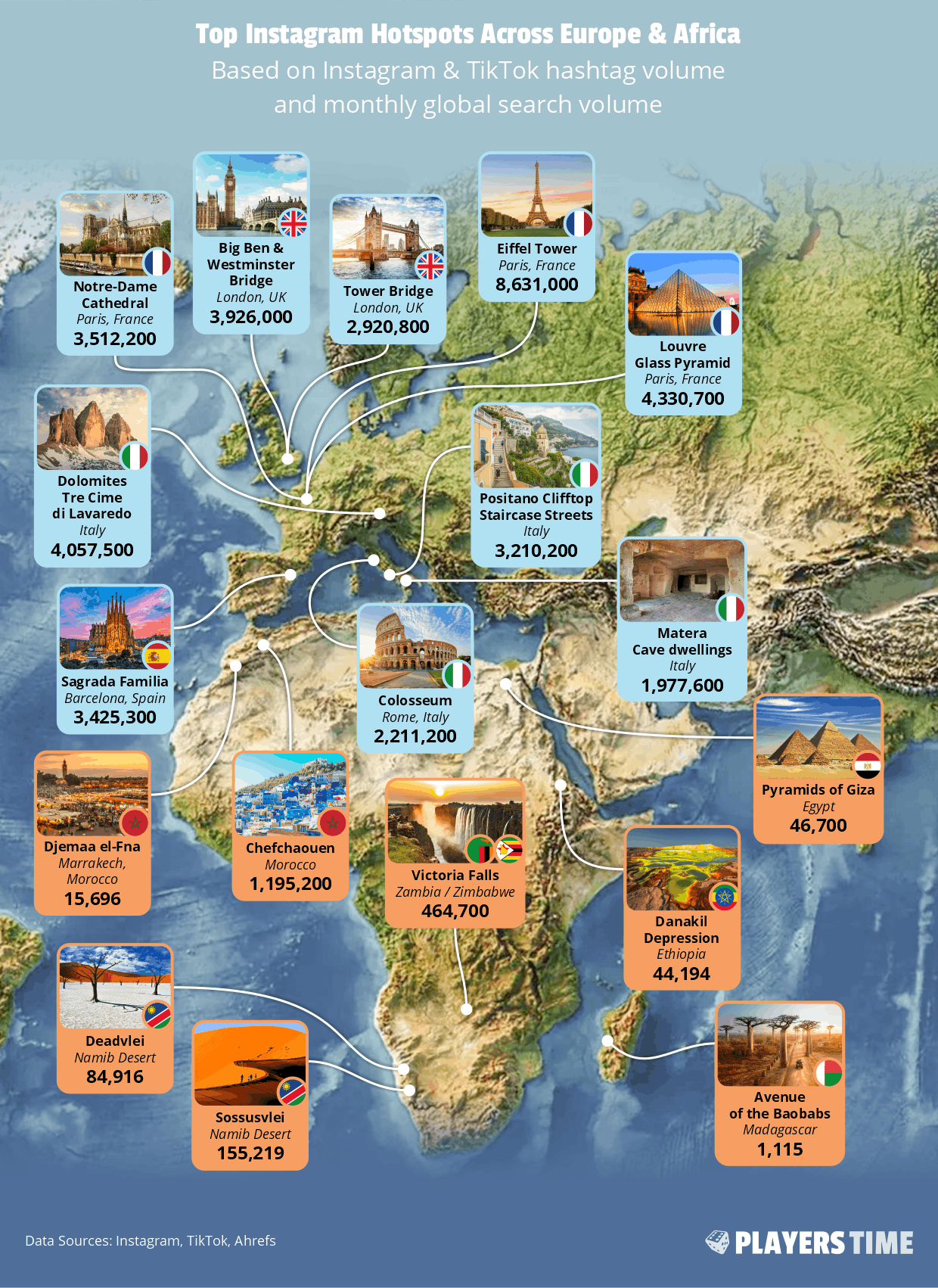
While Europe and Africa are presented together, a clear contrast emerges in the distribution of Instagrammable landmarks.
Europe features a high concentration of the world’s most photographed cities and landmarks, with several locations ranking among the global leaders. The ever-popular and romantic Eiffel Tower takes second position in the global landmarks ranking overall behind only Burj Khalifa, with an Instagrammability score of 73.22. It has generated 8.63 million posts on social media and is responsible for over 660,000 monthly searches; it has been the most photographed monument in the world for decades, and nothing in this data suggests that is changing anytime soon. Paris dominates the regional ranking, placing three entries in the top ten, including the Louvre Glass Pyramid and Notre-Dame Cathedral, which reopened in December 2024 after five years of restoration and has quickly re-established its strong presence across social media platforms.
Barcelona’s Sagrada Família, still under construction after more than 140 years, draws more monthly searches (737,000) than any other landmark in the region, a unique form of visibility driven as much by anticipation as by experience. Italy, meanwhile, offers one of the study’s clearest internal contrasts: the Dolomites have generated over 4 million tagged posts despite comparatively low search demand.
Africa’s relationship with the camera is more complex, a contrast captured in the rise of Chefchaouen, which leads the continent, a blue-painted hillside town in northern Morocco that was never built for tourism yet has become one of the most recognisable streetscapes on Instagram with almost 1.2 million posts. Elsewhere, visually striking natural landmarks such as Victoria Falls and Namibia’s desert landscapes, including Sossusvlei and Deadvlei, also attract strong levels of engagement, though at a smaller scale. Meanwhile, the Pyramids of Giza, one of the most significant structures ever built by human hands, instantly recognisable to billions of people, generate comparatively little social media buzz, with just 46,700 posts across Instagram and TikTok, trailing well behind the Moroccan alleyway.
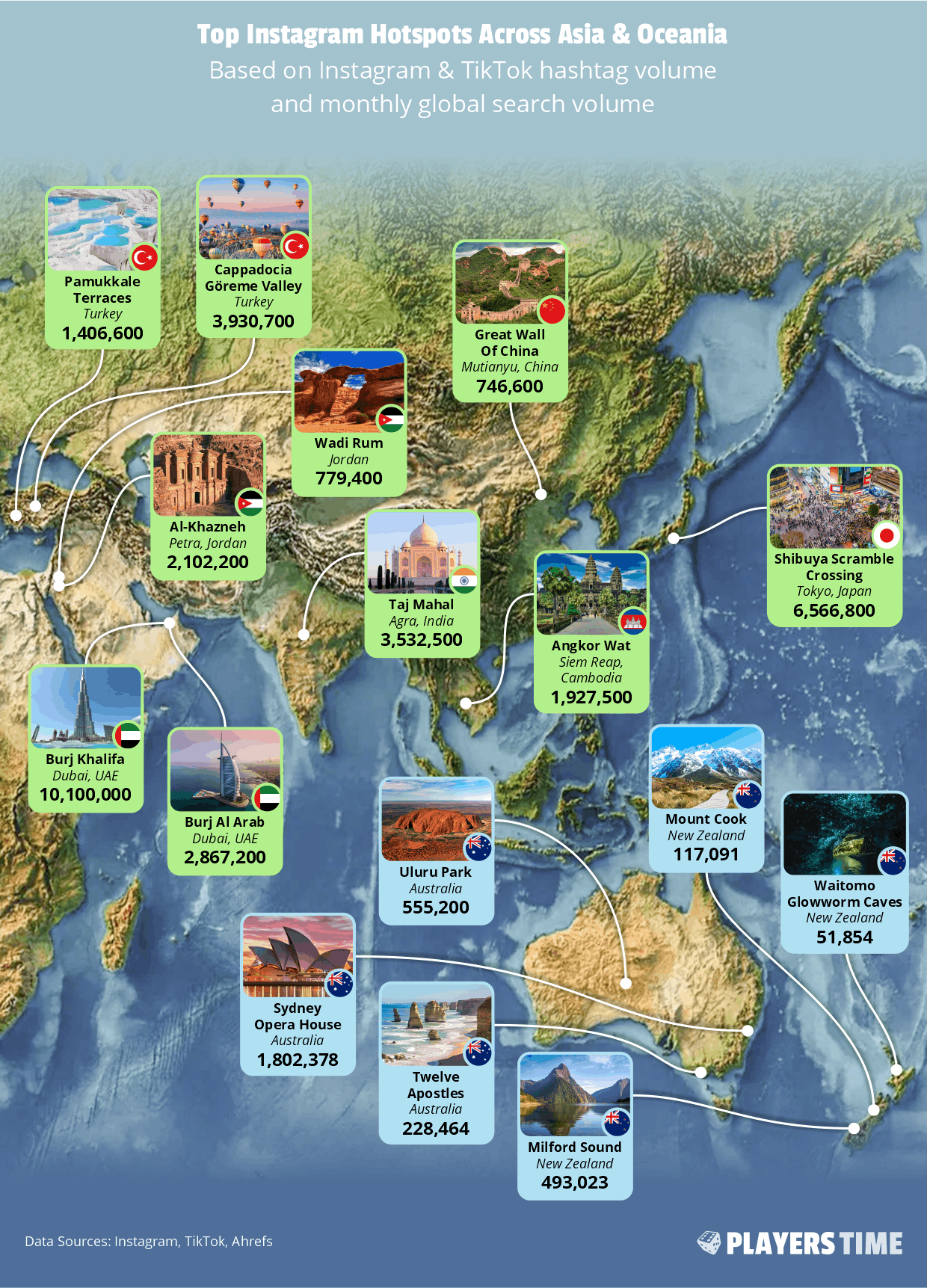
In contrast to Europe and Africa, Asia and Oceania are defined by extremes, combining the world’s most Instagrammable landmarks with some of the most visually striking yet less globally recognised destinations.
Topping both this list and the global ranking with a perfect score of 100, and supported by over 10 million posts alongside 1.1 million monthly searches, the Burj Khalifa continues to redefine Instagrammability, driven less by history or cultural weight, and more by visual dominance at scale. Dubai appears twice in the Asia regional table, with the Burj Al Arab‘s Jumeirah Beach viewpoint also generating nearly 2.9 million tagged posts.
Turkey also holds strong entries, with Cappadocia’s balloon-filled skies and Pamukkale’s white terraces both drawing millions of posts and standing out as some of the region’s most visually defined landscapes. The Taj Mahal and Angkor Wat anchor the list’s cultural weight, combining deep historical significance with consistently high global search interest of 854,000 and 294,000 monthly searches, respectively. At the lower end, Petra’s Treasury has been tagged in over 2.1 million posts but generates just 1,600 searches a month on average, suggesting a place more often captured than actively sought out.
Shifting the focus to Australia and Oceania reveals a smaller but highly distinctive collection, where Sydney’s Opera House and Harbour Bridge lead the regional ranking with a score of 16.38, placing them far below Asia’s top performers but reflecting the scale of the region rather than a lack of visual impact. Beyond Sydney, the region is defined by natural landmarks that are often globally remote but visually striking.
Uluru, a massive sandstone monolith in Australia’s Northern Territory, generates 170,000 monthly searches and over 555,000 posts, while Milford Sound, a glacial fjord in New Zealand’s South Island, records nearly 493,000 posts despite its isolation. The Twelve Apostles, a series of limestone stacks along Australia’s Great Ocean Road, and Aoraki (Mount Cook), the country’s highest peak surrounded by alpine valleys, attract relatively low search demand at 1,800 and 2,800 monthly searches respectively, yet continue to generate notable visual engagement. The Waitomo Glowworm Caves, a cave system illuminated by bioluminescent organisms, closes the ranking with just over 51,000 posts.
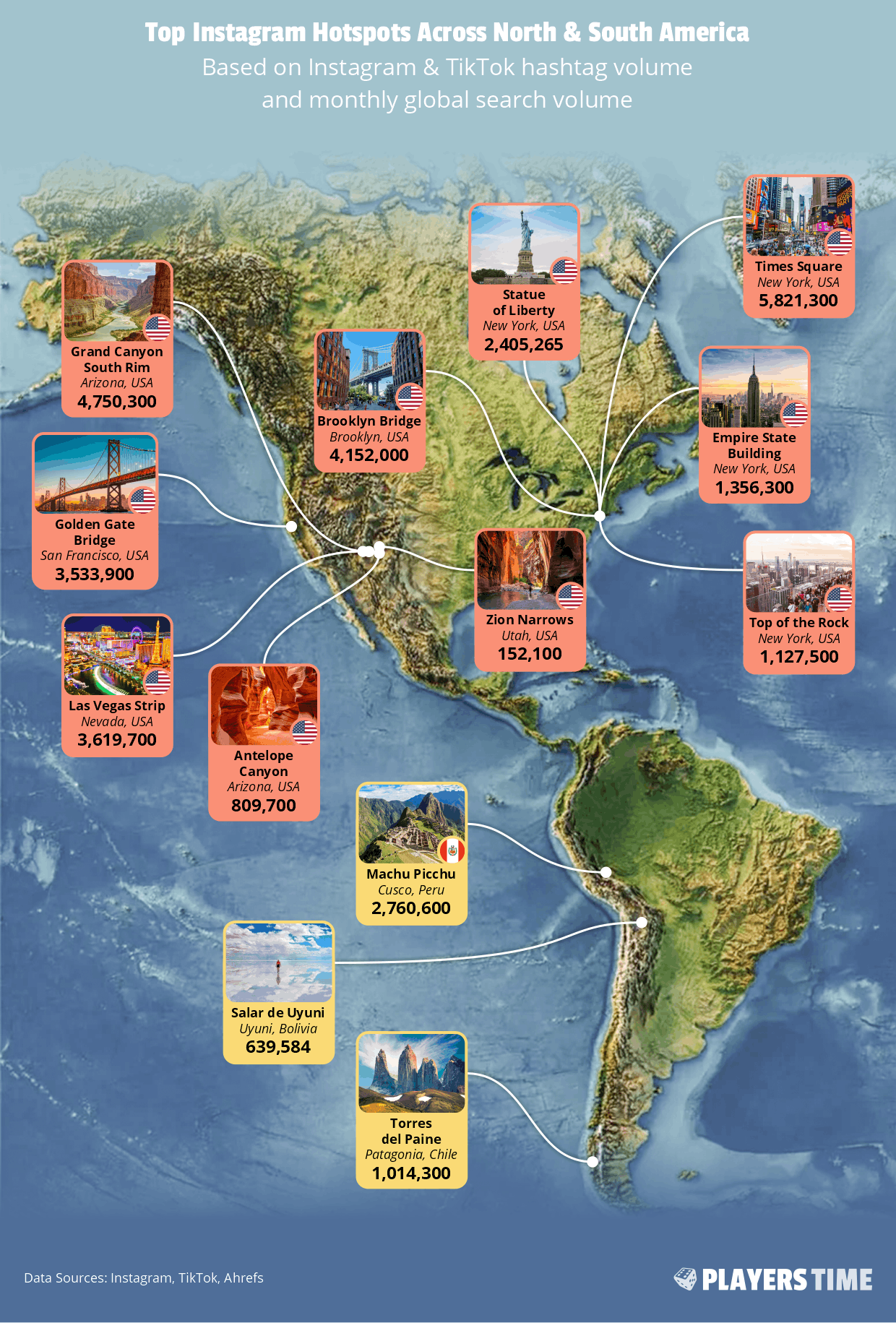
The Americas’ ranking is the most internally divided of any region, not between countries, but between two completely different ideas of what makes a place Instagrammable. Arizona’s Grand Canyon South Rim leads the regional ranking with an Instagrammability score of 47.25 backed by 4.75 million tagged posts and 696,000 monthly searches.
New York City runs close behind, yet pulls ahead entirely in one specific aspect. Its iconic Times Square generates over 5.8 million tagged posts, the highest social media volume in the entire region, while the Statue of Liberty and the Brooklyn Bridge maintain the kind of steady global recognition that comes from appearing in decades of film, television, and cultural memory. The Brooklyn Bridge’s Dumbo viewpoint is perhaps the clearest example of a place that lives on a visual platform rather than search engines, with over 4.1 million tagged posts, yet search volumes that don’t come close to matching that figure.
Beyond the United States, the regional picture shifts. Peru’s Machu Picchu is South America’s standout performer, scoring 39.12 on the index with 2.76 million tagged posts and the highest search demand in the region at 928,000 monthly searches, a rare case where cultural reverence and social media enthusiasm align almost perfectly. Chile’s Torres del Paine and Bolivia’s Salar de Uyuni sit further down the ranking, not because they lack visual impact but because global curiosity hasn’t caught up with their significance yet. Torres del Paine draws just 18,000 monthly searches despite over a million tagged posts, while Salar de Uyuni, the world’s largest salt flat, pulls 168,000 searches and 639,000 posts.
Methodology
To determine the world’s most Instagrammable destinations in 2026, the team at PlayersTime developed an Instagrammability Index, a data-driven model designed to measure and compare the digital visibility of global travel locations. The index covers over 240 locations, including approximately 55 cities, 135 landmarks, and 29 unusual places. These span major urban destinations, iconic cultural sites, natural landmarks, and visually distinctive locations from across the globe.
Destinations were selected based on a combination of global tourism prominence, social media presence, and inclusion in widely recognised 2026 travel rankings, such as major tourism board publications, leading travel guides, and high-traffic destination lists. Additional consideration was given to visually unique or emerging locations to ensure a diverse and representative dataset across all three categories.
Data was collected across search and social platforms. Using Ahrefs Keyword Explorer, we analysed the global monthly search demand on Google based on destination-specific queries. In parallel, cross-platform hashtag volume was measured using the most relevant destination hashtags on both Instagram and TikTok, capturing the scale of visual content associated with each location.
To ensure comparability across destinations of varying size and popularity, all metrics were normalised to a 0-100 scale. These were then combined into a single Instagrammability Score, with Instagram hashtag volume given additional weighting to reflect its continued role as a primary platform for travel inspiration. The final score balanced global interest with cross-platform social media visibility, allowing for a consistent, like-for-like comparison across all destinations.